
Home
Adorno and the Architects of Late Style India: Aesthetic Form after Twentieth-century Novel
Barnes and Noble
Loading Inventory...
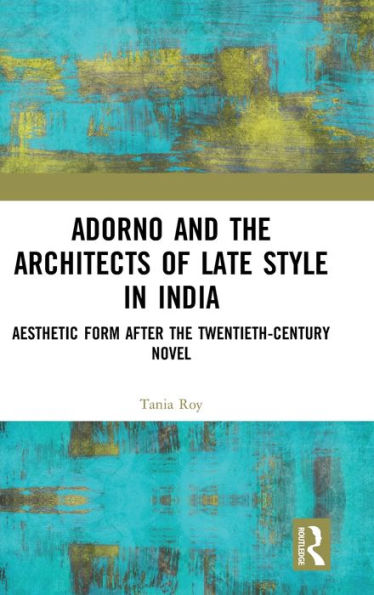
Adorno and the Architects of Late Style India: Aesthetic Form after Twentieth-century Novel in Franklin, TN
Current price: $190.00
Barnes and Noble
Adorno and the Architects of Late Style India: Aesthetic Form after Twentieth-century Novel in Franklin, TN
Current price: $190.00
Loading Inventory...
Size: Hardcover
In the postcolonial world, the claim to an emancipated national culture was bound to its aesthetic correlate, the unfolding time and experiments of the twentieth-century novel. Today, the constructs of both novel and a progressivist national project function, in all their closures, within global scales of economic disparity and violent exclusion.
What is the fate of a literary canon when it is no longer capable of delineating a future – or otherwise, is bound to reproduce the failures of the past within its own inscriptions? How do we experience our current "globalist" moment, when lived inequities of gender, labour and ethnicity emerge in a text’s inability to speak on time? When does artistic or literary failure become the measure of a work's accomplishment? And what sort of liberation is envisioned by works that refuse the imperatives of "progress" and "independence" – which
embrace
the appearance of obsolescence by rejecting values of artistic freedom, originality and innovation? These are some of the provocations that arise from T.W. Adorno's idea of late style for our own conjuncture – a
properly
postcolonial context, in which every conceptual or expressive engagement is articulated through an awareness of eroded national promise.
Examining works by Rabindranath Tagore, Mulk Raj Anand, Vikram Seth and the photography of Dayanita Singh, Tania Roy examines the delayed claims of literary and artistic modernity in India through Adorno’s category of late-style. In striking readings of Adorno and his interlocuters, the book extends a poetics of lateness toward a speculative history of the twentieth-century novel in India. Comprised of critically neglected selections from the oeuvres of canonical writers,
Adorno
and the Architects of Late Style in India
proposes that under conditions of advanced capitalism, logics of redundancy overtake the novel’s foundational reference point in the nation to produce altered frames of thought and sensibility – and therein, a reader who might encounter, anew, the figures of an unfulfilled twentieth century.
What is the fate of a literary canon when it is no longer capable of delineating a future – or otherwise, is bound to reproduce the failures of the past within its own inscriptions? How do we experience our current "globalist" moment, when lived inequities of gender, labour and ethnicity emerge in a text’s inability to speak on time? When does artistic or literary failure become the measure of a work's accomplishment? And what sort of liberation is envisioned by works that refuse the imperatives of "progress" and "independence" – which
embrace
the appearance of obsolescence by rejecting values of artistic freedom, originality and innovation? These are some of the provocations that arise from T.W. Adorno's idea of late style for our own conjuncture – a
properly
postcolonial context, in which every conceptual or expressive engagement is articulated through an awareness of eroded national promise.
Examining works by Rabindranath Tagore, Mulk Raj Anand, Vikram Seth and the photography of Dayanita Singh, Tania Roy examines the delayed claims of literary and artistic modernity in India through Adorno’s category of late-style. In striking readings of Adorno and his interlocuters, the book extends a poetics of lateness toward a speculative history of the twentieth-century novel in India. Comprised of critically neglected selections from the oeuvres of canonical writers,
Adorno
and the Architects of Late Style in India
proposes that under conditions of advanced capitalism, logics of redundancy overtake the novel’s foundational reference point in the nation to produce altered frames of thought and sensibility – and therein, a reader who might encounter, anew, the figures of an unfulfilled twentieth century.
In the postcolonial world, the claim to an emancipated national culture was bound to its aesthetic correlate, the unfolding time and experiments of the twentieth-century novel. Today, the constructs of both novel and a progressivist national project function, in all their closures, within global scales of economic disparity and violent exclusion.
What is the fate of a literary canon when it is no longer capable of delineating a future – or otherwise, is bound to reproduce the failures of the past within its own inscriptions? How do we experience our current "globalist" moment, when lived inequities of gender, labour and ethnicity emerge in a text’s inability to speak on time? When does artistic or literary failure become the measure of a work's accomplishment? And what sort of liberation is envisioned by works that refuse the imperatives of "progress" and "independence" – which
embrace
the appearance of obsolescence by rejecting values of artistic freedom, originality and innovation? These are some of the provocations that arise from T.W. Adorno's idea of late style for our own conjuncture – a
properly
postcolonial context, in which every conceptual or expressive engagement is articulated through an awareness of eroded national promise.
Examining works by Rabindranath Tagore, Mulk Raj Anand, Vikram Seth and the photography of Dayanita Singh, Tania Roy examines the delayed claims of literary and artistic modernity in India through Adorno’s category of late-style. In striking readings of Adorno and his interlocuters, the book extends a poetics of lateness toward a speculative history of the twentieth-century novel in India. Comprised of critically neglected selections from the oeuvres of canonical writers,
Adorno
and the Architects of Late Style in India
proposes that under conditions of advanced capitalism, logics of redundancy overtake the novel’s foundational reference point in the nation to produce altered frames of thought and sensibility – and therein, a reader who might encounter, anew, the figures of an unfulfilled twentieth century.
What is the fate of a literary canon when it is no longer capable of delineating a future – or otherwise, is bound to reproduce the failures of the past within its own inscriptions? How do we experience our current "globalist" moment, when lived inequities of gender, labour and ethnicity emerge in a text’s inability to speak on time? When does artistic or literary failure become the measure of a work's accomplishment? And what sort of liberation is envisioned by works that refuse the imperatives of "progress" and "independence" – which
embrace
the appearance of obsolescence by rejecting values of artistic freedom, originality and innovation? These are some of the provocations that arise from T.W. Adorno's idea of late style for our own conjuncture – a
properly
postcolonial context, in which every conceptual or expressive engagement is articulated through an awareness of eroded national promise.
Examining works by Rabindranath Tagore, Mulk Raj Anand, Vikram Seth and the photography of Dayanita Singh, Tania Roy examines the delayed claims of literary and artistic modernity in India through Adorno’s category of late-style. In striking readings of Adorno and his interlocuters, the book extends a poetics of lateness toward a speculative history of the twentieth-century novel in India. Comprised of critically neglected selections from the oeuvres of canonical writers,
Adorno
and the Architects of Late Style in India
proposes that under conditions of advanced capitalism, logics of redundancy overtake the novel’s foundational reference point in the nation to produce altered frames of thought and sensibility – and therein, a reader who might encounter, anew, the figures of an unfulfilled twentieth century.
You May Also Like











More About Barnes and Noble at CoolSprings Galleria
Barnes & Noble is the world’s largest retail bookseller and a leading retailer of content, digital media and educational products. Our Nook Digital business offers a lineup of NOOK® tablets and e-Readers and an expansive collection of digital reading content through the NOOK Store®. Barnes & Noble’s mission is to operate the best omni-channel specialty retail business in America, helping both our customers and booksellers reach their aspirations, while being a credit to the communities we serve.
1800 Galleria Blvd #1310, Franklin, TN 37067, United States
Find Barnes and Noble at CoolSprings Galleria in Franklin, TN
Visit Barnes and Noble at CoolSprings Galleria in Franklin, TN
