
Home
Against All Odds: The Pakistan Air Force in the 1971 Indo-Pakistan War
Barnes and Noble
Loading Inventory...
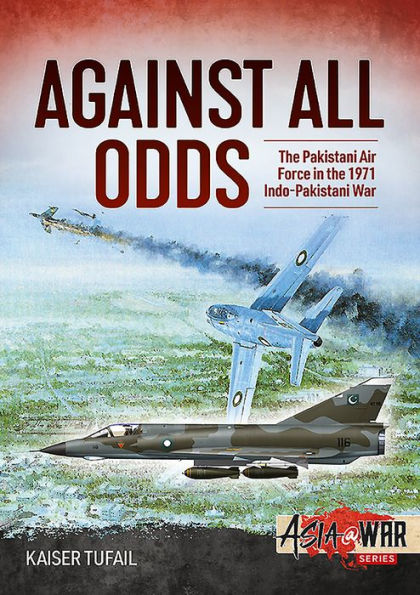
Against All Odds: The Pakistan Air Force in the 1971 Indo-Pakistan War in Franklin, TN
Current price: $29.95
Barnes and Noble
Against All Odds: The Pakistan Air Force in the 1971 Indo-Pakistan War in Franklin, TN
Current price: $29.95
Loading Inventory...
Size: OS
The IndoPakistani War of 1971 was a major military confrontation between India and Pakistan. Fought on two fronts of the Indian subcontinent between 3 and 17 December 1971, it pitted two major conventional armed forces in an allout war over the fate of the former East Pakistan, and resulted in the emergence of a new, independent nation of Bangladesh.
In the West, the Pakistan Air Force (PAF) initiated its involvement with an attack on the forward air bases of the Indian Air Force (IAF), on 3 December 1971. A series of major air battles followed over the primary conflict zones. In the East, the small PAF contingent was quickly neutralized by the IAF.
When the war ended in West Pakistan on 17 December, PAF was still in the ring and on its feet. It had parried the enemy’s blows and had been ever so careful in its offensive responses. It continued to be fixated with remaining viable for providing complete air support to the Army’s allimportant battle, which flowed out of the overarching dictum, ‘defense of the East lies in the West’. PAF’s overall performance can be gleaned from the fact that it managed to keep its aircraft attrition rate at par with the IAF. The PAF unmistakably denied a much stronger IAF the distinct possibility of delivering a knockout punch to it. In the circumstances obtaining, this was a commendable achievement.
Against All Odds
is richly illustrated with a selection of exclusive photography, more than a dozen authentic color artworks, and a similar number of maps. It provides a unique source of reference for enthusiasts and professionals alike.
In the West, the Pakistan Air Force (PAF) initiated its involvement with an attack on the forward air bases of the Indian Air Force (IAF), on 3 December 1971. A series of major air battles followed over the primary conflict zones. In the East, the small PAF contingent was quickly neutralized by the IAF.
When the war ended in West Pakistan on 17 December, PAF was still in the ring and on its feet. It had parried the enemy’s blows and had been ever so careful in its offensive responses. It continued to be fixated with remaining viable for providing complete air support to the Army’s allimportant battle, which flowed out of the overarching dictum, ‘defense of the East lies in the West’. PAF’s overall performance can be gleaned from the fact that it managed to keep its aircraft attrition rate at par with the IAF. The PAF unmistakably denied a much stronger IAF the distinct possibility of delivering a knockout punch to it. In the circumstances obtaining, this was a commendable achievement.
Against All Odds
is richly illustrated with a selection of exclusive photography, more than a dozen authentic color artworks, and a similar number of maps. It provides a unique source of reference for enthusiasts and professionals alike.
The IndoPakistani War of 1971 was a major military confrontation between India and Pakistan. Fought on two fronts of the Indian subcontinent between 3 and 17 December 1971, it pitted two major conventional armed forces in an allout war over the fate of the former East Pakistan, and resulted in the emergence of a new, independent nation of Bangladesh.
In the West, the Pakistan Air Force (PAF) initiated its involvement with an attack on the forward air bases of the Indian Air Force (IAF), on 3 December 1971. A series of major air battles followed over the primary conflict zones. In the East, the small PAF contingent was quickly neutralized by the IAF.
When the war ended in West Pakistan on 17 December, PAF was still in the ring and on its feet. It had parried the enemy’s blows and had been ever so careful in its offensive responses. It continued to be fixated with remaining viable for providing complete air support to the Army’s allimportant battle, which flowed out of the overarching dictum, ‘defense of the East lies in the West’. PAF’s overall performance can be gleaned from the fact that it managed to keep its aircraft attrition rate at par with the IAF. The PAF unmistakably denied a much stronger IAF the distinct possibility of delivering a knockout punch to it. In the circumstances obtaining, this was a commendable achievement.
Against All Odds
is richly illustrated with a selection of exclusive photography, more than a dozen authentic color artworks, and a similar number of maps. It provides a unique source of reference for enthusiasts and professionals alike.
In the West, the Pakistan Air Force (PAF) initiated its involvement with an attack on the forward air bases of the Indian Air Force (IAF), on 3 December 1971. A series of major air battles followed over the primary conflict zones. In the East, the small PAF contingent was quickly neutralized by the IAF.
When the war ended in West Pakistan on 17 December, PAF was still in the ring and on its feet. It had parried the enemy’s blows and had been ever so careful in its offensive responses. It continued to be fixated with remaining viable for providing complete air support to the Army’s allimportant battle, which flowed out of the overarching dictum, ‘defense of the East lies in the West’. PAF’s overall performance can be gleaned from the fact that it managed to keep its aircraft attrition rate at par with the IAF. The PAF unmistakably denied a much stronger IAF the distinct possibility of delivering a knockout punch to it. In the circumstances obtaining, this was a commendable achievement.
Against All Odds
is richly illustrated with a selection of exclusive photography, more than a dozen authentic color artworks, and a similar number of maps. It provides a unique source of reference for enthusiasts and professionals alike.
You May Also Like


















More About Barnes and Noble at CoolSprings Galleria
Barnes & Noble is the world’s largest retail bookseller and a leading retailer of content, digital media and educational products. Our Nook Digital business offers a lineup of NOOK® tablets and e-Readers and an expansive collection of digital reading content through the NOOK Store®. Barnes & Noble’s mission is to operate the best omni-channel specialty retail business in America, helping both our customers and booksellers reach their aspirations, while being a credit to the communities we serve.
1800 Galleria Blvd #1310, Franklin, TN 37067, United States
Find Barnes and Noble at CoolSprings Galleria in Franklin, TN
Visit Barnes and Noble at CoolSprings Galleria in Franklin, TN
