
Home
Airpower Reborn: The Strategic Concepts of John Warden and Boyd
Barnes and Noble
Loading Inventory...
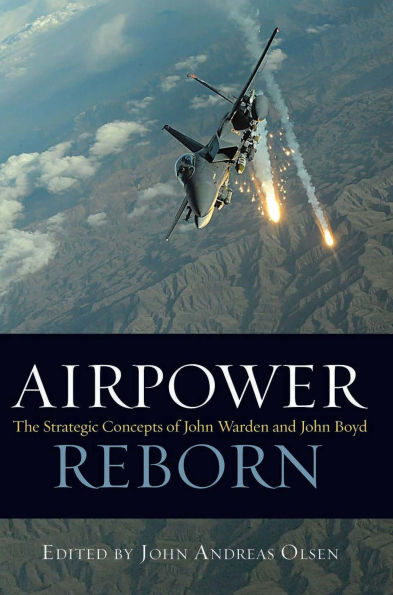
Airpower Reborn: The Strategic Concepts of John Warden and Boyd in Franklin, TN
Current price: $53.95
Barnes and Noble
Airpower Reborn: The Strategic Concepts of John Warden and Boyd in Franklin, TN
Current price: $53.95
Loading Inventory...
Size: Hardcover
Airpower Reborn offers a conceptual approach to warfare that emphasizes airpower's unique capability to achieve strategic effects. Six worldleading theorists argue that a viable strategy must transcend the purely military sphere, view the adversary as a multidimensional system, and pursue systemic paralysis and strategic effects rather than military destruction or attrition. The book is divided into three parts. The first section presents a historical perspective on airpower theory and airpower strategy, tracing their evolution from the 1920s to the 1980s. The second section contains indepth examinations of the strategic concepts that John R. Boyd and John A. Warden developed in the 1980s and 1990s, with an emphasis on their contemporary relevance. The final section provides further context on modern airpower theory and strategy. Theory, in this setting, serves as the basic paradigm, strategy represents its generic, mechanismscentered application, and plans of campaign constitute the specific steps for any given situation. In short, the authors look beyond the landcentric, battlefieldoriented paradigm that has continued to dominate military theories and strategies long after airpower offered new options. The book acknowledges the essential role of advanced technology in improving airpower capabilities, but emphasizes that air services must cultivate and harness the intellectual acumen of airmen and encourage officers and men to think conceptually and strategically about the application of aerospace power. Modern airpower can offer political decisionmakers more and better optionsprovided the underlying strategy coherently links the application of airpower directly to the endstate objectives rather than limiting it to “the battle.” The book recommends that all countries should consider establishing a dynamic and vibrant environment for mastering aerospace history, theory, strategy, and doctrine; a milieu for cultivating broader knowledge of and insight into airpower; and a setting in which airpower experts have the opportunity to communicate their narrative to politicians, the media, and fellow officers, and to interact to mutual benefit with experts from all sectors of governance. This effort should emphasize the potentially unique contribution of airpower to political objectives and joint operations, and in turn connect to operational headquarters that do operational planning. Mastering such strategic thought lies at the heart of the military profession, but it requires indepth knowledge and understanding of theory, strategy, and airpower, and transcends traditional metrics.
Airpower Reborn offers a conceptual approach to warfare that emphasizes airpower's unique capability to achieve strategic effects. Six worldleading theorists argue that a viable strategy must transcend the purely military sphere, view the adversary as a multidimensional system, and pursue systemic paralysis and strategic effects rather than military destruction or attrition. The book is divided into three parts. The first section presents a historical perspective on airpower theory and airpower strategy, tracing their evolution from the 1920s to the 1980s. The second section contains indepth examinations of the strategic concepts that John R. Boyd and John A. Warden developed in the 1980s and 1990s, with an emphasis on their contemporary relevance. The final section provides further context on modern airpower theory and strategy. Theory, in this setting, serves as the basic paradigm, strategy represents its generic, mechanismscentered application, and plans of campaign constitute the specific steps for any given situation. In short, the authors look beyond the landcentric, battlefieldoriented paradigm that has continued to dominate military theories and strategies long after airpower offered new options. The book acknowledges the essential role of advanced technology in improving airpower capabilities, but emphasizes that air services must cultivate and harness the intellectual acumen of airmen and encourage officers and men to think conceptually and strategically about the application of aerospace power. Modern airpower can offer political decisionmakers more and better optionsprovided the underlying strategy coherently links the application of airpower directly to the endstate objectives rather than limiting it to “the battle.” The book recommends that all countries should consider establishing a dynamic and vibrant environment for mastering aerospace history, theory, strategy, and doctrine; a milieu for cultivating broader knowledge of and insight into airpower; and a setting in which airpower experts have the opportunity to communicate their narrative to politicians, the media, and fellow officers, and to interact to mutual benefit with experts from all sectors of governance. This effort should emphasize the potentially unique contribution of airpower to political objectives and joint operations, and in turn connect to operational headquarters that do operational planning. Mastering such strategic thought lies at the heart of the military profession, but it requires indepth knowledge and understanding of theory, strategy, and airpower, and transcends traditional metrics.
You May Also Like














More About Barnes and Noble at CoolSprings Galleria
Barnes & Noble is the world’s largest retail bookseller and a leading retailer of content, digital media and educational products. Our Nook Digital business offers a lineup of NOOK® tablets and e-Readers and an expansive collection of digital reading content through the NOOK Store®. Barnes & Noble’s mission is to operate the best omni-channel specialty retail business in America, helping both our customers and booksellers reach their aspirations, while being a credit to the communities we serve.
1800 Galleria Blvd #1310, Franklin, TN 37067, United States
Find Barnes and Noble at CoolSprings Galleria in Franklin, TN
Visit Barnes and Noble at CoolSprings Galleria in Franklin, TN
