
Home
An Economic Historiography of Germany, 1918-1931: How Inflation and Foreign Capital Inflows Allowed the Weimar Republic to Survive
Barnes and Noble
Loading Inventory...
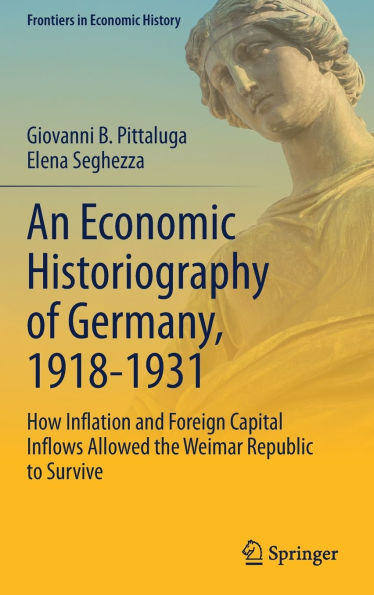
An Economic Historiography of Germany, 1918-1931: How Inflation and Foreign Capital Inflows Allowed the Weimar Republic to Survive in Franklin, TN
Current price: $129.99
Barnes and Noble
An Economic Historiography of Germany, 1918-1931: How Inflation and Foreign Capital Inflows Allowed the Weimar Republic to Survive in Franklin, TN
Current price: $129.99
Loading Inventory...
Size: Hardcover
Contrary to existing economic analyses of the Weimar Republic, this book looks beyond the explanations of the individual events that characterized it - in particular hyperinflation, Brüning's fiscal policy, and the 1931 crisis. Instead, it adopts a more unified approach, and thereby sheds light on the underlying causes of these events.
The book argues that these individual events were the final result of economic processes and policy choices which had made it possible to mitigate the social and political conflict that would otherwise have undermined the Republic’s existence. Specifically, it postulates that hyperinflation was the result of the "persistent" inflation, which had permitted Germany to maintain low unemployment, meet unions' wage demands, and contain left-wing radicalism.
Similarly, the banking and currency crisis of 1931 was caused by a sudden stop related to the high level of foreign debt incurred by Germany after the Dawes Plan. Debt which had, however, enabled the country to finance the persistent external deficits resulting from its high domestic demand and large public expenditure incurred in an attempt to avoid social conflict.
The book reviews the various models and approaches proposed highlighting their relative strengths and weakness and concludes by providing a unifying common thread which explains how the dramatic economic events which characterized the Weimar Republic were the result of the very economic processes which had contributed to its temporary survival.
This book will appeal to students, scholars, economic researchers in general, and more specifically to those interested in economic history, monetary and financial economics, economic policy, political decision making, and political economy, in particular, those seeking a better understanding of the Weimar Republic's economic history.
The book argues that these individual events were the final result of economic processes and policy choices which had made it possible to mitigate the social and political conflict that would otherwise have undermined the Republic’s existence. Specifically, it postulates that hyperinflation was the result of the "persistent" inflation, which had permitted Germany to maintain low unemployment, meet unions' wage demands, and contain left-wing radicalism.
Similarly, the banking and currency crisis of 1931 was caused by a sudden stop related to the high level of foreign debt incurred by Germany after the Dawes Plan. Debt which had, however, enabled the country to finance the persistent external deficits resulting from its high domestic demand and large public expenditure incurred in an attempt to avoid social conflict.
The book reviews the various models and approaches proposed highlighting their relative strengths and weakness and concludes by providing a unifying common thread which explains how the dramatic economic events which characterized the Weimar Republic were the result of the very economic processes which had contributed to its temporary survival.
This book will appeal to students, scholars, economic researchers in general, and more specifically to those interested in economic history, monetary and financial economics, economic policy, political decision making, and political economy, in particular, those seeking a better understanding of the Weimar Republic's economic history.
Contrary to existing economic analyses of the Weimar Republic, this book looks beyond the explanations of the individual events that characterized it - in particular hyperinflation, Brüning's fiscal policy, and the 1931 crisis. Instead, it adopts a more unified approach, and thereby sheds light on the underlying causes of these events.
The book argues that these individual events were the final result of economic processes and policy choices which had made it possible to mitigate the social and political conflict that would otherwise have undermined the Republic’s existence. Specifically, it postulates that hyperinflation was the result of the "persistent" inflation, which had permitted Germany to maintain low unemployment, meet unions' wage demands, and contain left-wing radicalism.
Similarly, the banking and currency crisis of 1931 was caused by a sudden stop related to the high level of foreign debt incurred by Germany after the Dawes Plan. Debt which had, however, enabled the country to finance the persistent external deficits resulting from its high domestic demand and large public expenditure incurred in an attempt to avoid social conflict.
The book reviews the various models and approaches proposed highlighting their relative strengths and weakness and concludes by providing a unifying common thread which explains how the dramatic economic events which characterized the Weimar Republic were the result of the very economic processes which had contributed to its temporary survival.
This book will appeal to students, scholars, economic researchers in general, and more specifically to those interested in economic history, monetary and financial economics, economic policy, political decision making, and political economy, in particular, those seeking a better understanding of the Weimar Republic's economic history.
The book argues that these individual events were the final result of economic processes and policy choices which had made it possible to mitigate the social and political conflict that would otherwise have undermined the Republic’s existence. Specifically, it postulates that hyperinflation was the result of the "persistent" inflation, which had permitted Germany to maintain low unemployment, meet unions' wage demands, and contain left-wing radicalism.
Similarly, the banking and currency crisis of 1931 was caused by a sudden stop related to the high level of foreign debt incurred by Germany after the Dawes Plan. Debt which had, however, enabled the country to finance the persistent external deficits resulting from its high domestic demand and large public expenditure incurred in an attempt to avoid social conflict.
The book reviews the various models and approaches proposed highlighting their relative strengths and weakness and concludes by providing a unifying common thread which explains how the dramatic economic events which characterized the Weimar Republic were the result of the very economic processes which had contributed to its temporary survival.
This book will appeal to students, scholars, economic researchers in general, and more specifically to those interested in economic history, monetary and financial economics, economic policy, political decision making, and political economy, in particular, those seeking a better understanding of the Weimar Republic's economic history.
You May Also Like












More About Barnes and Noble at CoolSprings Galleria
Barnes & Noble is the world’s largest retail bookseller and a leading retailer of content, digital media and educational products. Our Nook Digital business offers a lineup of NOOK® tablets and e-Readers and an expansive collection of digital reading content through the NOOK Store®. Barnes & Noble’s mission is to operate the best omni-channel specialty retail business in America, helping both our customers and booksellers reach their aspirations, while being a credit to the communities we serve.
1800 Galleria Blvd #1310, Franklin, TN 37067, United States
Find Barnes and Noble at CoolSprings Galleria in Franklin, TN
Visit Barnes and Noble at CoolSprings Galleria in Franklin, TN
