
Home
Can the Poor Save?: Saving and Asset Building Individual Development Accounts
Barnes and Noble
Loading Inventory...
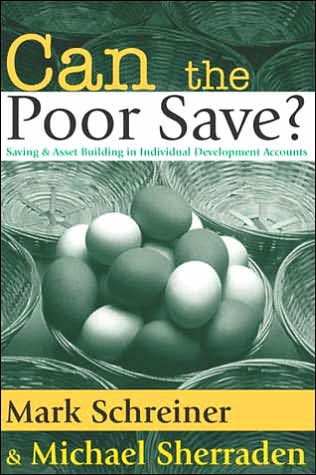
Can the Poor Save?: Saving and Asset Building Individual Development Accounts in Franklin, TN
Current price: $120.00
Barnes and Noble
Can the Poor Save?: Saving and Asset Building Individual Development Accounts in Franklin, TN
Current price: $120.00
Loading Inventory...
Size: Hardcover
Many policymakers argue that the best poverty policy not only provides cash to the poor for subsistence but also incentives and structures that encourage long-term social and economic improvement. As part of this, they make the case for Individual Development Accounts (IDAs), a new policy proposal designed to help the poor save and to build assets. This book explores IDAs to determine their effectiveness.
IDAs are matched savings accounts targeted on low-income, low-wealth individuals. Savings in IDAs are used for home ownership, post-secondary education, small business development, and other purposes. Do IDAs work? If they do, for whom? And does how an IDA is designed determine savings outcomes? This volume is the first analysis of matched savings by the poor to use data from monthly bank statements. It comes at a critical time, as debate rages over the merits of individual social security accounts. IDAs also respond to policy that is becoming more asset based and less inclusive of the poor. The authors argue for the efficacy of IDAs to counter this tendency. They find that while savings outcomes vary among participants, no characteristics (such as low income or public assistance) preclude saving. They examine effects of IDA design (the match rate, savings targets, and the use of automatic transfer) on savings results and analyze factors that influence varying rates of saving and spending over time. They conclude that financial education and other support services, though costly, improve savings performance. To address the issue of cost they suggest a two-tier system of IDA design, one with broad access and simple services and the other with targeted access and intensive services.
Can the Poor Save?
offers a wealth of lessons to those interested in saving and asset accumulation among the poor. It not only breaks new ground in the scientific study of savings behavior, but also offers concrete, evidence-based recommendations to improve policies designed to encourage the poor to save and how to make such policies more inclusive.
IDAs are matched savings accounts targeted on low-income, low-wealth individuals. Savings in IDAs are used for home ownership, post-secondary education, small business development, and other purposes. Do IDAs work? If they do, for whom? And does how an IDA is designed determine savings outcomes? This volume is the first analysis of matched savings by the poor to use data from monthly bank statements. It comes at a critical time, as debate rages over the merits of individual social security accounts. IDAs also respond to policy that is becoming more asset based and less inclusive of the poor. The authors argue for the efficacy of IDAs to counter this tendency. They find that while savings outcomes vary among participants, no characteristics (such as low income or public assistance) preclude saving. They examine effects of IDA design (the match rate, savings targets, and the use of automatic transfer) on savings results and analyze factors that influence varying rates of saving and spending over time. They conclude that financial education and other support services, though costly, improve savings performance. To address the issue of cost they suggest a two-tier system of IDA design, one with broad access and simple services and the other with targeted access and intensive services.
Can the Poor Save?
offers a wealth of lessons to those interested in saving and asset accumulation among the poor. It not only breaks new ground in the scientific study of savings behavior, but also offers concrete, evidence-based recommendations to improve policies designed to encourage the poor to save and how to make such policies more inclusive.
Many policymakers argue that the best poverty policy not only provides cash to the poor for subsistence but also incentives and structures that encourage long-term social and economic improvement. As part of this, they make the case for Individual Development Accounts (IDAs), a new policy proposal designed to help the poor save and to build assets. This book explores IDAs to determine their effectiveness.
IDAs are matched savings accounts targeted on low-income, low-wealth individuals. Savings in IDAs are used for home ownership, post-secondary education, small business development, and other purposes. Do IDAs work? If they do, for whom? And does how an IDA is designed determine savings outcomes? This volume is the first analysis of matched savings by the poor to use data from monthly bank statements. It comes at a critical time, as debate rages over the merits of individual social security accounts. IDAs also respond to policy that is becoming more asset based and less inclusive of the poor. The authors argue for the efficacy of IDAs to counter this tendency. They find that while savings outcomes vary among participants, no characteristics (such as low income or public assistance) preclude saving. They examine effects of IDA design (the match rate, savings targets, and the use of automatic transfer) on savings results and analyze factors that influence varying rates of saving and spending over time. They conclude that financial education and other support services, though costly, improve savings performance. To address the issue of cost they suggest a two-tier system of IDA design, one with broad access and simple services and the other with targeted access and intensive services.
Can the Poor Save?
offers a wealth of lessons to those interested in saving and asset accumulation among the poor. It not only breaks new ground in the scientific study of savings behavior, but also offers concrete, evidence-based recommendations to improve policies designed to encourage the poor to save and how to make such policies more inclusive.
IDAs are matched savings accounts targeted on low-income, low-wealth individuals. Savings in IDAs are used for home ownership, post-secondary education, small business development, and other purposes. Do IDAs work? If they do, for whom? And does how an IDA is designed determine savings outcomes? This volume is the first analysis of matched savings by the poor to use data from monthly bank statements. It comes at a critical time, as debate rages over the merits of individual social security accounts. IDAs also respond to policy that is becoming more asset based and less inclusive of the poor. The authors argue for the efficacy of IDAs to counter this tendency. They find that while savings outcomes vary among participants, no characteristics (such as low income or public assistance) preclude saving. They examine effects of IDA design (the match rate, savings targets, and the use of automatic transfer) on savings results and analyze factors that influence varying rates of saving and spending over time. They conclude that financial education and other support services, though costly, improve savings performance. To address the issue of cost they suggest a two-tier system of IDA design, one with broad access and simple services and the other with targeted access and intensive services.
Can the Poor Save?
offers a wealth of lessons to those interested in saving and asset accumulation among the poor. It not only breaks new ground in the scientific study of savings behavior, but also offers concrete, evidence-based recommendations to improve policies designed to encourage the poor to save and how to make such policies more inclusive.
You May Also Like















More About Barnes and Noble at CoolSprings Galleria
Barnes & Noble is the world’s largest retail bookseller and a leading retailer of content, digital media and educational products. Our Nook Digital business offers a lineup of NOOK® tablets and e-Readers and an expansive collection of digital reading content through the NOOK Store®. Barnes & Noble’s mission is to operate the best omni-channel specialty retail business in America, helping both our customers and booksellers reach their aspirations, while being a credit to the communities we serve.
1800 Galleria Blvd #1310, Franklin, TN 37067, United States
Find Barnes and Noble at CoolSprings Galleria in Franklin, TN
Visit Barnes and Noble at CoolSprings Galleria in Franklin, TN
