
Home
Cities of Commerce: the Institutional Foundations International Trade Low Countries, 1250-1650
Barnes and Noble
Loading Inventory...
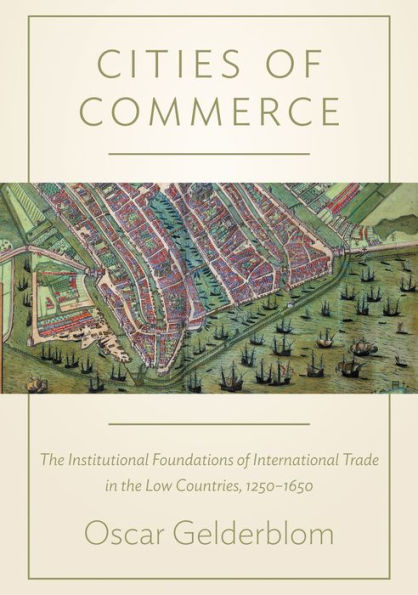
Cities of Commerce: the Institutional Foundations International Trade Low Countries, 1250-1650 in Franklin, TN
Current price: $50.00
Barnes and Noble
Cities of Commerce: the Institutional Foundations International Trade Low Countries, 1250-1650 in Franklin, TN
Current price: $50.00
Loading Inventory...
Size: Hardcover
Cities of Commerce
develops a model of institutional change in European commerce based on urban rivalry. Cities continuously competed with each other by adapting commercial, legal, and financial institutions to the evolving needs of merchants. Oscar Gelderblom traces the successive rise of Bruges, Antwerp, and Amsterdam to commercial primacy between 1250 and 1650, showing how dominant cities feared being displaced by challengers while lesser cities sought to keep up by cultivating policies favorable to trade. He argues that it was this competitive urban network that promoted open-access institutions in the Low Countries, and emphasizes the central role played by the urban power holdersthe magistratesin fostering these inclusive institutional arrangements. Gelderblom describes how the city fathers resisted the predatory or reckless actions of their territorial rulers, and how their nonrestrictive approach to commercial life succeeded in attracting merchants from all over Europe.
intervenes in an important debate on the growth of trade in Europe before the Industrial Revolution. Challenging influential theories that attribute this commercial expansion to the political strength of merchants, this book demonstrates how urban rivalry fostered the creation of open-access institutions in international trade.
develops a model of institutional change in European commerce based on urban rivalry. Cities continuously competed with each other by adapting commercial, legal, and financial institutions to the evolving needs of merchants. Oscar Gelderblom traces the successive rise of Bruges, Antwerp, and Amsterdam to commercial primacy between 1250 and 1650, showing how dominant cities feared being displaced by challengers while lesser cities sought to keep up by cultivating policies favorable to trade. He argues that it was this competitive urban network that promoted open-access institutions in the Low Countries, and emphasizes the central role played by the urban power holdersthe magistratesin fostering these inclusive institutional arrangements. Gelderblom describes how the city fathers resisted the predatory or reckless actions of their territorial rulers, and how their nonrestrictive approach to commercial life succeeded in attracting merchants from all over Europe.
intervenes in an important debate on the growth of trade in Europe before the Industrial Revolution. Challenging influential theories that attribute this commercial expansion to the political strength of merchants, this book demonstrates how urban rivalry fostered the creation of open-access institutions in international trade.
Cities of Commerce
develops a model of institutional change in European commerce based on urban rivalry. Cities continuously competed with each other by adapting commercial, legal, and financial institutions to the evolving needs of merchants. Oscar Gelderblom traces the successive rise of Bruges, Antwerp, and Amsterdam to commercial primacy between 1250 and 1650, showing how dominant cities feared being displaced by challengers while lesser cities sought to keep up by cultivating policies favorable to trade. He argues that it was this competitive urban network that promoted open-access institutions in the Low Countries, and emphasizes the central role played by the urban power holdersthe magistratesin fostering these inclusive institutional arrangements. Gelderblom describes how the city fathers resisted the predatory or reckless actions of their territorial rulers, and how their nonrestrictive approach to commercial life succeeded in attracting merchants from all over Europe.
intervenes in an important debate on the growth of trade in Europe before the Industrial Revolution. Challenging influential theories that attribute this commercial expansion to the political strength of merchants, this book demonstrates how urban rivalry fostered the creation of open-access institutions in international trade.
develops a model of institutional change in European commerce based on urban rivalry. Cities continuously competed with each other by adapting commercial, legal, and financial institutions to the evolving needs of merchants. Oscar Gelderblom traces the successive rise of Bruges, Antwerp, and Amsterdam to commercial primacy between 1250 and 1650, showing how dominant cities feared being displaced by challengers while lesser cities sought to keep up by cultivating policies favorable to trade. He argues that it was this competitive urban network that promoted open-access institutions in the Low Countries, and emphasizes the central role played by the urban power holdersthe magistratesin fostering these inclusive institutional arrangements. Gelderblom describes how the city fathers resisted the predatory or reckless actions of their territorial rulers, and how their nonrestrictive approach to commercial life succeeded in attracting merchants from all over Europe.
intervenes in an important debate on the growth of trade in Europe before the Industrial Revolution. Challenging influential theories that attribute this commercial expansion to the political strength of merchants, this book demonstrates how urban rivalry fostered the creation of open-access institutions in international trade.
You May Also Like
















More About Barnes and Noble at CoolSprings Galleria
Barnes & Noble is the world’s largest retail bookseller and a leading retailer of content, digital media and educational products. Our Nook Digital business offers a lineup of NOOK® tablets and e-Readers and an expansive collection of digital reading content through the NOOK Store®. Barnes & Noble’s mission is to operate the best omni-channel specialty retail business in America, helping both our customers and booksellers reach their aspirations, while being a credit to the communities we serve.
1800 Galleria Blvd #1310, Franklin, TN 37067, United States
Find Barnes and Noble at CoolSprings Galleria in Franklin, TN
Visit Barnes and Noble at CoolSprings Galleria in Franklin, TN