
Home
Consider the Platypus: Evolution through Biology's Most Baffling Beasts
Barnes and Noble
Loading Inventory...
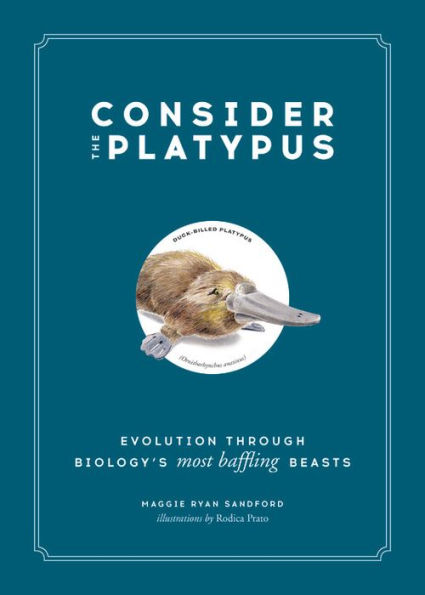
Consider the Platypus: Evolution through Biology's Most Baffling Beasts in Franklin, TN
Current price: $29.99
Barnes and Noble
Consider the Platypus: Evolution through Biology's Most Baffling Beasts in Franklin, TN
Current price: $29.99
Loading Inventory...
Size: Hardcover
*FINALIST FOR THE 2020 GENERAL NONFICTION MINNESOTA BOOK AWARDS*
Interested in the origins of the species?
Consider the Platypus
u
ses pets such as dogs and cats as well as animal outliers like the
axolotl and naked mole rat
to
wittily tackle mind-bending concepts about how evolution, biology, and genetics work.
explores the history and features of more than 50 animals to provide insight into our current understanding of evolution. Using Darwin's theory as a springboard, Maggie Ryan Sandford details scientists' initial understanding of the development of creatures and how that has expanded in the wake of genetic sequencing, including the:
Peppered Moth, which changed color based on the amount of soot in the London air;
California Two-Spotted Octopus, which has the amazing ability to alter its DNA/RNA not over generations but during its lifetime;
miniscule tardigrade, which is so hearty it can withstand radiation, lack of water and oxygen, and temperatures as low as -328°F and as high 304 °F;
and, of course, the platypus, which has so many disparate features, from a duck's bill to venomous spur to mammary patches, that scientists originally thought it was a hoax.
Surprising, witty, and impeccably researched, Sandford describes each animal's significant features and how these have adapted to its environment, such as the zebra finch's beak shape, which was observed by Charles Darwin and is a cornerstone of his Theory of Evolution. With scientifically accurate but charming art by Rodica Prato,
showcases species as diverse as the sloth, honey bee, cow, brown kiwi, and lungfish, to name a few, to tackle intimidating concepts is a accessible way.
Interested in the origins of the species?
Consider the Platypus
u
ses pets such as dogs and cats as well as animal outliers like the
axolotl and naked mole rat
to
wittily tackle mind-bending concepts about how evolution, biology, and genetics work.
explores the history and features of more than 50 animals to provide insight into our current understanding of evolution. Using Darwin's theory as a springboard, Maggie Ryan Sandford details scientists' initial understanding of the development of creatures and how that has expanded in the wake of genetic sequencing, including the:
Peppered Moth, which changed color based on the amount of soot in the London air;
California Two-Spotted Octopus, which has the amazing ability to alter its DNA/RNA not over generations but during its lifetime;
miniscule tardigrade, which is so hearty it can withstand radiation, lack of water and oxygen, and temperatures as low as -328°F and as high 304 °F;
and, of course, the platypus, which has so many disparate features, from a duck's bill to venomous spur to mammary patches, that scientists originally thought it was a hoax.
Surprising, witty, and impeccably researched, Sandford describes each animal's significant features and how these have adapted to its environment, such as the zebra finch's beak shape, which was observed by Charles Darwin and is a cornerstone of his Theory of Evolution. With scientifically accurate but charming art by Rodica Prato,
showcases species as diverse as the sloth, honey bee, cow, brown kiwi, and lungfish, to name a few, to tackle intimidating concepts is a accessible way.
*FINALIST FOR THE 2020 GENERAL NONFICTION MINNESOTA BOOK AWARDS*
Interested in the origins of the species?
Consider the Platypus
u
ses pets such as dogs and cats as well as animal outliers like the
axolotl and naked mole rat
to
wittily tackle mind-bending concepts about how evolution, biology, and genetics work.
explores the history and features of more than 50 animals to provide insight into our current understanding of evolution. Using Darwin's theory as a springboard, Maggie Ryan Sandford details scientists' initial understanding of the development of creatures and how that has expanded in the wake of genetic sequencing, including the:
Peppered Moth, which changed color based on the amount of soot in the London air;
California Two-Spotted Octopus, which has the amazing ability to alter its DNA/RNA not over generations but during its lifetime;
miniscule tardigrade, which is so hearty it can withstand radiation, lack of water and oxygen, and temperatures as low as -328°F and as high 304 °F;
and, of course, the platypus, which has so many disparate features, from a duck's bill to venomous spur to mammary patches, that scientists originally thought it was a hoax.
Surprising, witty, and impeccably researched, Sandford describes each animal's significant features and how these have adapted to its environment, such as the zebra finch's beak shape, which was observed by Charles Darwin and is a cornerstone of his Theory of Evolution. With scientifically accurate but charming art by Rodica Prato,
showcases species as diverse as the sloth, honey bee, cow, brown kiwi, and lungfish, to name a few, to tackle intimidating concepts is a accessible way.
Interested in the origins of the species?
Consider the Platypus
u
ses pets such as dogs and cats as well as animal outliers like the
axolotl and naked mole rat
to
wittily tackle mind-bending concepts about how evolution, biology, and genetics work.
explores the history and features of more than 50 animals to provide insight into our current understanding of evolution. Using Darwin's theory as a springboard, Maggie Ryan Sandford details scientists' initial understanding of the development of creatures and how that has expanded in the wake of genetic sequencing, including the:
Peppered Moth, which changed color based on the amount of soot in the London air;
California Two-Spotted Octopus, which has the amazing ability to alter its DNA/RNA not over generations but during its lifetime;
miniscule tardigrade, which is so hearty it can withstand radiation, lack of water and oxygen, and temperatures as low as -328°F and as high 304 °F;
and, of course, the platypus, which has so many disparate features, from a duck's bill to venomous spur to mammary patches, that scientists originally thought it was a hoax.
Surprising, witty, and impeccably researched, Sandford describes each animal's significant features and how these have adapted to its environment, such as the zebra finch's beak shape, which was observed by Charles Darwin and is a cornerstone of his Theory of Evolution. With scientifically accurate but charming art by Rodica Prato,
showcases species as diverse as the sloth, honey bee, cow, brown kiwi, and lungfish, to name a few, to tackle intimidating concepts is a accessible way.
You May Also Like










More About Barnes and Noble at CoolSprings Galleria
Barnes & Noble is the world’s largest retail bookseller and a leading retailer of content, digital media and educational products. Our Nook Digital business offers a lineup of NOOK® tablets and e-Readers and an expansive collection of digital reading content through the NOOK Store®. Barnes & Noble’s mission is to operate the best omni-channel specialty retail business in America, helping both our customers and booksellers reach their aspirations, while being a credit to the communities we serve.
1800 Galleria Blvd #1310, Franklin, TN 37067, United States
Find Barnes and Noble at CoolSprings Galleria in Franklin, TN
Visit Barnes and Noble at CoolSprings Galleria in Franklin, TN
