
Home
Contest of Faculties (Routledge Revivals): Philosophy and Theory after Deconstruction
Barnes and Noble
Loading Inventory...
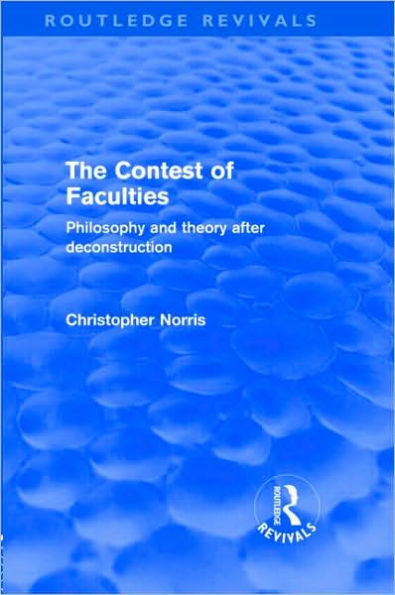
Contest of Faculties (Routledge Revivals): Philosophy and Theory after Deconstruction in Franklin, TN
Current price: $200.00
Barnes and Noble
Contest of Faculties (Routledge Revivals): Philosophy and Theory after Deconstruction in Franklin, TN
Current price: $200.00
Loading Inventory...
Size: Hardcover
This
Routledge Revival
, first published in 1985, gives detailed attention to the bearing of literary theory on questions of truth, meaning and reference. On the one hand, deconstruction brings a vigilant awareness of the figural and narrative tropes that make up the discourse of philosophic reason. On the other it insists that argumentative rigour cannot be divorced from the kind of close reading that has come to characterize literary theory in its more advanced or speculative forms. This present-day ‘contest of faculties’ has large implications for philosophers and critics, many of whom will welcome the reissue of such a clear-headed statement of the impact of deconstruction.
Routledge Revival
, first published in 1985, gives detailed attention to the bearing of literary theory on questions of truth, meaning and reference. On the one hand, deconstruction brings a vigilant awareness of the figural and narrative tropes that make up the discourse of philosophic reason. On the other it insists that argumentative rigour cannot be divorced from the kind of close reading that has come to characterize literary theory in its more advanced or speculative forms. This present-day ‘contest of faculties’ has large implications for philosophers and critics, many of whom will welcome the reissue of such a clear-headed statement of the impact of deconstruction.
This
Routledge Revival
, first published in 1985, gives detailed attention to the bearing of literary theory on questions of truth, meaning and reference. On the one hand, deconstruction brings a vigilant awareness of the figural and narrative tropes that make up the discourse of philosophic reason. On the other it insists that argumentative rigour cannot be divorced from the kind of close reading that has come to characterize literary theory in its more advanced or speculative forms. This present-day ‘contest of faculties’ has large implications for philosophers and critics, many of whom will welcome the reissue of such a clear-headed statement of the impact of deconstruction.
Routledge Revival
, first published in 1985, gives detailed attention to the bearing of literary theory on questions of truth, meaning and reference. On the one hand, deconstruction brings a vigilant awareness of the figural and narrative tropes that make up the discourse of philosophic reason. On the other it insists that argumentative rigour cannot be divorced from the kind of close reading that has come to characterize literary theory in its more advanced or speculative forms. This present-day ‘contest of faculties’ has large implications for philosophers and critics, many of whom will welcome the reissue of such a clear-headed statement of the impact of deconstruction.
You May Also Like













More About Barnes and Noble at CoolSprings Galleria
Barnes & Noble is the world’s largest retail bookseller and a leading retailer of content, digital media and educational products. Our Nook Digital business offers a lineup of NOOK® tablets and e-Readers and an expansive collection of digital reading content through the NOOK Store®. Barnes & Noble’s mission is to operate the best omni-channel specialty retail business in America, helping both our customers and booksellers reach their aspirations, while being a credit to the communities we serve.
1800 Galleria Blvd #1310, Franklin, TN 37067, United States
Find Barnes and Noble at CoolSprings Galleria in Franklin, TN
Visit Barnes and Noble at CoolSprings Galleria in Franklin, TN
