
Home
Current Debates over Exchange Rates: Overview and Issues for Congress
Barnes and Noble
Loading Inventory...
Current Debates over Exchange Rates: Overview and Issues for Congress in Franklin, TN
Current price: $19.95
Barnes and Noble
Current Debates over Exchange Rates: Overview and Issues for Congress in Franklin, TN
Current price: $19.95
Loading Inventory...
Size: OS
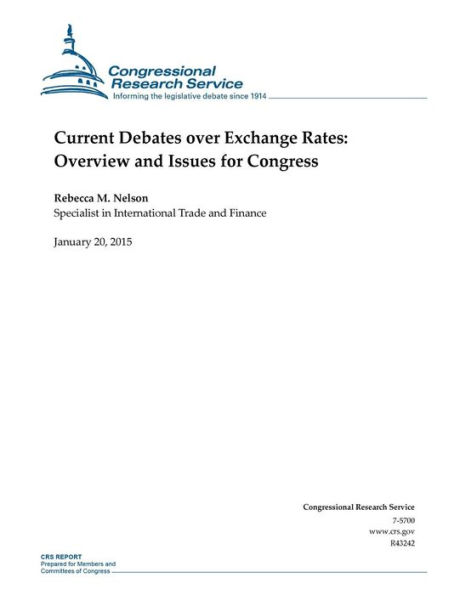
Exchange rates affect the price of every country's imports and exports, as well as the value of every overseas investment. Following the global financial crisis of 2008-2009 and ensuing economic recession, disagreements among countries over exchange rates became more widespread. At the heart of disagreements is whether or not countries are using exchange rate policies to undermine free markets and intentionally push down the value of their currency in order to gain a trade advantage at the expense of other countries. A weak currency makes exports cheaper to foreigners, which can lead to higher exports and job creation in the export sector. There can also be implications for other countries. In general, exporters and firms producing import-sensitive goods may find it harder to compete against countries with weak currencies. Consumers and businesses that rely on inputs from abroad may benefit when other countries have weak currencies, because imports may become cheaper. The United States has found itself on both sides of debates over exchange rates. On one hand, some Members of Congress and U.S. policy experts argue that U.S. exports and U.S. jobs have been adversely affected by the exchange rate policies adopted by China, Japan, and a number of other countries. On the other hand, some emerging markets, notably Brazil, argued during the global financial crisis that expansionary monetary policies in the United States and other developed countries caused the currencies of developed countries to depreciate, hurting the competitiveness of emerging markets. However, these concerns have diminished as the dollar has strengthened in recent months. Through the International Monetary Fund (IMF), countries have committed to avoid "currency manipulation." There are also provisions in U.S. law to address "currency manipulation" by other countries. In the context of recent disagreements, neither the IMF nor the U.S. Treasury Department has determined any country to be manipulating its exchange rate. There are differing views on why. Some argue that countries have not engaged in policies that violate international commitments on exchange rates or triggered provisions in U.S. law relating to currency manipulation. Others argue that currency manipulation has occurred, but that estimating a currency's "fundamental" value is complicated, and that the provisions do not effectively respond to exchange rate disputes.
Exchange rates affect the price of every country's imports and exports, as well as the value of every overseas investment. Following the global financial crisis of 2008-2009 and ensuing economic recession, disagreements among countries over exchange rates became more widespread. At the heart of disagreements is whether or not countries are using exchange rate policies to undermine free markets and intentionally push down the value of their currency in order to gain a trade advantage at the expense of other countries. A weak currency makes exports cheaper to foreigners, which can lead to higher exports and job creation in the export sector. There can also be implications for other countries. In general, exporters and firms producing import-sensitive goods may find it harder to compete against countries with weak currencies. Consumers and businesses that rely on inputs from abroad may benefit when other countries have weak currencies, because imports may become cheaper. The United States has found itself on both sides of debates over exchange rates. On one hand, some Members of Congress and U.S. policy experts argue that U.S. exports and U.S. jobs have been adversely affected by the exchange rate policies adopted by China, Japan, and a number of other countries. On the other hand, some emerging markets, notably Brazil, argued during the global financial crisis that expansionary monetary policies in the United States and other developed countries caused the currencies of developed countries to depreciate, hurting the competitiveness of emerging markets. However, these concerns have diminished as the dollar has strengthened in recent months. Through the International Monetary Fund (IMF), countries have committed to avoid "currency manipulation." There are also provisions in U.S. law to address "currency manipulation" by other countries. In the context of recent disagreements, neither the IMF nor the U.S. Treasury Department has determined any country to be manipulating its exchange rate. There are differing views on why. Some argue that countries have not engaged in policies that violate international commitments on exchange rates or triggered provisions in U.S. law relating to currency manipulation. Others argue that currency manipulation has occurred, but that estimating a currency's "fundamental" value is complicated, and that the provisions do not effectively respond to exchange rate disputes.
You May Also Like










More About Barnes and Noble at CoolSprings Galleria
Barnes & Noble is the world’s largest retail bookseller and a leading retailer of content, digital media and educational products. Our Nook Digital business offers a lineup of NOOK® tablets and e-Readers and an expansive collection of digital reading content through the NOOK Store®. Barnes & Noble’s mission is to operate the best omni-channel specialty retail business in America, helping both our customers and booksellers reach their aspirations, while being a credit to the communities we serve.
1800 Galleria Blvd #1310, Franklin, TN 37067, United States
Find Barnes and Noble at CoolSprings Galleria in Franklin, TN
Visit Barnes and Noble at CoolSprings Galleria in Franklin, TN
