
Home
Economic Circularity the Roman and Early Medieval Worlds: New Perspectives on Invisible Agents Dynamics
Barnes and Noble
Loading Inventory...
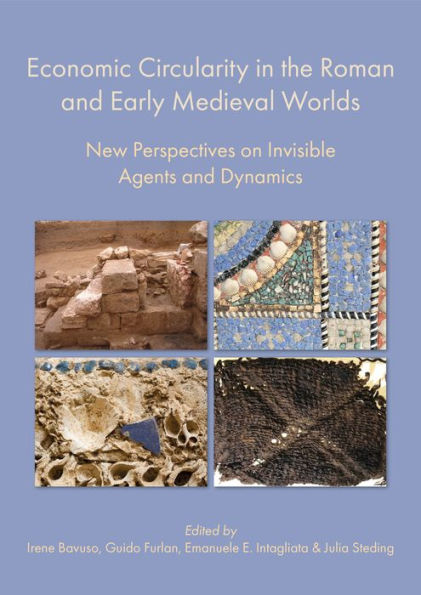
Economic Circularity the Roman and Early Medieval Worlds: New Perspectives on Invisible Agents Dynamics in Franklin, TN
Current price: $80.00
Barnes and Noble
Economic Circularity the Roman and Early Medieval Worlds: New Perspectives on Invisible Agents Dynamics in Franklin, TN
Current price: $80.00
Loading Inventory...
Size: Hardcover
Develops and expands current research into the concept of economic circularity, whereby societies reduce waste by recycling, reusing, and repairing raw materials and finished products.
Economic circularity is the ability of a society to reduce waste by recycling, reusing, and repairing raw materials and finished products. This concept has gained momentum in academia, in part due to contemporary environmental concerns. Although the blurry conceptual boundaries of this term are open to a wide array of interpretations, the scholarly community generally perceives circular economy as a convenient umbrella definition that encompasses a vast array of regenerative and preservative processes.
Despite the recent surge of interest, economic circularity has not been fully addressed as a macrophenomenon by historical and archaeological studies. The limitations of data and the relatively new formulation of targeted research questions mean that several processes and agents involved in ancient circular economies are still invisible to the eye of modern scholarship. Examples include forms of curation, maintenance, and repair, which must have had an influence on the economic systems of premodern societies but are rarely accounted for. Moreover, the people behind these processes, such as collectors and scavengers, are rarely investigated and poorly understood. Even better-studied mechanisms, like reuse and recycling, are not explored to their full potential within the broader picture of ancient urban economies.
This volume stems from a conference held at Moesgaard Museum supported by the Carlsberg Foundation and the Centre for Urban Networks Evolutions (Urb Net) at Aarhus University. To enhance our understanding of circular economic processes, the contributions in this volume expand the framework of the discussion by exploring circular economy over the longue durée and by integrating an interdisciplinary perspective. Furthermore, the volume gives prominence to classes of material, processes, agents, and methodologies generally overlooked or ignored in modern scholarship.
Economic circularity is the ability of a society to reduce waste by recycling, reusing, and repairing raw materials and finished products. This concept has gained momentum in academia, in part due to contemporary environmental concerns. Although the blurry conceptual boundaries of this term are open to a wide array of interpretations, the scholarly community generally perceives circular economy as a convenient umbrella definition that encompasses a vast array of regenerative and preservative processes.
Despite the recent surge of interest, economic circularity has not been fully addressed as a macrophenomenon by historical and archaeological studies. The limitations of data and the relatively new formulation of targeted research questions mean that several processes and agents involved in ancient circular economies are still invisible to the eye of modern scholarship. Examples include forms of curation, maintenance, and repair, which must have had an influence on the economic systems of premodern societies but are rarely accounted for. Moreover, the people behind these processes, such as collectors and scavengers, are rarely investigated and poorly understood. Even better-studied mechanisms, like reuse and recycling, are not explored to their full potential within the broader picture of ancient urban economies.
This volume stems from a conference held at Moesgaard Museum supported by the Carlsberg Foundation and the Centre for Urban Networks Evolutions (Urb Net) at Aarhus University. To enhance our understanding of circular economic processes, the contributions in this volume expand the framework of the discussion by exploring circular economy over the longue durée and by integrating an interdisciplinary perspective. Furthermore, the volume gives prominence to classes of material, processes, agents, and methodologies generally overlooked or ignored in modern scholarship.
Develops and expands current research into the concept of economic circularity, whereby societies reduce waste by recycling, reusing, and repairing raw materials and finished products.
Economic circularity is the ability of a society to reduce waste by recycling, reusing, and repairing raw materials and finished products. This concept has gained momentum in academia, in part due to contemporary environmental concerns. Although the blurry conceptual boundaries of this term are open to a wide array of interpretations, the scholarly community generally perceives circular economy as a convenient umbrella definition that encompasses a vast array of regenerative and preservative processes.
Despite the recent surge of interest, economic circularity has not been fully addressed as a macrophenomenon by historical and archaeological studies. The limitations of data and the relatively new formulation of targeted research questions mean that several processes and agents involved in ancient circular economies are still invisible to the eye of modern scholarship. Examples include forms of curation, maintenance, and repair, which must have had an influence on the economic systems of premodern societies but are rarely accounted for. Moreover, the people behind these processes, such as collectors and scavengers, are rarely investigated and poorly understood. Even better-studied mechanisms, like reuse and recycling, are not explored to their full potential within the broader picture of ancient urban economies.
This volume stems from a conference held at Moesgaard Museum supported by the Carlsberg Foundation and the Centre for Urban Networks Evolutions (Urb Net) at Aarhus University. To enhance our understanding of circular economic processes, the contributions in this volume expand the framework of the discussion by exploring circular economy over the longue durée and by integrating an interdisciplinary perspective. Furthermore, the volume gives prominence to classes of material, processes, agents, and methodologies generally overlooked or ignored in modern scholarship.
Economic circularity is the ability of a society to reduce waste by recycling, reusing, and repairing raw materials and finished products. This concept has gained momentum in academia, in part due to contemporary environmental concerns. Although the blurry conceptual boundaries of this term are open to a wide array of interpretations, the scholarly community generally perceives circular economy as a convenient umbrella definition that encompasses a vast array of regenerative and preservative processes.
Despite the recent surge of interest, economic circularity has not been fully addressed as a macrophenomenon by historical and archaeological studies. The limitations of data and the relatively new formulation of targeted research questions mean that several processes and agents involved in ancient circular economies are still invisible to the eye of modern scholarship. Examples include forms of curation, maintenance, and repair, which must have had an influence on the economic systems of premodern societies but are rarely accounted for. Moreover, the people behind these processes, such as collectors and scavengers, are rarely investigated and poorly understood. Even better-studied mechanisms, like reuse and recycling, are not explored to their full potential within the broader picture of ancient urban economies.
This volume stems from a conference held at Moesgaard Museum supported by the Carlsberg Foundation and the Centre for Urban Networks Evolutions (Urb Net) at Aarhus University. To enhance our understanding of circular economic processes, the contributions in this volume expand the framework of the discussion by exploring circular economy over the longue durée and by integrating an interdisciplinary perspective. Furthermore, the volume gives prominence to classes of material, processes, agents, and methodologies generally overlooked or ignored in modern scholarship.
You May Also Like










More About Barnes and Noble at CoolSprings Galleria
Barnes & Noble is the world’s largest retail bookseller and a leading retailer of content, digital media and educational products. Our Nook Digital business offers a lineup of NOOK® tablets and e-Readers and an expansive collection of digital reading content through the NOOK Store®. Barnes & Noble’s mission is to operate the best omni-channel specialty retail business in America, helping both our customers and booksellers reach their aspirations, while being a credit to the communities we serve.
1800 Galleria Blvd #1310, Franklin, TN 37067, United States
Find Barnes and Noble at CoolSprings Galleria in Franklin, TN
Visit Barnes and Noble at CoolSprings Galleria in Franklin, TN
