
Home
Empire Autopsy: How Rome Died of Its Own Strength
Barnes and Noble
Loading Inventory...
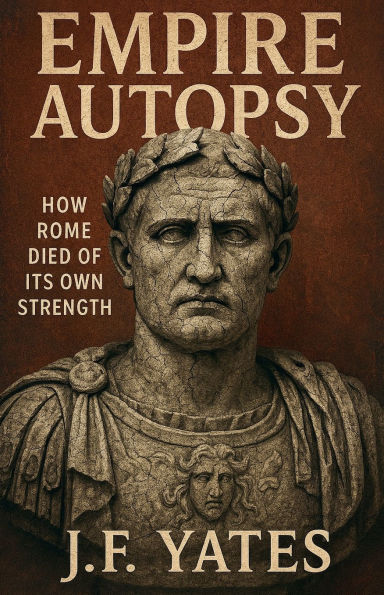
Empire Autopsy: How Rome Died of Its Own Strength in Franklin, TN
Current price: $29.99
Barnes and Noble
Empire Autopsy: How Rome Died of Its Own Strength in Franklin, TN
Current price: $29.99
Loading Inventory...
Size: Paperback
Empire Autopsy: How Rome Died of Its Own Strength
A groundbreaking reexamination of Rome's fall that reveals how history's greatest empire collapsed not from external enemies, but from the very strengths that made it invincible.
For centuries, historians have blamed Rome's collapse on barbarian invasions, moral decay, and political corruption. But what if the real killer was success itself?
Empire Autopsy
, performs a forensic examination of Rome's "body politic" to reveal a startling diagnosis, the empire died of its own strength.
Through meticulous analysis spanning fifteen centuries, from Augustus to the fall of Constantinople, this book demonstrates how Rome's greatest assets became fatal liabilities. The professional military that conquered the Mediterranean became a kingmaking force that devoured the state's resources. The sophisticated bureaucracy that governed millions calcified into an innovation-killing maze of red tape. The cultural assimilation that unified diverse peoples reached a breaking point when integration became dilution. The economic networks that created unprecedented prosperity grew so complex they collapsed under their own weight.
Using the metaphor of a medical autopsy,
traces the pathology of imperial decline through three distinct phases: the "Vital Signs" of Rome's golden age (27-180 CE), when core strengths were at their peak; the "Pathology Develops" crisis period (180-284 CE), when those strengths began turning toxic; and the "Immune System Failure" of late antiquity (284-476/1453 CE), when Rome could no longer adapt to survive.
But this isn't just ancient history. In a provocative final section, the book turns its diagnostic lens on modern superpowers, examining how America's military-industrial complex, China's bureaucratic apparatus, and Europe's integration project mirror Rome's fatal patterns. Through detailed case studies and original comparative analysis,
offers both a warning and a prescription for contemporary civilizations struggling with the paradoxes of peak power.
Part detective story, part civilizational diagnosis, part survival manual for modern democracies,
reveals why the question isn't whether Rome fell but whether we can learn from its autopsy before writing our own.
A groundbreaking reexamination of Rome's fall that reveals how history's greatest empire collapsed not from external enemies, but from the very strengths that made it invincible.
For centuries, historians have blamed Rome's collapse on barbarian invasions, moral decay, and political corruption. But what if the real killer was success itself?
Empire Autopsy
, performs a forensic examination of Rome's "body politic" to reveal a startling diagnosis, the empire died of its own strength.
Through meticulous analysis spanning fifteen centuries, from Augustus to the fall of Constantinople, this book demonstrates how Rome's greatest assets became fatal liabilities. The professional military that conquered the Mediterranean became a kingmaking force that devoured the state's resources. The sophisticated bureaucracy that governed millions calcified into an innovation-killing maze of red tape. The cultural assimilation that unified diverse peoples reached a breaking point when integration became dilution. The economic networks that created unprecedented prosperity grew so complex they collapsed under their own weight.
Using the metaphor of a medical autopsy,
traces the pathology of imperial decline through three distinct phases: the "Vital Signs" of Rome's golden age (27-180 CE), when core strengths were at their peak; the "Pathology Develops" crisis period (180-284 CE), when those strengths began turning toxic; and the "Immune System Failure" of late antiquity (284-476/1453 CE), when Rome could no longer adapt to survive.
But this isn't just ancient history. In a provocative final section, the book turns its diagnostic lens on modern superpowers, examining how America's military-industrial complex, China's bureaucratic apparatus, and Europe's integration project mirror Rome's fatal patterns. Through detailed case studies and original comparative analysis,
offers both a warning and a prescription for contemporary civilizations struggling with the paradoxes of peak power.
Part detective story, part civilizational diagnosis, part survival manual for modern democracies,
reveals why the question isn't whether Rome fell but whether we can learn from its autopsy before writing our own.
Empire Autopsy: How Rome Died of Its Own Strength
A groundbreaking reexamination of Rome's fall that reveals how history's greatest empire collapsed not from external enemies, but from the very strengths that made it invincible.
For centuries, historians have blamed Rome's collapse on barbarian invasions, moral decay, and political corruption. But what if the real killer was success itself?
Empire Autopsy
, performs a forensic examination of Rome's "body politic" to reveal a startling diagnosis, the empire died of its own strength.
Through meticulous analysis spanning fifteen centuries, from Augustus to the fall of Constantinople, this book demonstrates how Rome's greatest assets became fatal liabilities. The professional military that conquered the Mediterranean became a kingmaking force that devoured the state's resources. The sophisticated bureaucracy that governed millions calcified into an innovation-killing maze of red tape. The cultural assimilation that unified diverse peoples reached a breaking point when integration became dilution. The economic networks that created unprecedented prosperity grew so complex they collapsed under their own weight.
Using the metaphor of a medical autopsy,
traces the pathology of imperial decline through three distinct phases: the "Vital Signs" of Rome's golden age (27-180 CE), when core strengths were at their peak; the "Pathology Develops" crisis period (180-284 CE), when those strengths began turning toxic; and the "Immune System Failure" of late antiquity (284-476/1453 CE), when Rome could no longer adapt to survive.
But this isn't just ancient history. In a provocative final section, the book turns its diagnostic lens on modern superpowers, examining how America's military-industrial complex, China's bureaucratic apparatus, and Europe's integration project mirror Rome's fatal patterns. Through detailed case studies and original comparative analysis,
offers both a warning and a prescription for contemporary civilizations struggling with the paradoxes of peak power.
Part detective story, part civilizational diagnosis, part survival manual for modern democracies,
reveals why the question isn't whether Rome fell but whether we can learn from its autopsy before writing our own.
A groundbreaking reexamination of Rome's fall that reveals how history's greatest empire collapsed not from external enemies, but from the very strengths that made it invincible.
For centuries, historians have blamed Rome's collapse on barbarian invasions, moral decay, and political corruption. But what if the real killer was success itself?
Empire Autopsy
, performs a forensic examination of Rome's "body politic" to reveal a startling diagnosis, the empire died of its own strength.
Through meticulous analysis spanning fifteen centuries, from Augustus to the fall of Constantinople, this book demonstrates how Rome's greatest assets became fatal liabilities. The professional military that conquered the Mediterranean became a kingmaking force that devoured the state's resources. The sophisticated bureaucracy that governed millions calcified into an innovation-killing maze of red tape. The cultural assimilation that unified diverse peoples reached a breaking point when integration became dilution. The economic networks that created unprecedented prosperity grew so complex they collapsed under their own weight.
Using the metaphor of a medical autopsy,
traces the pathology of imperial decline through three distinct phases: the "Vital Signs" of Rome's golden age (27-180 CE), when core strengths were at their peak; the "Pathology Develops" crisis period (180-284 CE), when those strengths began turning toxic; and the "Immune System Failure" of late antiquity (284-476/1453 CE), when Rome could no longer adapt to survive.
But this isn't just ancient history. In a provocative final section, the book turns its diagnostic lens on modern superpowers, examining how America's military-industrial complex, China's bureaucratic apparatus, and Europe's integration project mirror Rome's fatal patterns. Through detailed case studies and original comparative analysis,
offers both a warning and a prescription for contemporary civilizations struggling with the paradoxes of peak power.
Part detective story, part civilizational diagnosis, part survival manual for modern democracies,
reveals why the question isn't whether Rome fell but whether we can learn from its autopsy before writing our own.
You May Also Like















More About Barnes and Noble at CoolSprings Galleria
Barnes & Noble is the world’s largest retail bookseller and a leading retailer of content, digital media and educational products. Our Nook Digital business offers a lineup of NOOK® tablets and e-Readers and an expansive collection of digital reading content through the NOOK Store®. Barnes & Noble’s mission is to operate the best omni-channel specialty retail business in America, helping both our customers and booksellers reach their aspirations, while being a credit to the communities we serve.
1800 Galleria Blvd #1310, Franklin, TN 37067, United States
Find Barnes and Noble at CoolSprings Galleria in Franklin, TN
Visit Barnes and Noble at CoolSprings Galleria in Franklin, TN
