
Home
Energy Australia: Peak Oil, Solar Power, and Asia's Economic Growth
Barnes and Noble
Loading Inventory...
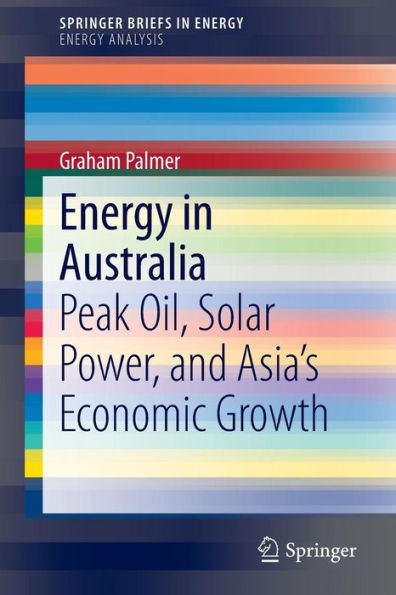
Energy Australia: Peak Oil, Solar Power, and Asia's Economic Growth in Franklin, TN
Current price: $54.99
Barnes and Noble
Energy Australia: Peak Oil, Solar Power, and Asia's Economic Growth in Franklin, TN
Current price: $54.99
Loading Inventory...
Size: Paperback
With rapidly declining costs and seemingly unlimited sunshine, the choice of solar in Australia seems obvious. Yet despite its many advantages, homes with solar remain completely dependent on the electricity grid for reliable supply, which in Australia implies mostly coal-fired generation. Indeed, even countries that have invested heavily in solar, such as Spain and Germany, have been unable to deflect the trajectory of fossil fuel dependence.
The reasons for this apparent paradox are varied, and this book provides a deeper and more nuanced understanding of the practical applications of photovoltaics (PV) in modern electricity systems. While the conventional life-cycle assessment (LCA) boundaries as prescribed by the IEA-PVPS provide a consistent methodology for comparing evolving PV technologies, the narrow boundaries exclude many critical downstream energy costs. Similarly, simple cost comparisons of PV versus conventional power sources overlook the significant economic and energy costs of intermittency and grid integration. Yet distributed storage, which could provide potentially valuable network support, is frequently given a low priority by advocates of solar.
Treating PV as an extension of, rather than as a substitute for, the fossil fuel enterprise enables a more productive discussion of PV’s potential role in electricity generation. The sunburnt country of Australia, which has a modern electricity system, is an ideal case study for exploring the potential of solar PV. With a focus on rooftop solar, energy storage, grid integration, and electricity system issues,
Energy in Australia
offers valuable insights into the practical challenges of solar power. Although many national economies are already confronting a downward trend in energy return on investment (EROI) of oil and gas from both conventional and unconventional sources, the large-scale deployment of low-emission energy sources that lie below a critical minimum EROIthreshold may ultimately prove counter-productive.
The reasons for this apparent paradox are varied, and this book provides a deeper and more nuanced understanding of the practical applications of photovoltaics (PV) in modern electricity systems. While the conventional life-cycle assessment (LCA) boundaries as prescribed by the IEA-PVPS provide a consistent methodology for comparing evolving PV technologies, the narrow boundaries exclude many critical downstream energy costs. Similarly, simple cost comparisons of PV versus conventional power sources overlook the significant economic and energy costs of intermittency and grid integration. Yet distributed storage, which could provide potentially valuable network support, is frequently given a low priority by advocates of solar.
Treating PV as an extension of, rather than as a substitute for, the fossil fuel enterprise enables a more productive discussion of PV’s potential role in electricity generation. The sunburnt country of Australia, which has a modern electricity system, is an ideal case study for exploring the potential of solar PV. With a focus on rooftop solar, energy storage, grid integration, and electricity system issues,
Energy in Australia
offers valuable insights into the practical challenges of solar power. Although many national economies are already confronting a downward trend in energy return on investment (EROI) of oil and gas from both conventional and unconventional sources, the large-scale deployment of low-emission energy sources that lie below a critical minimum EROIthreshold may ultimately prove counter-productive.
With rapidly declining costs and seemingly unlimited sunshine, the choice of solar in Australia seems obvious. Yet despite its many advantages, homes with solar remain completely dependent on the electricity grid for reliable supply, which in Australia implies mostly coal-fired generation. Indeed, even countries that have invested heavily in solar, such as Spain and Germany, have been unable to deflect the trajectory of fossil fuel dependence.
The reasons for this apparent paradox are varied, and this book provides a deeper and more nuanced understanding of the practical applications of photovoltaics (PV) in modern electricity systems. While the conventional life-cycle assessment (LCA) boundaries as prescribed by the IEA-PVPS provide a consistent methodology for comparing evolving PV technologies, the narrow boundaries exclude many critical downstream energy costs. Similarly, simple cost comparisons of PV versus conventional power sources overlook the significant economic and energy costs of intermittency and grid integration. Yet distributed storage, which could provide potentially valuable network support, is frequently given a low priority by advocates of solar.
Treating PV as an extension of, rather than as a substitute for, the fossil fuel enterprise enables a more productive discussion of PV’s potential role in electricity generation. The sunburnt country of Australia, which has a modern electricity system, is an ideal case study for exploring the potential of solar PV. With a focus on rooftop solar, energy storage, grid integration, and electricity system issues,
Energy in Australia
offers valuable insights into the practical challenges of solar power. Although many national economies are already confronting a downward trend in energy return on investment (EROI) of oil and gas from both conventional and unconventional sources, the large-scale deployment of low-emission energy sources that lie below a critical minimum EROIthreshold may ultimately prove counter-productive.
The reasons for this apparent paradox are varied, and this book provides a deeper and more nuanced understanding of the practical applications of photovoltaics (PV) in modern electricity systems. While the conventional life-cycle assessment (LCA) boundaries as prescribed by the IEA-PVPS provide a consistent methodology for comparing evolving PV technologies, the narrow boundaries exclude many critical downstream energy costs. Similarly, simple cost comparisons of PV versus conventional power sources overlook the significant economic and energy costs of intermittency and grid integration. Yet distributed storage, which could provide potentially valuable network support, is frequently given a low priority by advocates of solar.
Treating PV as an extension of, rather than as a substitute for, the fossil fuel enterprise enables a more productive discussion of PV’s potential role in electricity generation. The sunburnt country of Australia, which has a modern electricity system, is an ideal case study for exploring the potential of solar PV. With a focus on rooftop solar, energy storage, grid integration, and electricity system issues,
Energy in Australia
offers valuable insights into the practical challenges of solar power. Although many national economies are already confronting a downward trend in energy return on investment (EROI) of oil and gas from both conventional and unconventional sources, the large-scale deployment of low-emission energy sources that lie below a critical minimum EROIthreshold may ultimately prove counter-productive.
You May Also Like







More About Barnes and Noble at CoolSprings Galleria
Barnes & Noble is the world’s largest retail bookseller and a leading retailer of content, digital media and educational products. Our Nook Digital business offers a lineup of NOOK® tablets and e-Readers and an expansive collection of digital reading content through the NOOK Store®. Barnes & Noble’s mission is to operate the best omni-channel specialty retail business in America, helping both our customers and booksellers reach their aspirations, while being a credit to the communities we serve.
1800 Galleria Blvd #1310, Franklin, TN 37067, United States
Find Barnes and Noble at CoolSprings Galleria in Franklin, TN
Visit Barnes and Noble at CoolSprings Galleria in Franklin, TN
