
Home
EU Conditionality at Work in the Accession Process of Central and Eastern Europe. Hungary, Minorities and the Criteria of 'Good Neighborliness'
Barnes and Noble
Loading Inventory...
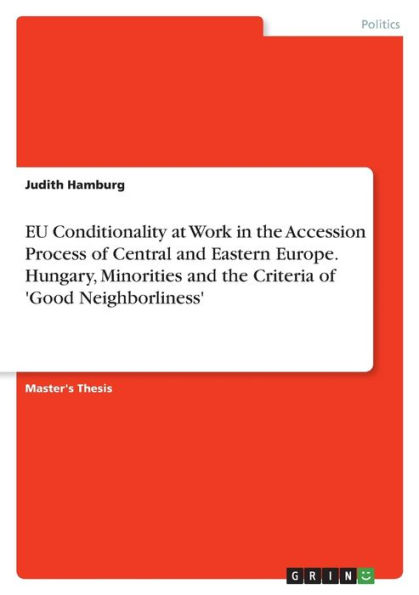
EU Conditionality at Work in the Accession Process of Central and Eastern Europe. Hungary, Minorities and the Criteria of 'Good Neighborliness' in Franklin, TN
Current price: $58.50
Barnes and Noble
EU Conditionality at Work in the Accession Process of Central and Eastern Europe. Hungary, Minorities and the Criteria of 'Good Neighborliness' in Franklin, TN
Current price: $58.50
Loading Inventory...
Size: OS
Master's Thesis from the year 2007 in the subject Politics - International Politics - Topic: European Union, language: English, abstract: Hungary, one of the Central European states that freed itself from Communist rule through a peaceful and negotiated revolution during 1988/1989, entered the post-Cold War era with a considerable unsolved national 'problem', or the "minority problem" as Katona points out. This 'problem' is constituted by the existance of more than 2 million ethnic Hungarians living as national minority groups in its neighbouring states. The particuliarity of this problem does not only derive from the size of the minority groups - which is approximately third of the Hungarian state's total population - but also from the fact that the post-1989 era was one of the first opportunities in Hungarian history when the state could actually lead a sovereign foreign policy.
Master's Thesis from the year 2007 in the subject Politics - International Politics - Topic: European Union, language: English, abstract: Hungary, one of the Central European states that freed itself from Communist rule through a peaceful and negotiated revolution during 1988/1989, entered the post-Cold War era with a considerable unsolved national 'problem', or the "minority problem" as Katona points out. This 'problem' is constituted by the existance of more than 2 million ethnic Hungarians living as national minority groups in its neighbouring states. The particuliarity of this problem does not only derive from the size of the minority groups - which is approximately third of the Hungarian state's total population - but also from the fact that the post-1989 era was one of the first opportunities in Hungarian history when the state could actually lead a sovereign foreign policy.
You May Also Like















More About Barnes and Noble at CoolSprings Galleria
Barnes & Noble is the world’s largest retail bookseller and a leading retailer of content, digital media and educational products. Our Nook Digital business offers a lineup of NOOK® tablets and e-Readers and an expansive collection of digital reading content through the NOOK Store®. Barnes & Noble’s mission is to operate the best omni-channel specialty retail business in America, helping both our customers and booksellers reach their aspirations, while being a credit to the communities we serve.
1800 Galleria Blvd #1310, Franklin, TN 37067, United States
Find Barnes and Noble at CoolSprings Galleria in Franklin, TN
Visit Barnes and Noble at CoolSprings Galleria in Franklin, TN
