
Home
Evaluation of Alternative Technologies to Supply Drinking Water to Marines in Forward Deployed Locations
Barnes and Noble
Loading Inventory...
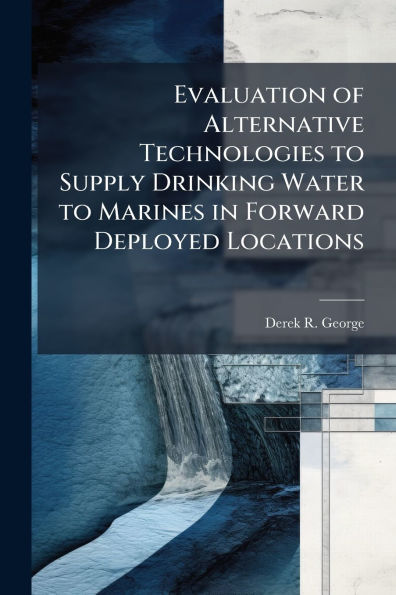
Evaluation of Alternative Technologies to Supply Drinking Water to Marines in Forward Deployed Locations in Franklin, TN
Current price: $17.95
Barnes and Noble
Evaluation of Alternative Technologies to Supply Drinking Water to Marines in Forward Deployed Locations in Franklin, TN
Current price: $17.95
Loading Inventory...
Size: OS
With recent increases, there are approximately 20,000 Marines deployed in the Helmand Province of Afghanistan. The cost of delivering bottled water to the troops is rapidly becoming unsustainable and convoys delivering bottled water are vulnerable to Improvised Explosive Devices (IEDs). Currently, raw water from indigenous sources, which has chemical and microbiological contaminants, is treated with reverse osmosis (RO), but only used for hygiene, with bottled water used for drinking. Due to the economic costs and risks to life of providing bottled water, decision-makers need to evaluate technology alternatives to treat raw water to supply safe drinking water. In this study, an innovative decision analysis tool, Choosing by Advantages (CBA), was used to evaluate and select the best alternative water treatment technology to support Marines in Afghanistan. Using criteria developed by a panel of experts, the CBA method was applied to determine that the best alternative technology is a treatment train: ultrafiltration pretreatment, RO treatment, and electrodeionization post treatment. This treatment train would produce high quality water and lower overall RO energy consumption, operation and maintenance costs, and reduce the replacement frequency of RO membranes.
This work has been selected by scholars as being culturally important, and is part of the knowledge base of civilization as we know it. This work was reproduced from the original artifact, and remains as true to the original work as possible. Therefore, you will see the original copyright references, library stamps (as most of these works have been housed in our most important libraries around the world), and other notations in the work.
This work is in the public domain in the United States of America, and possibly other nations. Within the United States, you may freely copy and distribute this work, as no entity (individual or corporate) has a copyright on the body of the work.
As a reproduction of a historical artifact, this work may contain missing or blurred pages, poor pictures, errant marks, etc. Scholars believe, and we concur, that this work is important enough to be preserved, reproduced, and made generally available to the public. We appreciate your support of the preservation process, and thank you for being an important part of keeping this knowledge alive and relevant.
This work has been selected by scholars as being culturally important, and is part of the knowledge base of civilization as we know it. This work was reproduced from the original artifact, and remains as true to the original work as possible. Therefore, you will see the original copyright references, library stamps (as most of these works have been housed in our most important libraries around the world), and other notations in the work.
This work is in the public domain in the United States of America, and possibly other nations. Within the United States, you may freely copy and distribute this work, as no entity (individual or corporate) has a copyright on the body of the work.
As a reproduction of a historical artifact, this work may contain missing or blurred pages, poor pictures, errant marks, etc. Scholars believe, and we concur, that this work is important enough to be preserved, reproduced, and made generally available to the public. We appreciate your support of the preservation process, and thank you for being an important part of keeping this knowledge alive and relevant.
With recent increases, there are approximately 20,000 Marines deployed in the Helmand Province of Afghanistan. The cost of delivering bottled water to the troops is rapidly becoming unsustainable and convoys delivering bottled water are vulnerable to Improvised Explosive Devices (IEDs). Currently, raw water from indigenous sources, which has chemical and microbiological contaminants, is treated with reverse osmosis (RO), but only used for hygiene, with bottled water used for drinking. Due to the economic costs and risks to life of providing bottled water, decision-makers need to evaluate technology alternatives to treat raw water to supply safe drinking water. In this study, an innovative decision analysis tool, Choosing by Advantages (CBA), was used to evaluate and select the best alternative water treatment technology to support Marines in Afghanistan. Using criteria developed by a panel of experts, the CBA method was applied to determine that the best alternative technology is a treatment train: ultrafiltration pretreatment, RO treatment, and electrodeionization post treatment. This treatment train would produce high quality water and lower overall RO energy consumption, operation and maintenance costs, and reduce the replacement frequency of RO membranes.
This work has been selected by scholars as being culturally important, and is part of the knowledge base of civilization as we know it. This work was reproduced from the original artifact, and remains as true to the original work as possible. Therefore, you will see the original copyright references, library stamps (as most of these works have been housed in our most important libraries around the world), and other notations in the work.
This work is in the public domain in the United States of America, and possibly other nations. Within the United States, you may freely copy and distribute this work, as no entity (individual or corporate) has a copyright on the body of the work.
As a reproduction of a historical artifact, this work may contain missing or blurred pages, poor pictures, errant marks, etc. Scholars believe, and we concur, that this work is important enough to be preserved, reproduced, and made generally available to the public. We appreciate your support of the preservation process, and thank you for being an important part of keeping this knowledge alive and relevant.
This work has been selected by scholars as being culturally important, and is part of the knowledge base of civilization as we know it. This work was reproduced from the original artifact, and remains as true to the original work as possible. Therefore, you will see the original copyright references, library stamps (as most of these works have been housed in our most important libraries around the world), and other notations in the work.
This work is in the public domain in the United States of America, and possibly other nations. Within the United States, you may freely copy and distribute this work, as no entity (individual or corporate) has a copyright on the body of the work.
As a reproduction of a historical artifact, this work may contain missing or blurred pages, poor pictures, errant marks, etc. Scholars believe, and we concur, that this work is important enough to be preserved, reproduced, and made generally available to the public. We appreciate your support of the preservation process, and thank you for being an important part of keeping this knowledge alive and relevant.
You May Also Like












More About Barnes and Noble at CoolSprings Galleria
Barnes & Noble is the world’s largest retail bookseller and a leading retailer of content, digital media and educational products. Our Nook Digital business offers a lineup of NOOK® tablets and e-Readers and an expansive collection of digital reading content through the NOOK Store®. Barnes & Noble’s mission is to operate the best omni-channel specialty retail business in America, helping both our customers and booksellers reach their aspirations, while being a credit to the communities we serve.
1800 Galleria Blvd #1310, Franklin, TN 37067, United States
Find Barnes and Noble at CoolSprings Galleria in Franklin, TN
Visit Barnes and Noble at CoolSprings Galleria in Franklin, TN
