
Home
Exodus: Kaufmann, Rubin, Tal
Barnes and Noble
Loading Inventory...
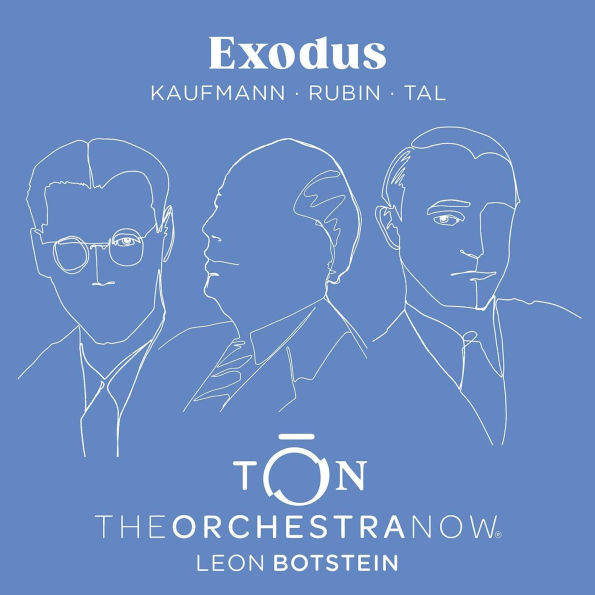
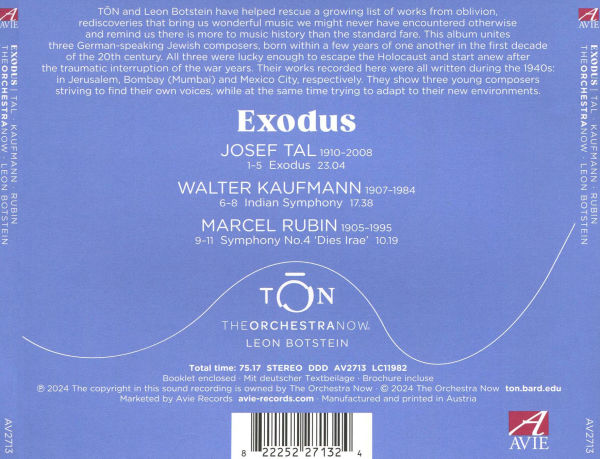
Exodus: Kaufmann, Rubin, Tal in Franklin, TN
Current price: $21.99
Barnes and Noble
Exodus: Kaufmann, Rubin, Tal in Franklin, TN
Current price: $21.99
Loading Inventory...
Size: OS
Several of the Jewish composers who fled Nazi Germany for the U.S. and Britain are well known, and some of the former group are largely responsible for film music as it is known today. However, Jews also left for other lands, and here, conductor
Leon Botstein
and his group
The Orchestra Now
(here stylized as
TON
) have revived works of three of those. This ensemble can be counted on for offbeat programming, and so it is here.
Josef Tal
left for Mandatory Palestine, later to become the state of Israel. His
Exodus for baritone and orchestra
(
Noam Heinz
is excellent in the solo part here) is just what it sounds like -- a programmatic depiction of the biblical Book of Exodus. Although
Tal
was a follower of
Schoenberg
earlier in his career, this is a piece of straight Romantic program music, perhaps intended to aid in the national ambitions of the Jewish state. It is in five linked movements, respectively representing a state of servitude, a prayer, the Exodus, the Parting of the Red Sea (a coda memorializes the Egyptian pursuers), and a celebratory dance. To these ears, this varied, exciting score is the strongest of the three.
's work is followed by the
Indian Symphony
of
Walter Kaufmann
(unconnected with the philosopher of the same name), a composer who headed for what was then Bombay, worked for All-India Radio, taught
Zubin Mehta
, and wrote music prolifically. This work is said to be based on an Indian raga, but to the untutored ear, it sounds like a lot of pentatonic scales;
The Beatles
may have had more creative solutions to the vexing problem of fusing Western and Indian musical languages. Last comes the
Symphony No. 4 ("Dies Irae")
Marcel Rubin
, who spent the World War II years in Mexico. Little of that culture seems to have rubbed off on him; his symphony deploys music based on a
Bertolt Brecht
poem and, curiously, the Catholic Dies irae chant in the only one of the three works to address the European tragedy directly. Listeners may have their own preferences about these three works, which are certainly not dull, and
Botstein
and his musicians are to be commended for reviving them.
hardly sounds like a student group, even an advanced one; these are fully competent performances. ~ James Manheim
Leon Botstein
and his group
The Orchestra Now
(here stylized as
TON
) have revived works of three of those. This ensemble can be counted on for offbeat programming, and so it is here.
Josef Tal
left for Mandatory Palestine, later to become the state of Israel. His
Exodus for baritone and orchestra
(
Noam Heinz
is excellent in the solo part here) is just what it sounds like -- a programmatic depiction of the biblical Book of Exodus. Although
Tal
was a follower of
Schoenberg
earlier in his career, this is a piece of straight Romantic program music, perhaps intended to aid in the national ambitions of the Jewish state. It is in five linked movements, respectively representing a state of servitude, a prayer, the Exodus, the Parting of the Red Sea (a coda memorializes the Egyptian pursuers), and a celebratory dance. To these ears, this varied, exciting score is the strongest of the three.
's work is followed by the
Indian Symphony
of
Walter Kaufmann
(unconnected with the philosopher of the same name), a composer who headed for what was then Bombay, worked for All-India Radio, taught
Zubin Mehta
, and wrote music prolifically. This work is said to be based on an Indian raga, but to the untutored ear, it sounds like a lot of pentatonic scales;
The Beatles
may have had more creative solutions to the vexing problem of fusing Western and Indian musical languages. Last comes the
Symphony No. 4 ("Dies Irae")
Marcel Rubin
, who spent the World War II years in Mexico. Little of that culture seems to have rubbed off on him; his symphony deploys music based on a
Bertolt Brecht
poem and, curiously, the Catholic Dies irae chant in the only one of the three works to address the European tragedy directly. Listeners may have their own preferences about these three works, which are certainly not dull, and
Botstein
and his musicians are to be commended for reviving them.
hardly sounds like a student group, even an advanced one; these are fully competent performances. ~ James Manheim
Several of the Jewish composers who fled Nazi Germany for the U.S. and Britain are well known, and some of the former group are largely responsible for film music as it is known today. However, Jews also left for other lands, and here, conductor
Leon Botstein
and his group
The Orchestra Now
(here stylized as
TON
) have revived works of three of those. This ensemble can be counted on for offbeat programming, and so it is here.
Josef Tal
left for Mandatory Palestine, later to become the state of Israel. His
Exodus for baritone and orchestra
(
Noam Heinz
is excellent in the solo part here) is just what it sounds like -- a programmatic depiction of the biblical Book of Exodus. Although
Tal
was a follower of
Schoenberg
earlier in his career, this is a piece of straight Romantic program music, perhaps intended to aid in the national ambitions of the Jewish state. It is in five linked movements, respectively representing a state of servitude, a prayer, the Exodus, the Parting of the Red Sea (a coda memorializes the Egyptian pursuers), and a celebratory dance. To these ears, this varied, exciting score is the strongest of the three.
's work is followed by the
Indian Symphony
of
Walter Kaufmann
(unconnected with the philosopher of the same name), a composer who headed for what was then Bombay, worked for All-India Radio, taught
Zubin Mehta
, and wrote music prolifically. This work is said to be based on an Indian raga, but to the untutored ear, it sounds like a lot of pentatonic scales;
The Beatles
may have had more creative solutions to the vexing problem of fusing Western and Indian musical languages. Last comes the
Symphony No. 4 ("Dies Irae")
Marcel Rubin
, who spent the World War II years in Mexico. Little of that culture seems to have rubbed off on him; his symphony deploys music based on a
Bertolt Brecht
poem and, curiously, the Catholic Dies irae chant in the only one of the three works to address the European tragedy directly. Listeners may have their own preferences about these three works, which are certainly not dull, and
Botstein
and his musicians are to be commended for reviving them.
hardly sounds like a student group, even an advanced one; these are fully competent performances. ~ James Manheim
Leon Botstein
and his group
The Orchestra Now
(here stylized as
TON
) have revived works of three of those. This ensemble can be counted on for offbeat programming, and so it is here.
Josef Tal
left for Mandatory Palestine, later to become the state of Israel. His
Exodus for baritone and orchestra
(
Noam Heinz
is excellent in the solo part here) is just what it sounds like -- a programmatic depiction of the biblical Book of Exodus. Although
Tal
was a follower of
Schoenberg
earlier in his career, this is a piece of straight Romantic program music, perhaps intended to aid in the national ambitions of the Jewish state. It is in five linked movements, respectively representing a state of servitude, a prayer, the Exodus, the Parting of the Red Sea (a coda memorializes the Egyptian pursuers), and a celebratory dance. To these ears, this varied, exciting score is the strongest of the three.
's work is followed by the
Indian Symphony
of
Walter Kaufmann
(unconnected with the philosopher of the same name), a composer who headed for what was then Bombay, worked for All-India Radio, taught
Zubin Mehta
, and wrote music prolifically. This work is said to be based on an Indian raga, but to the untutored ear, it sounds like a lot of pentatonic scales;
The Beatles
may have had more creative solutions to the vexing problem of fusing Western and Indian musical languages. Last comes the
Symphony No. 4 ("Dies Irae")
Marcel Rubin
, who spent the World War II years in Mexico. Little of that culture seems to have rubbed off on him; his symphony deploys music based on a
Bertolt Brecht
poem and, curiously, the Catholic Dies irae chant in the only one of the three works to address the European tragedy directly. Listeners may have their own preferences about these three works, which are certainly not dull, and
Botstein
and his musicians are to be commended for reviving them.
hardly sounds like a student group, even an advanced one; these are fully competent performances. ~ James Manheim
You May Also Like













More About Barnes and Noble at CoolSprings Galleria
Barnes & Noble is the world’s largest retail bookseller and a leading retailer of content, digital media and educational products. Our Nook Digital business offers a lineup of NOOK® tablets and e-Readers and an expansive collection of digital reading content through the NOOK Store®. Barnes & Noble’s mission is to operate the best omni-channel specialty retail business in America, helping both our customers and booksellers reach their aspirations, while being a credit to the communities we serve.
1800 Galleria Blvd #1310, Franklin, TN 37067, United States
Find Barnes and Noble at CoolSprings Galleria in Franklin, TN
Visit Barnes and Noble at CoolSprings Galleria in Franklin, TN
