
Home
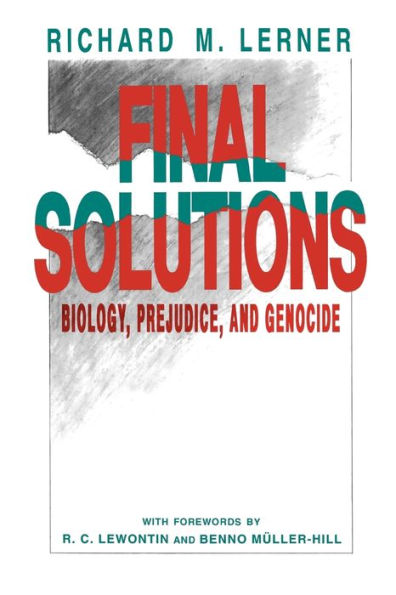
Final Solutions: Biology, Prejudice, and Genocide
Barnes and Noble
Loading Inventory...
Final Solutions: Biology, Prejudice, and Genocide in Franklin, TN
Current price: $34.95
Barnes and Noble
Final Solutions: Biology, Prejudice, and Genocide in Franklin, TN
Current price: $34.95
Loading Inventory...
Size: OS
The nature-nurture debate continues to stir controversy in the social and behavioral sciences. How much of human behavior and development can be attributed to biology and how much to the environment? Can either be said to “determine” human development? And what are the implications of each view for society? In this important study, a noted developmental psychologist contributes to this debate by confronting the difficult issue of “doctrines” of human development and the consequences for society of deriving political programs and public policy from them.
Beginning with the premise that scientific ideas are not neutral but can be used for either good or evil, Richard Lerner considers the recent history of one such idea, biological determinism, which at times has had the backing of respected scientists, intellectuals, and political leaders. During this century, biological determinism has been coupled with political philosophies that hold that some people are inherently better than others. This has meant that certain groups of people—Jews, Blacks, Native Americans, women—have been stigmatized because of supposedly innate, even “biological,” differences, with sometimes disastrous consequences. The most notorious instance was Nazi Germany, where “racial science,” given legitimacy by the scientific community, became a cornerstone of the Nazi “Final Solution.”
Meanwhile, theories of biological determinism continue to find adherents within the scientific community. Konrad Lorenz, who was awarded a Nobel Prize in 1973, was a critical figure in the development of the most recent manifestation of biological determinism—sociobiology. Lerner examines the work of Lorenz and current sociobiologists and the implications of their claims for modern society. He fears that biological determinism may again be co-opted to serve the political agenda of today’s reactionary politicians. In fact, Lerner notes, sociobiologists have had to face the fact that organizations such as the fascist National Front party in Britain and its counterparts in France and the United States have selectively seized upon sociobiology to fuel their notions of genetically superior and inferior races.
Beginning with the premise that scientific ideas are not neutral but can be used for either good or evil, Richard Lerner considers the recent history of one such idea, biological determinism, which at times has had the backing of respected scientists, intellectuals, and political leaders. During this century, biological determinism has been coupled with political philosophies that hold that some people are inherently better than others. This has meant that certain groups of people—Jews, Blacks, Native Americans, women—have been stigmatized because of supposedly innate, even “biological,” differences, with sometimes disastrous consequences. The most notorious instance was Nazi Germany, where “racial science,” given legitimacy by the scientific community, became a cornerstone of the Nazi “Final Solution.”
Meanwhile, theories of biological determinism continue to find adherents within the scientific community. Konrad Lorenz, who was awarded a Nobel Prize in 1973, was a critical figure in the development of the most recent manifestation of biological determinism—sociobiology. Lerner examines the work of Lorenz and current sociobiologists and the implications of their claims for modern society. He fears that biological determinism may again be co-opted to serve the political agenda of today’s reactionary politicians. In fact, Lerner notes, sociobiologists have had to face the fact that organizations such as the fascist National Front party in Britain and its counterparts in France and the United States have selectively seized upon sociobiology to fuel their notions of genetically superior and inferior races.
The nature-nurture debate continues to stir controversy in the social and behavioral sciences. How much of human behavior and development can be attributed to biology and how much to the environment? Can either be said to “determine” human development? And what are the implications of each view for society? In this important study, a noted developmental psychologist contributes to this debate by confronting the difficult issue of “doctrines” of human development and the consequences for society of deriving political programs and public policy from them.
Beginning with the premise that scientific ideas are not neutral but can be used for either good or evil, Richard Lerner considers the recent history of one such idea, biological determinism, which at times has had the backing of respected scientists, intellectuals, and political leaders. During this century, biological determinism has been coupled with political philosophies that hold that some people are inherently better than others. This has meant that certain groups of people—Jews, Blacks, Native Americans, women—have been stigmatized because of supposedly innate, even “biological,” differences, with sometimes disastrous consequences. The most notorious instance was Nazi Germany, where “racial science,” given legitimacy by the scientific community, became a cornerstone of the Nazi “Final Solution.”
Meanwhile, theories of biological determinism continue to find adherents within the scientific community. Konrad Lorenz, who was awarded a Nobel Prize in 1973, was a critical figure in the development of the most recent manifestation of biological determinism—sociobiology. Lerner examines the work of Lorenz and current sociobiologists and the implications of their claims for modern society. He fears that biological determinism may again be co-opted to serve the political agenda of today’s reactionary politicians. In fact, Lerner notes, sociobiologists have had to face the fact that organizations such as the fascist National Front party in Britain and its counterparts in France and the United States have selectively seized upon sociobiology to fuel their notions of genetically superior and inferior races.
Beginning with the premise that scientific ideas are not neutral but can be used for either good or evil, Richard Lerner considers the recent history of one such idea, biological determinism, which at times has had the backing of respected scientists, intellectuals, and political leaders. During this century, biological determinism has been coupled with political philosophies that hold that some people are inherently better than others. This has meant that certain groups of people—Jews, Blacks, Native Americans, women—have been stigmatized because of supposedly innate, even “biological,” differences, with sometimes disastrous consequences. The most notorious instance was Nazi Germany, where “racial science,” given legitimacy by the scientific community, became a cornerstone of the Nazi “Final Solution.”
Meanwhile, theories of biological determinism continue to find adherents within the scientific community. Konrad Lorenz, who was awarded a Nobel Prize in 1973, was a critical figure in the development of the most recent manifestation of biological determinism—sociobiology. Lerner examines the work of Lorenz and current sociobiologists and the implications of their claims for modern society. He fears that biological determinism may again be co-opted to serve the political agenda of today’s reactionary politicians. In fact, Lerner notes, sociobiologists have had to face the fact that organizations such as the fascist National Front party in Britain and its counterparts in France and the United States have selectively seized upon sociobiology to fuel their notions of genetically superior and inferior races.
You May Also Like


















More About Barnes and Noble at CoolSprings Galleria
Barnes & Noble is the world’s largest retail bookseller and a leading retailer of content, digital media and educational products. Our Nook Digital business offers a lineup of NOOK® tablets and e-Readers and an expansive collection of digital reading content through the NOOK Store®. Barnes & Noble’s mission is to operate the best omni-channel specialty retail business in America, helping both our customers and booksellers reach their aspirations, while being a credit to the communities we serve.
1800 Galleria Blvd #1310, Franklin, TN 37067, United States
Find Barnes and Noble at CoolSprings Galleria in Franklin, TN
Visit Barnes and Noble at CoolSprings Galleria in Franklin, TN
