
Home
Gauss and Digital Signal Processing: Volume 3 "Scientist and Science" series
Barnes and Noble
Loading Inventory...
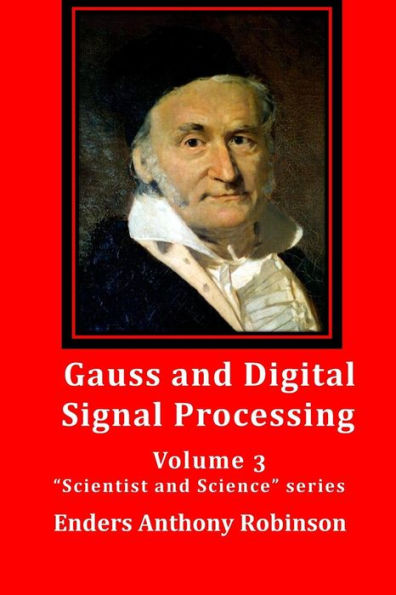
Gauss and Digital Signal Processing: Volume 3 "Scientist and Science" series in Franklin, TN
Current price: $10.25
Barnes and Noble
Gauss and Digital Signal Processing: Volume 3 "Scientist and Science" series in Franklin, TN
Current price: $10.25
Loading Inventory...
Size: OS
Carl Frederick Gauss was one of the greatest scientists of all time. He was an exceptional mathematician as well as a calculating prodigy. He believed that mathematics is the queen of sciences and arithmetic is the queen of mathematics. Gauss did not shirk from numerical calculations. He used his skill in arithmetic to do the practical computations that determined the orbits of planets and comets. He came to believe his potential theory and his method of least squares provided vital links between science and nature. In later years, he collaborated with Wilhelm Weber on measurements of the Earth's magnetic field, and invented the first electric telegraph. In effect, the practical arithmetical labors of Gauss were early examples of digital signal processing. Today we are connected like never before. Our mobile phones and tablets are everywhere. These portable devices provide the means to connect us with the world around us. Digital signal processing (DSP) deconvolution chip power these devices. Deconvolution takes apart complicated signals encountered in practice. Re-convolution reassembles component parts into signals more amenable to our purposes. The following passage is from the 1953 film on MIT Project Whirlwind, Making Electrons Count. "The film which you are about to see first shows a few examples of the types of problems in which computers can be useful, and then describes the efforts of a typical user in programming a problem for Whirlwind. Whirlwind has been involved in more than a hundred such computations problems, originating in many different departments of MIT. Take the Geology Department, for example. Seismic methods of prospecting for oil may seem a little strange to the onlooker. A charge is exploded at one point, and the sound, reflected from various underground layers of rock, is recorded at a number of other points. A great deal of information about underground formations can be determined from these sound patterns, but only after long and tedious computations have been performed on them." The chapters are 1. Overview of the seismic method; 2. Seismic models; 3. Seismic migration; 4. Wave motion; 5. Hamilton's equations and seismic modeling; 6. Predictive deconvolution; 7. Seismic waves; 8. Ghost reflections; 9. Fourier series and Fourier transform; and 10. Gauss and Maxwell's equations.
Carl Frederick Gauss was one of the greatest scientists of all time. He was an exceptional mathematician as well as a calculating prodigy. He believed that mathematics is the queen of sciences and arithmetic is the queen of mathematics. Gauss did not shirk from numerical calculations. He used his skill in arithmetic to do the practical computations that determined the orbits of planets and comets. He came to believe his potential theory and his method of least squares provided vital links between science and nature. In later years, he collaborated with Wilhelm Weber on measurements of the Earth's magnetic field, and invented the first electric telegraph. In effect, the practical arithmetical labors of Gauss were early examples of digital signal processing. Today we are connected like never before. Our mobile phones and tablets are everywhere. These portable devices provide the means to connect us with the world around us. Digital signal processing (DSP) deconvolution chip power these devices. Deconvolution takes apart complicated signals encountered in practice. Re-convolution reassembles component parts into signals more amenable to our purposes. The following passage is from the 1953 film on MIT Project Whirlwind, Making Electrons Count. "The film which you are about to see first shows a few examples of the types of problems in which computers can be useful, and then describes the efforts of a typical user in programming a problem for Whirlwind. Whirlwind has been involved in more than a hundred such computations problems, originating in many different departments of MIT. Take the Geology Department, for example. Seismic methods of prospecting for oil may seem a little strange to the onlooker. A charge is exploded at one point, and the sound, reflected from various underground layers of rock, is recorded at a number of other points. A great deal of information about underground formations can be determined from these sound patterns, but only after long and tedious computations have been performed on them." The chapters are 1. Overview of the seismic method; 2. Seismic models; 3. Seismic migration; 4. Wave motion; 5. Hamilton's equations and seismic modeling; 6. Predictive deconvolution; 7. Seismic waves; 8. Ghost reflections; 9. Fourier series and Fourier transform; and 10. Gauss and Maxwell's equations.
You May Also Like












More About Barnes and Noble at CoolSprings Galleria
Barnes & Noble is the world’s largest retail bookseller and a leading retailer of content, digital media and educational products. Our Nook Digital business offers a lineup of NOOK® tablets and e-Readers and an expansive collection of digital reading content through the NOOK Store®. Barnes & Noble’s mission is to operate the best omni-channel specialty retail business in America, helping both our customers and booksellers reach their aspirations, while being a credit to the communities we serve.
1800 Galleria Blvd #1310, Franklin, TN 37067, United States
Find Barnes and Noble at CoolSprings Galleria in Franklin, TN
Visit Barnes and Noble at CoolSprings Galleria in Franklin, TN
