
Home
Graded Logic: Modeling Human Commonsense Reasoning Decision-Making and AI
Barnes and Noble
Loading Inventory...
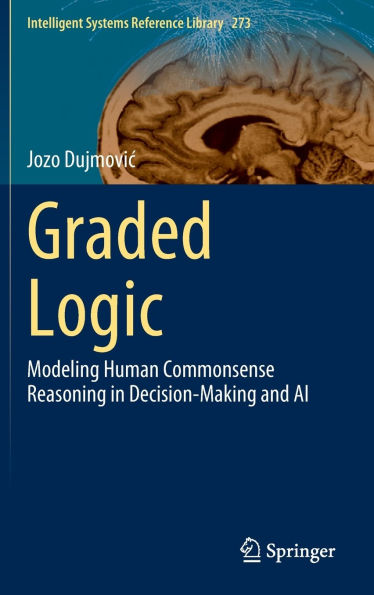
Graded Logic: Modeling Human Commonsense Reasoning Decision-Making and AI in Franklin, TN
Current price: $199.99
Barnes and Noble
Graded Logic: Modeling Human Commonsense Reasoning Decision-Making and AI in Franklin, TN
Current price: $199.99
Loading Inventory...
Size: Hardcover
Observable human commonsense reasoning can be modeled with graded propositional logic. Our approach is distinctive in that all mathematical models are directly linked to specific, observable, and explainable mental activities. Decision-makers evaluate alternatives through perceived gradations of truth, importance, suitability, simultaneity, and substitutability. Each graded variable has a semantic identity, reflecting its role and meaning tied to the goals and interests of a specific decision-maker.
Graded logic was introduced 50 years ago, and this book presents its current status based on a half-century of improvements and applications. The book includes examples of decision problems solved using graded logic models. Our aim is to provide readers with a solid theoretical foundation in graded propositional calculus, enabling them to confidently apply the LSP method on complex evaluation and decision problems. Additionally, the book suggests numerous directions for future research and applications.
Graded logic was introduced 50 years ago, and this book presents its current status based on a half-century of improvements and applications. The book includes examples of decision problems solved using graded logic models. Our aim is to provide readers with a solid theoretical foundation in graded propositional calculus, enabling them to confidently apply the LSP method on complex evaluation and decision problems. Additionally, the book suggests numerous directions for future research and applications.
Observable human commonsense reasoning can be modeled with graded propositional logic. Our approach is distinctive in that all mathematical models are directly linked to specific, observable, and explainable mental activities. Decision-makers evaluate alternatives through perceived gradations of truth, importance, suitability, simultaneity, and substitutability. Each graded variable has a semantic identity, reflecting its role and meaning tied to the goals and interests of a specific decision-maker.
Graded logic was introduced 50 years ago, and this book presents its current status based on a half-century of improvements and applications. The book includes examples of decision problems solved using graded logic models. Our aim is to provide readers with a solid theoretical foundation in graded propositional calculus, enabling them to confidently apply the LSP method on complex evaluation and decision problems. Additionally, the book suggests numerous directions for future research and applications.
Graded logic was introduced 50 years ago, and this book presents its current status based on a half-century of improvements and applications. The book includes examples of decision problems solved using graded logic models. Our aim is to provide readers with a solid theoretical foundation in graded propositional calculus, enabling them to confidently apply the LSP method on complex evaluation and decision problems. Additionally, the book suggests numerous directions for future research and applications.
You May Also Like









More About Barnes and Noble at CoolSprings Galleria
Barnes & Noble is the world’s largest retail bookseller and a leading retailer of content, digital media and educational products. Our Nook Digital business offers a lineup of NOOK® tablets and e-Readers and an expansive collection of digital reading content through the NOOK Store®. Barnes & Noble’s mission is to operate the best omni-channel specialty retail business in America, helping both our customers and booksellers reach their aspirations, while being a credit to the communities we serve.
1800 Galleria Blvd #1310, Franklin, TN 37067, United States
Find Barnes and Noble at CoolSprings Galleria in Franklin, TN
Visit Barnes and Noble at CoolSprings Galleria in Franklin, TN
