
Home
Handbook of Web Surveys
Barnes and Noble
Loading Inventory...
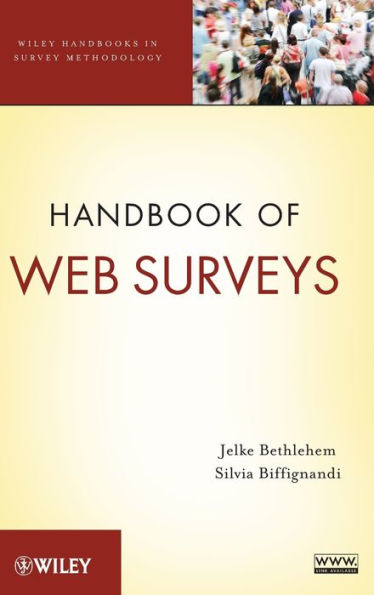
Handbook of Web Surveys in Franklin, TN
Current price: $191.95
Barnes and Noble
Handbook of Web Surveys in Franklin, TN
Current price: $191.95
Loading Inventory...
Size: Hardcover
BEST PRACTICES TO CREATE AND IMPLEMENTHIGHLY EFFECTIVE WEB SURVEYS
Exclusively combining design and sampling issues,
Handbook of Web Surveys
presents a theoretical yet practical approach to creating and conducting web surveys. From the history of web surveys to various modes of data collection to tips for detecting error, this book thoroughly introduces readers to the this cutting-edge technique and offers tips for creating successful web surveys.
The authors provide a history of web surveys and go on to explore the advantages and disadvantages of this mode of data collection. Common challenges involving under-coverage, self-selection, and measurement errors are discussed as well as topics including:
Sampling designs and estimation procedures
Comparing web surveys to face-to-face, telephone, and mail surveys
Errors in web surveys
Mixed-mode surveys
Weighting techniques including post-stratification, generalized regression estimation, and raking ratio estimation
Use of propensity scores to correct bias
Web panels
Real-world examples illustrate the discussed concepts, methods, and techniques, with related data freely available on the book's Website.
is an essential reference for researchers in the fields of government, business, economics, and the social sciences who utilize technology to gather, analyze, and draw results from data. It is also a suitable supplement for survey methods courses at the upper-undergraduate and graduate levels.
Exclusively combining design and sampling issues,
Handbook of Web Surveys
presents a theoretical yet practical approach to creating and conducting web surveys. From the history of web surveys to various modes of data collection to tips for detecting error, this book thoroughly introduces readers to the this cutting-edge technique and offers tips for creating successful web surveys.
The authors provide a history of web surveys and go on to explore the advantages and disadvantages of this mode of data collection. Common challenges involving under-coverage, self-selection, and measurement errors are discussed as well as topics including:
Sampling designs and estimation procedures
Comparing web surveys to face-to-face, telephone, and mail surveys
Errors in web surveys
Mixed-mode surveys
Weighting techniques including post-stratification, generalized regression estimation, and raking ratio estimation
Use of propensity scores to correct bias
Web panels
Real-world examples illustrate the discussed concepts, methods, and techniques, with related data freely available on the book's Website.
is an essential reference for researchers in the fields of government, business, economics, and the social sciences who utilize technology to gather, analyze, and draw results from data. It is also a suitable supplement for survey methods courses at the upper-undergraduate and graduate levels.
BEST PRACTICES TO CREATE AND IMPLEMENTHIGHLY EFFECTIVE WEB SURVEYS
Exclusively combining design and sampling issues,
Handbook of Web Surveys
presents a theoretical yet practical approach to creating and conducting web surveys. From the history of web surveys to various modes of data collection to tips for detecting error, this book thoroughly introduces readers to the this cutting-edge technique and offers tips for creating successful web surveys.
The authors provide a history of web surveys and go on to explore the advantages and disadvantages of this mode of data collection. Common challenges involving under-coverage, self-selection, and measurement errors are discussed as well as topics including:
Sampling designs and estimation procedures
Comparing web surveys to face-to-face, telephone, and mail surveys
Errors in web surveys
Mixed-mode surveys
Weighting techniques including post-stratification, generalized regression estimation, and raking ratio estimation
Use of propensity scores to correct bias
Web panels
Real-world examples illustrate the discussed concepts, methods, and techniques, with related data freely available on the book's Website.
is an essential reference for researchers in the fields of government, business, economics, and the social sciences who utilize technology to gather, analyze, and draw results from data. It is also a suitable supplement for survey methods courses at the upper-undergraduate and graduate levels.
Exclusively combining design and sampling issues,
Handbook of Web Surveys
presents a theoretical yet practical approach to creating and conducting web surveys. From the history of web surveys to various modes of data collection to tips for detecting error, this book thoroughly introduces readers to the this cutting-edge technique and offers tips for creating successful web surveys.
The authors provide a history of web surveys and go on to explore the advantages and disadvantages of this mode of data collection. Common challenges involving under-coverage, self-selection, and measurement errors are discussed as well as topics including:
Sampling designs and estimation procedures
Comparing web surveys to face-to-face, telephone, and mail surveys
Errors in web surveys
Mixed-mode surveys
Weighting techniques including post-stratification, generalized regression estimation, and raking ratio estimation
Use of propensity scores to correct bias
Web panels
Real-world examples illustrate the discussed concepts, methods, and techniques, with related data freely available on the book's Website.
is an essential reference for researchers in the fields of government, business, economics, and the social sciences who utilize technology to gather, analyze, and draw results from data. It is also a suitable supplement for survey methods courses at the upper-undergraduate and graduate levels.
You May Also Like
















More About Barnes and Noble at CoolSprings Galleria
Barnes & Noble is the world’s largest retail bookseller and a leading retailer of content, digital media and educational products. Our Nook Digital business offers a lineup of NOOK® tablets and e-Readers and an expansive collection of digital reading content through the NOOK Store®. Barnes & Noble’s mission is to operate the best omni-channel specialty retail business in America, helping both our customers and booksellers reach their aspirations, while being a credit to the communities we serve.
1800 Galleria Blvd #1310, Franklin, TN 37067, United States
Find Barnes and Noble at CoolSprings Galleria in Franklin, TN
Visit Barnes and Noble at CoolSprings Galleria in Franklin, TN
