
Home
Illiberal Reformers: Race, Eugenics, and American Economics the Progressive Era
Barnes and Noble
Loading Inventory...
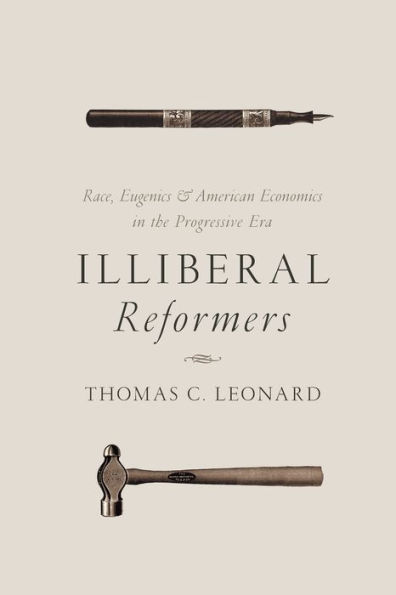
Illiberal Reformers: Race, Eugenics, and American Economics the Progressive Era in Franklin, TN
Current price: $48.00
Barnes and Noble
Illiberal Reformers: Race, Eugenics, and American Economics the Progressive Era in Franklin, TN
Current price: $48.00
Loading Inventory...
Size: Hardcover
The pivotal and troubling role of progressive-era economics in the shaping of modern American liberalism
In
Illiberal Reformers
, Thomas Leonard reexamines the economic progressives whose ideas and reform agenda underwrote the Progressive Era dismantling of laissez-faire and the creation of the regulatory welfare state, which, they believed, would humanize and rationalize industrial capitalism. But not for all. Academic social scientists such as Richard T. Ely, John R. Commons, and Edward A. Ross, together with their reform allies in social work, charity, journalism, and law, played a pivotal role in establishing minimum-wage and maximum-hours laws, workmen's compensation, antitrust regulation, and other hallmarks of the regulatory welfare state. But even as they offered uplift to some, economic progressives advocated exclusion for others, and did both in the name of progress. Leonard meticulously reconstructs the influence of Darwinism, racial science, and eugenics on scholars and activists of the late nineteenth and early twentieth centuries, revealing a reform community deeply ambivalent about America's poor.
shows that the intellectual champions of the regulatory welfare state proposed using it not to help those they portrayed as hereditary inferiors but to exclude them.
In
Illiberal Reformers
, Thomas Leonard reexamines the economic progressives whose ideas and reform agenda underwrote the Progressive Era dismantling of laissez-faire and the creation of the regulatory welfare state, which, they believed, would humanize and rationalize industrial capitalism. But not for all. Academic social scientists such as Richard T. Ely, John R. Commons, and Edward A. Ross, together with their reform allies in social work, charity, journalism, and law, played a pivotal role in establishing minimum-wage and maximum-hours laws, workmen's compensation, antitrust regulation, and other hallmarks of the regulatory welfare state. But even as they offered uplift to some, economic progressives advocated exclusion for others, and did both in the name of progress. Leonard meticulously reconstructs the influence of Darwinism, racial science, and eugenics on scholars and activists of the late nineteenth and early twentieth centuries, revealing a reform community deeply ambivalent about America's poor.
shows that the intellectual champions of the regulatory welfare state proposed using it not to help those they portrayed as hereditary inferiors but to exclude them.
The pivotal and troubling role of progressive-era economics in the shaping of modern American liberalism
In
Illiberal Reformers
, Thomas Leonard reexamines the economic progressives whose ideas and reform agenda underwrote the Progressive Era dismantling of laissez-faire and the creation of the regulatory welfare state, which, they believed, would humanize and rationalize industrial capitalism. But not for all. Academic social scientists such as Richard T. Ely, John R. Commons, and Edward A. Ross, together with their reform allies in social work, charity, journalism, and law, played a pivotal role in establishing minimum-wage and maximum-hours laws, workmen's compensation, antitrust regulation, and other hallmarks of the regulatory welfare state. But even as they offered uplift to some, economic progressives advocated exclusion for others, and did both in the name of progress. Leonard meticulously reconstructs the influence of Darwinism, racial science, and eugenics on scholars and activists of the late nineteenth and early twentieth centuries, revealing a reform community deeply ambivalent about America's poor.
shows that the intellectual champions of the regulatory welfare state proposed using it not to help those they portrayed as hereditary inferiors but to exclude them.
In
Illiberal Reformers
, Thomas Leonard reexamines the economic progressives whose ideas and reform agenda underwrote the Progressive Era dismantling of laissez-faire and the creation of the regulatory welfare state, which, they believed, would humanize and rationalize industrial capitalism. But not for all. Academic social scientists such as Richard T. Ely, John R. Commons, and Edward A. Ross, together with their reform allies in social work, charity, journalism, and law, played a pivotal role in establishing minimum-wage and maximum-hours laws, workmen's compensation, antitrust regulation, and other hallmarks of the regulatory welfare state. But even as they offered uplift to some, economic progressives advocated exclusion for others, and did both in the name of progress. Leonard meticulously reconstructs the influence of Darwinism, racial science, and eugenics on scholars and activists of the late nineteenth and early twentieth centuries, revealing a reform community deeply ambivalent about America's poor.
shows that the intellectual champions of the regulatory welfare state proposed using it not to help those they portrayed as hereditary inferiors but to exclude them.
You May Also Like









More About Barnes and Noble at CoolSprings Galleria
Barnes & Noble is the world’s largest retail bookseller and a leading retailer of content, digital media and educational products. Our Nook Digital business offers a lineup of NOOK® tablets and e-Readers and an expansive collection of digital reading content through the NOOK Store®. Barnes & Noble’s mission is to operate the best omni-channel specialty retail business in America, helping both our customers and booksellers reach their aspirations, while being a credit to the communities we serve.
1800 Galleria Blvd #1310, Franklin, TN 37067, United States
Find Barnes and Noble at CoolSprings Galleria in Franklin, TN
Visit Barnes and Noble at CoolSprings Galleria in Franklin, TN