
Home
Immersive Words: Mass Media, Visuality, and American Literature, 1839-1893
Barnes and Noble
Loading Inventory...
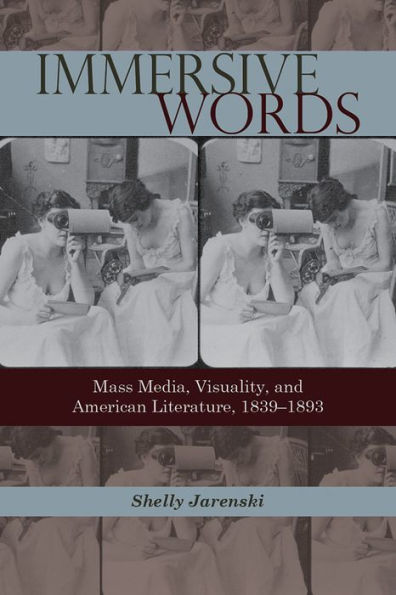
Immersive Words: Mass Media, Visuality, and American Literature, 1839-1893 in Franklin, TN
Current price: $54.95
Barnes and Noble
Immersive Words: Mass Media, Visuality, and American Literature, 1839-1893 in Franklin, TN
Current price: $54.95
Loading Inventory...
Size: Hardcover
In
Immersive Words
, Michelle Jarenski demonstrates that the contemporary challenge that visual images and virtual environments in cinema and photography, on the web, and in video games pose to reading and writing are not uniquely contemporary developments but equally exercised the imaginations, anxieties, and works of nineteenth-century authors.
The middle of the nineteenth century witnessed the emergence of numerous visual technologies and techniques: the daguerreotype, immersive exhibition spaces such as cycloramas and panoramas, mechanized tourism, and large-scale exhibitions and spectacles such as the World’s Fair. In closely argued chapters devoted to these four visual forms, Jarenski demonstrates that the popularity of these novelties catalyzed a shift by authors of the period beyond narratives that merely described images to ones that invoked aesthetic experiences.
Jarenski describes how Herman Melville adapts the aesthetic of the daguerreotype through his use of dramatic point-of-view and unexpected shifts that disorient readers. Frederick Douglass is shown to appropriate a panoramic aesthetic that severs spatial and temporal narratives from standard expectations. Jarenski traces how Nathaniel Hawthorne’s
The Marble Faun
found success as a travel guide to Rome, though intended as a work of serious fiction. Finally, Sarah Orne Jewett is shown to simulate the interactivity of the World Columbian Exposition to promote racialized and gendered forms of aesthetic communication. These techniques and strategies drawn from visual forms blur the just-so boundary critics and theorists have traditionally drawn between text and image.
In the mid-nineteenth century, the national identity of the United States remained fluid and hinged upon matters of gender, sexuality, and, crucially, race. Authors both reflected that evolving identity and contributed to its ongoing evolution. In demonstrating how the aesthetic and visual technologies of the nineteenth century changed the fundamental aesthetics of American literature, the importance of
goes far beyond literary criticism.
Immersive Words
, Michelle Jarenski demonstrates that the contemporary challenge that visual images and virtual environments in cinema and photography, on the web, and in video games pose to reading and writing are not uniquely contemporary developments but equally exercised the imaginations, anxieties, and works of nineteenth-century authors.
The middle of the nineteenth century witnessed the emergence of numerous visual technologies and techniques: the daguerreotype, immersive exhibition spaces such as cycloramas and panoramas, mechanized tourism, and large-scale exhibitions and spectacles such as the World’s Fair. In closely argued chapters devoted to these four visual forms, Jarenski demonstrates that the popularity of these novelties catalyzed a shift by authors of the period beyond narratives that merely described images to ones that invoked aesthetic experiences.
Jarenski describes how Herman Melville adapts the aesthetic of the daguerreotype through his use of dramatic point-of-view and unexpected shifts that disorient readers. Frederick Douglass is shown to appropriate a panoramic aesthetic that severs spatial and temporal narratives from standard expectations. Jarenski traces how Nathaniel Hawthorne’s
The Marble Faun
found success as a travel guide to Rome, though intended as a work of serious fiction. Finally, Sarah Orne Jewett is shown to simulate the interactivity of the World Columbian Exposition to promote racialized and gendered forms of aesthetic communication. These techniques and strategies drawn from visual forms blur the just-so boundary critics and theorists have traditionally drawn between text and image.
In the mid-nineteenth century, the national identity of the United States remained fluid and hinged upon matters of gender, sexuality, and, crucially, race. Authors both reflected that evolving identity and contributed to its ongoing evolution. In demonstrating how the aesthetic and visual technologies of the nineteenth century changed the fundamental aesthetics of American literature, the importance of
goes far beyond literary criticism.
In
Immersive Words
, Michelle Jarenski demonstrates that the contemporary challenge that visual images and virtual environments in cinema and photography, on the web, and in video games pose to reading and writing are not uniquely contemporary developments but equally exercised the imaginations, anxieties, and works of nineteenth-century authors.
The middle of the nineteenth century witnessed the emergence of numerous visual technologies and techniques: the daguerreotype, immersive exhibition spaces such as cycloramas and panoramas, mechanized tourism, and large-scale exhibitions and spectacles such as the World’s Fair. In closely argued chapters devoted to these four visual forms, Jarenski demonstrates that the popularity of these novelties catalyzed a shift by authors of the period beyond narratives that merely described images to ones that invoked aesthetic experiences.
Jarenski describes how Herman Melville adapts the aesthetic of the daguerreotype through his use of dramatic point-of-view and unexpected shifts that disorient readers. Frederick Douglass is shown to appropriate a panoramic aesthetic that severs spatial and temporal narratives from standard expectations. Jarenski traces how Nathaniel Hawthorne’s
The Marble Faun
found success as a travel guide to Rome, though intended as a work of serious fiction. Finally, Sarah Orne Jewett is shown to simulate the interactivity of the World Columbian Exposition to promote racialized and gendered forms of aesthetic communication. These techniques and strategies drawn from visual forms blur the just-so boundary critics and theorists have traditionally drawn between text and image.
In the mid-nineteenth century, the national identity of the United States remained fluid and hinged upon matters of gender, sexuality, and, crucially, race. Authors both reflected that evolving identity and contributed to its ongoing evolution. In demonstrating how the aesthetic and visual technologies of the nineteenth century changed the fundamental aesthetics of American literature, the importance of
goes far beyond literary criticism.
Immersive Words
, Michelle Jarenski demonstrates that the contemporary challenge that visual images and virtual environments in cinema and photography, on the web, and in video games pose to reading and writing are not uniquely contemporary developments but equally exercised the imaginations, anxieties, and works of nineteenth-century authors.
The middle of the nineteenth century witnessed the emergence of numerous visual technologies and techniques: the daguerreotype, immersive exhibition spaces such as cycloramas and panoramas, mechanized tourism, and large-scale exhibitions and spectacles such as the World’s Fair. In closely argued chapters devoted to these four visual forms, Jarenski demonstrates that the popularity of these novelties catalyzed a shift by authors of the period beyond narratives that merely described images to ones that invoked aesthetic experiences.
Jarenski describes how Herman Melville adapts the aesthetic of the daguerreotype through his use of dramatic point-of-view and unexpected shifts that disorient readers. Frederick Douglass is shown to appropriate a panoramic aesthetic that severs spatial and temporal narratives from standard expectations. Jarenski traces how Nathaniel Hawthorne’s
The Marble Faun
found success as a travel guide to Rome, though intended as a work of serious fiction. Finally, Sarah Orne Jewett is shown to simulate the interactivity of the World Columbian Exposition to promote racialized and gendered forms of aesthetic communication. These techniques and strategies drawn from visual forms blur the just-so boundary critics and theorists have traditionally drawn between text and image.
In the mid-nineteenth century, the national identity of the United States remained fluid and hinged upon matters of gender, sexuality, and, crucially, race. Authors both reflected that evolving identity and contributed to its ongoing evolution. In demonstrating how the aesthetic and visual technologies of the nineteenth century changed the fundamental aesthetics of American literature, the importance of
goes far beyond literary criticism.
You May Also Like








More About Barnes and Noble at CoolSprings Galleria
Barnes & Noble is the world’s largest retail bookseller and a leading retailer of content, digital media and educational products. Our Nook Digital business offers a lineup of NOOK® tablets and e-Readers and an expansive collection of digital reading content through the NOOK Store®. Barnes & Noble’s mission is to operate the best omni-channel specialty retail business in America, helping both our customers and booksellers reach their aspirations, while being a credit to the communities we serve.
1800 Galleria Blvd #1310, Franklin, TN 37067, United States
Find Barnes and Noble at CoolSprings Galleria in Franklin, TN
Visit Barnes and Noble at CoolSprings Galleria in Franklin, TN