
Home
Letters of Fire: Thirteenth Regiment West Virginia Infantry Volunteers Beyond God's Country the 4th Year War January-July 1864
Barnes and Noble
Loading Inventory...
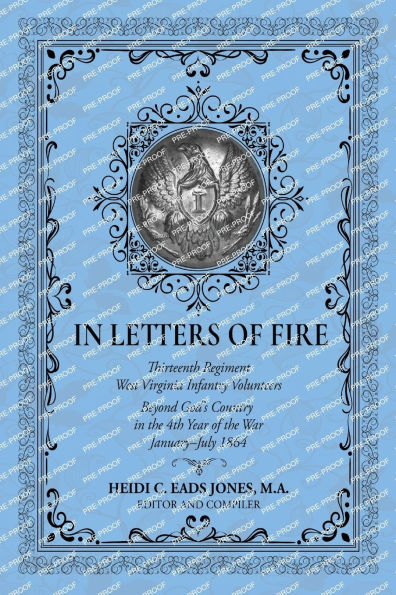
Letters of Fire: Thirteenth Regiment West Virginia Infantry Volunteers Beyond God's Country the 4th Year War January-July 1864 in Franklin, TN
Current price: $45.95
Barnes and Noble
Letters of Fire: Thirteenth Regiment West Virginia Infantry Volunteers Beyond God's Country the 4th Year War January-July 1864 in Franklin, TN
Current price: $45.95
Loading Inventory...
Size: Hardcover
January 1864 came with arctic severity. The soldiers of the detached companies of the 13
th
West Virginia Infantry Regiment were charged with holding and clearing troublesome areas on the very edge of the Union lines then flung across Northwestern Virginia. They struggled to survive and execute orders in the inclement weather and rough terrain. Indeed, it was a surprisingly busy season of duty given the cold and icy conditions. Finally, pursuant to plans set out by Lieutenant-General Ulysses Grant, commanding the United States Army, the 13
West Virginia with her sister regiments in the Kanawha Division were unified and cut loose from garrison and guerilla duties to play a pivotal role in the great campaigns of Summer 1864. The Kanawha Division and Grant's four other great armies marched out simultaneously to converge upon the enemy and his resources. The 13
West Virginia strode out beyond what the men called 'God's Country' to raid into the Southland. It was a grueling strike following the rail lines to Staunton, Lexington and Lynchburg that would take them twice over the forbidding Allegheny Mountains. It was uniformly considered by all those who marched it-the hardest campaign of the war beggaring all description.
th
West Virginia Infantry Regiment were charged with holding and clearing troublesome areas on the very edge of the Union lines then flung across Northwestern Virginia. They struggled to survive and execute orders in the inclement weather and rough terrain. Indeed, it was a surprisingly busy season of duty given the cold and icy conditions. Finally, pursuant to plans set out by Lieutenant-General Ulysses Grant, commanding the United States Army, the 13
West Virginia with her sister regiments in the Kanawha Division were unified and cut loose from garrison and guerilla duties to play a pivotal role in the great campaigns of Summer 1864. The Kanawha Division and Grant's four other great armies marched out simultaneously to converge upon the enemy and his resources. The 13
West Virginia strode out beyond what the men called 'God's Country' to raid into the Southland. It was a grueling strike following the rail lines to Staunton, Lexington and Lynchburg that would take them twice over the forbidding Allegheny Mountains. It was uniformly considered by all those who marched it-the hardest campaign of the war beggaring all description.
January 1864 came with arctic severity. The soldiers of the detached companies of the 13
th
West Virginia Infantry Regiment were charged with holding and clearing troublesome areas on the very edge of the Union lines then flung across Northwestern Virginia. They struggled to survive and execute orders in the inclement weather and rough terrain. Indeed, it was a surprisingly busy season of duty given the cold and icy conditions. Finally, pursuant to plans set out by Lieutenant-General Ulysses Grant, commanding the United States Army, the 13
West Virginia with her sister regiments in the Kanawha Division were unified and cut loose from garrison and guerilla duties to play a pivotal role in the great campaigns of Summer 1864. The Kanawha Division and Grant's four other great armies marched out simultaneously to converge upon the enemy and his resources. The 13
West Virginia strode out beyond what the men called 'God's Country' to raid into the Southland. It was a grueling strike following the rail lines to Staunton, Lexington and Lynchburg that would take them twice over the forbidding Allegheny Mountains. It was uniformly considered by all those who marched it-the hardest campaign of the war beggaring all description.
th
West Virginia Infantry Regiment were charged with holding and clearing troublesome areas on the very edge of the Union lines then flung across Northwestern Virginia. They struggled to survive and execute orders in the inclement weather and rough terrain. Indeed, it was a surprisingly busy season of duty given the cold and icy conditions. Finally, pursuant to plans set out by Lieutenant-General Ulysses Grant, commanding the United States Army, the 13
West Virginia with her sister regiments in the Kanawha Division were unified and cut loose from garrison and guerilla duties to play a pivotal role in the great campaigns of Summer 1864. The Kanawha Division and Grant's four other great armies marched out simultaneously to converge upon the enemy and his resources. The 13
West Virginia strode out beyond what the men called 'God's Country' to raid into the Southland. It was a grueling strike following the rail lines to Staunton, Lexington and Lynchburg that would take them twice over the forbidding Allegheny Mountains. It was uniformly considered by all those who marched it-the hardest campaign of the war beggaring all description.
You May Also Like


















More About Barnes and Noble at CoolSprings Galleria
Barnes & Noble is the world’s largest retail bookseller and a leading retailer of content, digital media and educational products. Our Nook Digital business offers a lineup of NOOK® tablets and e-Readers and an expansive collection of digital reading content through the NOOK Store®. Barnes & Noble’s mission is to operate the best omni-channel specialty retail business in America, helping both our customers and booksellers reach their aspirations, while being a credit to the communities we serve.
1800 Galleria Blvd #1310, Franklin, TN 37067, United States
Find Barnes and Noble at CoolSprings Galleria in Franklin, TN
Visit Barnes and Noble at CoolSprings Galleria in Franklin, TN
