
Home
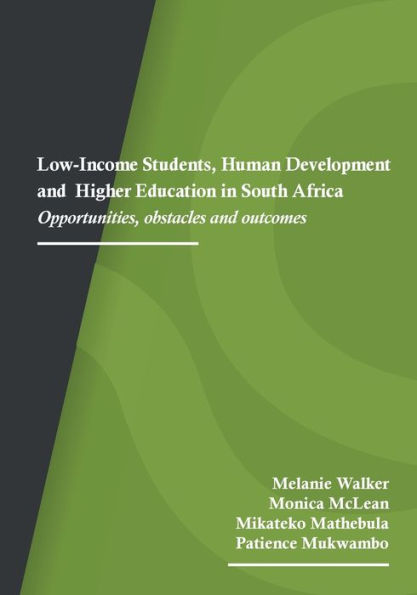
Low-Income Students, Human Development and Higher Education in South Africa: Opportunities, obstacles and outcomes
Barnes and Noble
Loading Inventory...
Low-Income Students, Human Development and Higher Education in South Africa: Opportunities, obstacles and outcomes in Franklin, TN
Current price: $62.37
Barnes and Noble
Low-Income Students, Human Development and Higher Education in South Africa: Opportunities, obstacles and outcomes in Franklin, TN
Current price: $62.37
Loading Inventory...
Size: OS
This book explores learning outcomes for low-income rural and township youth at five South African universities. The book is framed as a contribution to southern and Africa-centred scholarship, adapting Amartya Sen's capability approach and a framework of key concepts: capabilities, functionings, context, conversion factors, poverty and agency to investigate opportunities and obstacles to achieved student outcomes. This approach allows a reimagining of 'inclusive learning outcomes' to encompass the multi-dimensional value of a university education and a plurality of valued cognitive and non-cognitive outcomes for students from low-income backgrounds whose experiences are strongly shaped by hardship.
Based on capability theorising and student voices, the book proposes for policy and practice a set of contextual higher education capability domains and corresponding functionings orientated to more justice and more equality for each person to have the opportunities to be and to do what they have reason to value. The book concludes that sufficient material resources are necessary to get into university and flourish while there; the benefits of a university education should be rich and multi-dimensional so that they can result in functionings in all areas of life as well as work and future study; the inequalities and exclusion of the labour market and pathways to further study must be addressed by wider economic and social policies for 'inclusive learning outcomes' to be meaningful; and that universities ought to be doing more to enable black working-class students to participate and succeed.
Low-Income Students, Human Development and Higher Education in South Africa
makes an original contribution to capabilitarian scholarship: conceptually in theorising a South-based multi-dimensional student well-being higher education matrix and a rich reconceptualisation of learning outcomes, as well as empirically by conducting rigorous, longitudinal in-depth mixed-methods research on students' lives and experiences in higher education in South Africa. The audience for the book includes higher education researchers, international capabilitarian scholars, practitioners and policy-makers.
Based on capability theorising and student voices, the book proposes for policy and practice a set of contextual higher education capability domains and corresponding functionings orientated to more justice and more equality for each person to have the opportunities to be and to do what they have reason to value. The book concludes that sufficient material resources are necessary to get into university and flourish while there; the benefits of a university education should be rich and multi-dimensional so that they can result in functionings in all areas of life as well as work and future study; the inequalities and exclusion of the labour market and pathways to further study must be addressed by wider economic and social policies for 'inclusive learning outcomes' to be meaningful; and that universities ought to be doing more to enable black working-class students to participate and succeed.
Low-Income Students, Human Development and Higher Education in South Africa
makes an original contribution to capabilitarian scholarship: conceptually in theorising a South-based multi-dimensional student well-being higher education matrix and a rich reconceptualisation of learning outcomes, as well as empirically by conducting rigorous, longitudinal in-depth mixed-methods research on students' lives and experiences in higher education in South Africa. The audience for the book includes higher education researchers, international capabilitarian scholars, practitioners and policy-makers.
This book explores learning outcomes for low-income rural and township youth at five South African universities. The book is framed as a contribution to southern and Africa-centred scholarship, adapting Amartya Sen's capability approach and a framework of key concepts: capabilities, functionings, context, conversion factors, poverty and agency to investigate opportunities and obstacles to achieved student outcomes. This approach allows a reimagining of 'inclusive learning outcomes' to encompass the multi-dimensional value of a university education and a plurality of valued cognitive and non-cognitive outcomes for students from low-income backgrounds whose experiences are strongly shaped by hardship.
Based on capability theorising and student voices, the book proposes for policy and practice a set of contextual higher education capability domains and corresponding functionings orientated to more justice and more equality for each person to have the opportunities to be and to do what they have reason to value. The book concludes that sufficient material resources are necessary to get into university and flourish while there; the benefits of a university education should be rich and multi-dimensional so that they can result in functionings in all areas of life as well as work and future study; the inequalities and exclusion of the labour market and pathways to further study must be addressed by wider economic and social policies for 'inclusive learning outcomes' to be meaningful; and that universities ought to be doing more to enable black working-class students to participate and succeed.
Low-Income Students, Human Development and Higher Education in South Africa
makes an original contribution to capabilitarian scholarship: conceptually in theorising a South-based multi-dimensional student well-being higher education matrix and a rich reconceptualisation of learning outcomes, as well as empirically by conducting rigorous, longitudinal in-depth mixed-methods research on students' lives and experiences in higher education in South Africa. The audience for the book includes higher education researchers, international capabilitarian scholars, practitioners and policy-makers.
Based on capability theorising and student voices, the book proposes for policy and practice a set of contextual higher education capability domains and corresponding functionings orientated to more justice and more equality for each person to have the opportunities to be and to do what they have reason to value. The book concludes that sufficient material resources are necessary to get into university and flourish while there; the benefits of a university education should be rich and multi-dimensional so that they can result in functionings in all areas of life as well as work and future study; the inequalities and exclusion of the labour market and pathways to further study must be addressed by wider economic and social policies for 'inclusive learning outcomes' to be meaningful; and that universities ought to be doing more to enable black working-class students to participate and succeed.
Low-Income Students, Human Development and Higher Education in South Africa
makes an original contribution to capabilitarian scholarship: conceptually in theorising a South-based multi-dimensional student well-being higher education matrix and a rich reconceptualisation of learning outcomes, as well as empirically by conducting rigorous, longitudinal in-depth mixed-methods research on students' lives and experiences in higher education in South Africa. The audience for the book includes higher education researchers, international capabilitarian scholars, practitioners and policy-makers.
You May Also Like







More About Barnes and Noble at CoolSprings Galleria
Barnes & Noble is the world’s largest retail bookseller and a leading retailer of content, digital media and educational products. Our Nook Digital business offers a lineup of NOOK® tablets and e-Readers and an expansive collection of digital reading content through the NOOK Store®. Barnes & Noble’s mission is to operate the best omni-channel specialty retail business in America, helping both our customers and booksellers reach their aspirations, while being a credit to the communities we serve.
1800 Galleria Blvd #1310, Franklin, TN 37067, United States
Find Barnes and Noble at CoolSprings Galleria in Franklin, TN
Visit Barnes and Noble at CoolSprings Galleria in Franklin, TN
