
Home
Luke in Codex Bezae: A Jewish Approach to Interpreting the Bible in the Gospel of Luke
Barnes and Noble
Loading Inventory...
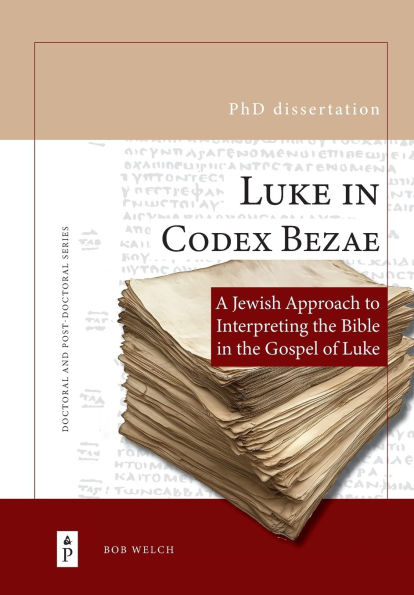
Luke in Codex Bezae: A Jewish Approach to Interpreting the Bible in the Gospel of Luke in Franklin, TN
Current price: $58.99
Barnes and Noble
Luke in Codex Bezae: A Jewish Approach to Interpreting the Bible in the Gospel of Luke in Franklin, TN
Current price: $58.99
Loading Inventory...
Size: OS
Luke in Codex Bezae: A Jewish Approach to Interpreting the Bible in the Gospel of Luke is an analysis of Jewish hermeneutics used in the NT especially a pattern of redactional doublets within the early 5th CE Greek-Latin bilingual New Testament manuscript of Codex Bezae (D), specifically in the Gospel of Luke. Seven doublets, as well as other very interesting variants, are examined in comparison with Codex Vaticanus (B). As background, the aspects of possible harmonization, prophetical interpretation during the Second Temple Period, intertextuality/internarrativity and use of the Elijah/Elisha motif, and presumably with Jewish rabbinical hermeneutics, support the conclusion that these patterns align in proof of argument for Luke's Jewish background and are representative of the author/redactor's controlling hermeneutic. The conclusions of this study reveal that this pattern is prophetical/affirmational in agreement with the aforementioned methodology during the period of the exemplar.
Luke in Codex Bezae: A Jewish Approach to Interpreting the Bible in the Gospel of Luke is an analysis of Jewish hermeneutics used in the NT especially a pattern of redactional doublets within the early 5th CE Greek-Latin bilingual New Testament manuscript of Codex Bezae (D), specifically in the Gospel of Luke. Seven doublets, as well as other very interesting variants, are examined in comparison with Codex Vaticanus (B). As background, the aspects of possible harmonization, prophetical interpretation during the Second Temple Period, intertextuality/internarrativity and use of the Elijah/Elisha motif, and presumably with Jewish rabbinical hermeneutics, support the conclusion that these patterns align in proof of argument for Luke's Jewish background and are representative of the author/redactor's controlling hermeneutic. The conclusions of this study reveal that this pattern is prophetical/affirmational in agreement with the aforementioned methodology during the period of the exemplar.
You May Also Like

















More About Barnes and Noble at CoolSprings Galleria
Barnes & Noble is the world’s largest retail bookseller and a leading retailer of content, digital media and educational products. Our Nook Digital business offers a lineup of NOOK® tablets and e-Readers and an expansive collection of digital reading content through the NOOK Store®. Barnes & Noble’s mission is to operate the best omni-channel specialty retail business in America, helping both our customers and booksellers reach their aspirations, while being a credit to the communities we serve.
1800 Galleria Blvd #1310, Franklin, TN 37067, United States
Find Barnes and Noble at CoolSprings Galleria in Franklin, TN
Visit Barnes and Noble at CoolSprings Galleria in Franklin, TN
