
Home
Moving the Chains: Civil Rights Protest That Saved Saints and Transformed New Orleans
Barnes and Noble
Loading Inventory...
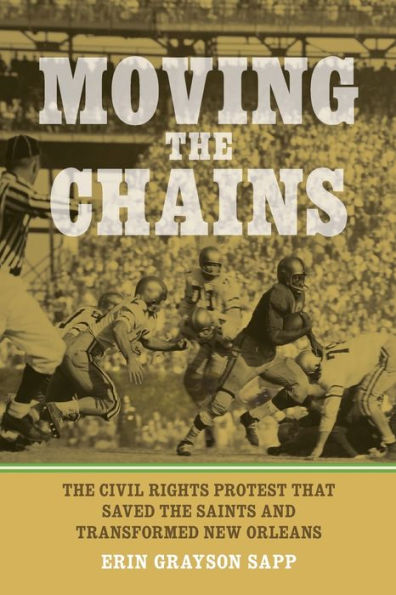
Moving the Chains: Civil Rights Protest That Saved Saints and Transformed New Orleans in Franklin, TN
Current price: $34.95
Barnes and Noble
Moving the Chains: Civil Rights Protest That Saved Saints and Transformed New Orleans in Franklin, TN
Current price: $34.95
Loading Inventory...
Size: Paperback
We remember the 1966 birth of the New Orleans Saints as a shady quid pro quo between the NFL commissioner and a Louisiana congressman.
Moving the Chains
is the untold story of the athlete protest that necessitated this backroom deal, as New Orleans scrambled to respond to a very public repudiation of the racist policies that governed the city.
In the decade that preceded the 1965 athlete walkout, a reactionary backlash had swept through Louisiana, bringing with it a host of new segregation laws and enough social strongarming to quash any complaints, even from suffering sports promoters. Nationwide protests had assailed the Tulane Green Wave, the Sugar Bowl, and the AFL’s preseason stopoffs, and only legal loopholes and a lot of luck kept football alive in the city.
Still, live it did, and in January 1965, locals believed they were just a week away from landing their own pro franchise. All they had to do was pack Tulane Stadium for the city’s biggest audition yet, the AFL AllStar game. Ultimately, all fiftyeight Black and white teammates walked out of the game to protest the town’s lingering segregation practices and public abuse of Black players. Following that, love of the gridiron prompted and excused something out of sync with the city’s branding: change. In less than two years, the Big Easy made enough progress to pass a blitz inspection by Black and white NFL officials and receive the longdesired expansion team.
The story of the athletes whose bravery led to change quickly fell by the wayside. Locals framed desegregation efforts as proof that the town had been progressive and tolerant all along. Furthermore, when a handshake between Pete Rozelle and Hale Boggs gave America its first Super Bowl and New Orleans its own club, the city proudly clung to that version of events, never admitting the cleanup even took place. As a result,
is the first book to reveal the ramifications of the AllStars’ civil resistance and to detail the Saints’ true first win.
Moving the Chains
is the untold story of the athlete protest that necessitated this backroom deal, as New Orleans scrambled to respond to a very public repudiation of the racist policies that governed the city.
In the decade that preceded the 1965 athlete walkout, a reactionary backlash had swept through Louisiana, bringing with it a host of new segregation laws and enough social strongarming to quash any complaints, even from suffering sports promoters. Nationwide protests had assailed the Tulane Green Wave, the Sugar Bowl, and the AFL’s preseason stopoffs, and only legal loopholes and a lot of luck kept football alive in the city.
Still, live it did, and in January 1965, locals believed they were just a week away from landing their own pro franchise. All they had to do was pack Tulane Stadium for the city’s biggest audition yet, the AFL AllStar game. Ultimately, all fiftyeight Black and white teammates walked out of the game to protest the town’s lingering segregation practices and public abuse of Black players. Following that, love of the gridiron prompted and excused something out of sync with the city’s branding: change. In less than two years, the Big Easy made enough progress to pass a blitz inspection by Black and white NFL officials and receive the longdesired expansion team.
The story of the athletes whose bravery led to change quickly fell by the wayside. Locals framed desegregation efforts as proof that the town had been progressive and tolerant all along. Furthermore, when a handshake between Pete Rozelle and Hale Boggs gave America its first Super Bowl and New Orleans its own club, the city proudly clung to that version of events, never admitting the cleanup even took place. As a result,
is the first book to reveal the ramifications of the AllStars’ civil resistance and to detail the Saints’ true first win.
We remember the 1966 birth of the New Orleans Saints as a shady quid pro quo between the NFL commissioner and a Louisiana congressman.
Moving the Chains
is the untold story of the athlete protest that necessitated this backroom deal, as New Orleans scrambled to respond to a very public repudiation of the racist policies that governed the city.
In the decade that preceded the 1965 athlete walkout, a reactionary backlash had swept through Louisiana, bringing with it a host of new segregation laws and enough social strongarming to quash any complaints, even from suffering sports promoters. Nationwide protests had assailed the Tulane Green Wave, the Sugar Bowl, and the AFL’s preseason stopoffs, and only legal loopholes and a lot of luck kept football alive in the city.
Still, live it did, and in January 1965, locals believed they were just a week away from landing their own pro franchise. All they had to do was pack Tulane Stadium for the city’s biggest audition yet, the AFL AllStar game. Ultimately, all fiftyeight Black and white teammates walked out of the game to protest the town’s lingering segregation practices and public abuse of Black players. Following that, love of the gridiron prompted and excused something out of sync with the city’s branding: change. In less than two years, the Big Easy made enough progress to pass a blitz inspection by Black and white NFL officials and receive the longdesired expansion team.
The story of the athletes whose bravery led to change quickly fell by the wayside. Locals framed desegregation efforts as proof that the town had been progressive and tolerant all along. Furthermore, when a handshake between Pete Rozelle and Hale Boggs gave America its first Super Bowl and New Orleans its own club, the city proudly clung to that version of events, never admitting the cleanup even took place. As a result,
is the first book to reveal the ramifications of the AllStars’ civil resistance and to detail the Saints’ true first win.
Moving the Chains
is the untold story of the athlete protest that necessitated this backroom deal, as New Orleans scrambled to respond to a very public repudiation of the racist policies that governed the city.
In the decade that preceded the 1965 athlete walkout, a reactionary backlash had swept through Louisiana, bringing with it a host of new segregation laws and enough social strongarming to quash any complaints, even from suffering sports promoters. Nationwide protests had assailed the Tulane Green Wave, the Sugar Bowl, and the AFL’s preseason stopoffs, and only legal loopholes and a lot of luck kept football alive in the city.
Still, live it did, and in January 1965, locals believed they were just a week away from landing their own pro franchise. All they had to do was pack Tulane Stadium for the city’s biggest audition yet, the AFL AllStar game. Ultimately, all fiftyeight Black and white teammates walked out of the game to protest the town’s lingering segregation practices and public abuse of Black players. Following that, love of the gridiron prompted and excused something out of sync with the city’s branding: change. In less than two years, the Big Easy made enough progress to pass a blitz inspection by Black and white NFL officials and receive the longdesired expansion team.
The story of the athletes whose bravery led to change quickly fell by the wayside. Locals framed desegregation efforts as proof that the town had been progressive and tolerant all along. Furthermore, when a handshake between Pete Rozelle and Hale Boggs gave America its first Super Bowl and New Orleans its own club, the city proudly clung to that version of events, never admitting the cleanup even took place. As a result,
is the first book to reveal the ramifications of the AllStars’ civil resistance and to detail the Saints’ true first win.
You May Also Like









More About Barnes and Noble at CoolSprings Galleria
Barnes & Noble is the world’s largest retail bookseller and a leading retailer of content, digital media and educational products. Our Nook Digital business offers a lineup of NOOK® tablets and e-Readers and an expansive collection of digital reading content through the NOOK Store®. Barnes & Noble’s mission is to operate the best omni-channel specialty retail business in America, helping both our customers and booksellers reach their aspirations, while being a credit to the communities we serve.
1800 Galleria Blvd #1310, Franklin, TN 37067, United States
Find Barnes and Noble at CoolSprings Galleria in Franklin, TN
Visit Barnes and Noble at CoolSprings Galleria in Franklin, TN
