
Home
Nothing Too Beautiful for the Gods: Altars and Contemporary Creation
Barnes and Noble
Loading Inventory...
Nothing Too Beautiful for the Gods: Altars and Contemporary Creation in Franklin, TN
Current price: $42.00
Barnes and Noble
Nothing Too Beautiful for the Gods: Altars and Contemporary Creation in Franklin, TN
Current price: $42.00
Loading Inventory...
Size: OS
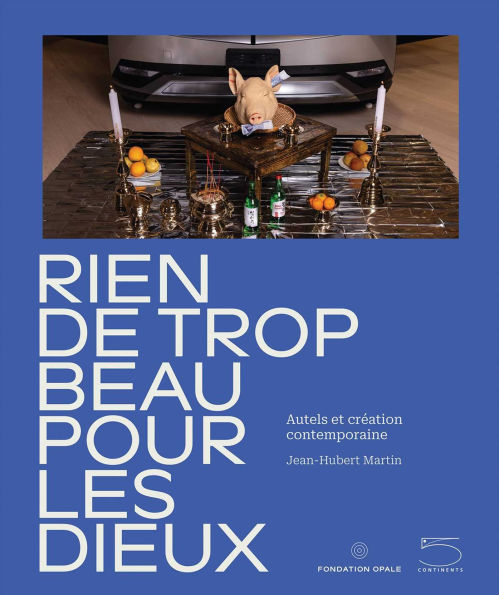
This book argues that globalisation challenges the Western idea of art and explores how different cultures express spirituality through art. Text in English and French.
Globalization has forced us to stop thinking that art only exists in the West. The very notion of art was invented by the West and refers to the learned version of its material culture. It was then projected onto other civilizations, particularly Asian ones, and finally onto the preliterate societies of Africa and Oceania.
Whether or not these cultures possess the concept of art is of little importance, because when they honor their gods, they inevitably address what they consider to be the acme of beauty. For a long time, this openness to other aesthetics was based on the arts of the past, until it was finally accepted that there were living creators in these distant lands, and that today’s means of communication have brought them closer to us.
These “others” who appeared in the 1980s are by no means a homogenous group. Without stretching this analysis too far, they can be regarded as falling into two categories: those who have opted for modernity and submit to the demands of the market and Western based institutions, and those who concentrate on giving visual expression to their communities and beliefs, ignoring the demands of the art market. Australian Aboriginal art represents an intermediate situation, since alongside art of a sacred nature, there are works deliberately produced for sale, initially encouraged by missionaries.
Nothing Too Beautiful for the Gods
aims to show the variety of works connected with the spiritual impulse, from those used in religious rites to contemporary artworks that refer to them. These hybrid works are often the result of accommodations with modernity. The exhibition and accompanying book bring together altars from Africa, the Caribbean and Asia, works by artists invested with religious responsibilities (Didi, Shiraga), works by religious artists (Ramoun) and others by artists who refer explicitly to religions and spirituality (Sooja Kim, El Anatsui, Vasquez de la Horra, Bedia, Boltanski, Viola).
Text in English and French.
Globalization has forced us to stop thinking that art only exists in the West. The very notion of art was invented by the West and refers to the learned version of its material culture. It was then projected onto other civilizations, particularly Asian ones, and finally onto the preliterate societies of Africa and Oceania.
Whether or not these cultures possess the concept of art is of little importance, because when they honor their gods, they inevitably address what they consider to be the acme of beauty. For a long time, this openness to other aesthetics was based on the arts of the past, until it was finally accepted that there were living creators in these distant lands, and that today’s means of communication have brought them closer to us.
These “others” who appeared in the 1980s are by no means a homogenous group. Without stretching this analysis too far, they can be regarded as falling into two categories: those who have opted for modernity and submit to the demands of the market and Western based institutions, and those who concentrate on giving visual expression to their communities and beliefs, ignoring the demands of the art market. Australian Aboriginal art represents an intermediate situation, since alongside art of a sacred nature, there are works deliberately produced for sale, initially encouraged by missionaries.
Nothing Too Beautiful for the Gods
aims to show the variety of works connected with the spiritual impulse, from those used in religious rites to contemporary artworks that refer to them. These hybrid works are often the result of accommodations with modernity. The exhibition and accompanying book bring together altars from Africa, the Caribbean and Asia, works by artists invested with religious responsibilities (Didi, Shiraga), works by religious artists (Ramoun) and others by artists who refer explicitly to religions and spirituality (Sooja Kim, El Anatsui, Vasquez de la Horra, Bedia, Boltanski, Viola).
Text in English and French.
This book argues that globalisation challenges the Western idea of art and explores how different cultures express spirituality through art. Text in English and French.
Globalization has forced us to stop thinking that art only exists in the West. The very notion of art was invented by the West and refers to the learned version of its material culture. It was then projected onto other civilizations, particularly Asian ones, and finally onto the preliterate societies of Africa and Oceania.
Whether or not these cultures possess the concept of art is of little importance, because when they honor their gods, they inevitably address what they consider to be the acme of beauty. For a long time, this openness to other aesthetics was based on the arts of the past, until it was finally accepted that there were living creators in these distant lands, and that today’s means of communication have brought them closer to us.
These “others” who appeared in the 1980s are by no means a homogenous group. Without stretching this analysis too far, they can be regarded as falling into two categories: those who have opted for modernity and submit to the demands of the market and Western based institutions, and those who concentrate on giving visual expression to their communities and beliefs, ignoring the demands of the art market. Australian Aboriginal art represents an intermediate situation, since alongside art of a sacred nature, there are works deliberately produced for sale, initially encouraged by missionaries.
Nothing Too Beautiful for the Gods
aims to show the variety of works connected with the spiritual impulse, from those used in religious rites to contemporary artworks that refer to them. These hybrid works are often the result of accommodations with modernity. The exhibition and accompanying book bring together altars from Africa, the Caribbean and Asia, works by artists invested with religious responsibilities (Didi, Shiraga), works by religious artists (Ramoun) and others by artists who refer explicitly to religions and spirituality (Sooja Kim, El Anatsui, Vasquez de la Horra, Bedia, Boltanski, Viola).
Text in English and French.
Globalization has forced us to stop thinking that art only exists in the West. The very notion of art was invented by the West and refers to the learned version of its material culture. It was then projected onto other civilizations, particularly Asian ones, and finally onto the preliterate societies of Africa and Oceania.
Whether or not these cultures possess the concept of art is of little importance, because when they honor their gods, they inevitably address what they consider to be the acme of beauty. For a long time, this openness to other aesthetics was based on the arts of the past, until it was finally accepted that there were living creators in these distant lands, and that today’s means of communication have brought them closer to us.
These “others” who appeared in the 1980s are by no means a homogenous group. Without stretching this analysis too far, they can be regarded as falling into two categories: those who have opted for modernity and submit to the demands of the market and Western based institutions, and those who concentrate on giving visual expression to their communities and beliefs, ignoring the demands of the art market. Australian Aboriginal art represents an intermediate situation, since alongside art of a sacred nature, there are works deliberately produced for sale, initially encouraged by missionaries.
Nothing Too Beautiful for the Gods
aims to show the variety of works connected with the spiritual impulse, from those used in religious rites to contemporary artworks that refer to them. These hybrid works are often the result of accommodations with modernity. The exhibition and accompanying book bring together altars from Africa, the Caribbean and Asia, works by artists invested with religious responsibilities (Didi, Shiraga), works by religious artists (Ramoun) and others by artists who refer explicitly to religions and spirituality (Sooja Kim, El Anatsui, Vasquez de la Horra, Bedia, Boltanski, Viola).
Text in English and French.
You May Also Like










More About Barnes and Noble at CoolSprings Galleria
Barnes & Noble is the world’s largest retail bookseller and a leading retailer of content, digital media and educational products. Our Nook Digital business offers a lineup of NOOK® tablets and e-Readers and an expansive collection of digital reading content through the NOOK Store®. Barnes & Noble’s mission is to operate the best omni-channel specialty retail business in America, helping both our customers and booksellers reach their aspirations, while being a credit to the communities we serve.
1800 Galleria Blvd #1310, Franklin, TN 37067, United States
Find Barnes and Noble at CoolSprings Galleria in Franklin, TN
Visit Barnes and Noble at CoolSprings Galleria in Franklin, TN
