
Home
Passing On: Kinship and Inheritance England
Barnes and Noble
Loading Inventory...
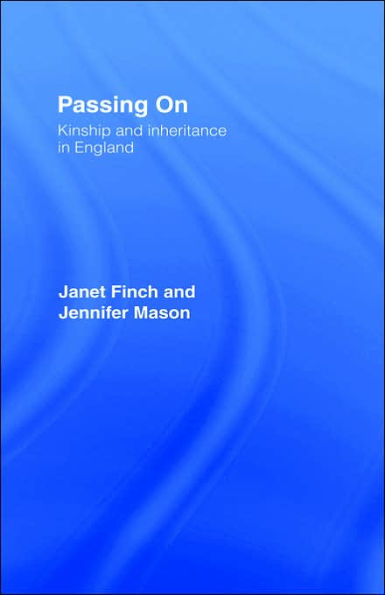
Passing On: Kinship and Inheritance England in Franklin, TN
Current price: $190.00
Barnes and Noble
Passing On: Kinship and Inheritance England in Franklin, TN
Current price: $190.00
Loading Inventory...
Size: Hardcover
Inheritance, once the preserve of the propertied upper classes, has become a much more common experience. Many more people now than in the past have something of material value to bequeath when they die, mainly because of the spread of home ownership during the second half of the twentieth century.
Passing On
examines what these changes can tell us about kinship in England, through a study of how contemporary families handle inheritance.
Based on the findings of a major research project into inheritance and kinship,
examines how it is transmitted, 'who gets what' and the meaning this has for individuals and families. The authors argue that we should understand English kinship as a set of relational practices which are flexible and variable, rather than as a rigid structure or system. Inheritance is characterised more by symbolic practices and moral reasoning than by materialism.
Of interest to lecturers and students of sociology, anthropology, social policy, law and gender studies,
is also of considerable interest to those seeking to understand changing forms of kinship and ownership, especially researchers, policy makers and legal practitioners.
Passing On
examines what these changes can tell us about kinship in England, through a study of how contemporary families handle inheritance.
Based on the findings of a major research project into inheritance and kinship,
examines how it is transmitted, 'who gets what' and the meaning this has for individuals and families. The authors argue that we should understand English kinship as a set of relational practices which are flexible and variable, rather than as a rigid structure or system. Inheritance is characterised more by symbolic practices and moral reasoning than by materialism.
Of interest to lecturers and students of sociology, anthropology, social policy, law and gender studies,
is also of considerable interest to those seeking to understand changing forms of kinship and ownership, especially researchers, policy makers and legal practitioners.
Inheritance, once the preserve of the propertied upper classes, has become a much more common experience. Many more people now than in the past have something of material value to bequeath when they die, mainly because of the spread of home ownership during the second half of the twentieth century.
Passing On
examines what these changes can tell us about kinship in England, through a study of how contemporary families handle inheritance.
Based on the findings of a major research project into inheritance and kinship,
examines how it is transmitted, 'who gets what' and the meaning this has for individuals and families. The authors argue that we should understand English kinship as a set of relational practices which are flexible and variable, rather than as a rigid structure or system. Inheritance is characterised more by symbolic practices and moral reasoning than by materialism.
Of interest to lecturers and students of sociology, anthropology, social policy, law and gender studies,
is also of considerable interest to those seeking to understand changing forms of kinship and ownership, especially researchers, policy makers and legal practitioners.
Passing On
examines what these changes can tell us about kinship in England, through a study of how contemporary families handle inheritance.
Based on the findings of a major research project into inheritance and kinship,
examines how it is transmitted, 'who gets what' and the meaning this has for individuals and families. The authors argue that we should understand English kinship as a set of relational practices which are flexible and variable, rather than as a rigid structure or system. Inheritance is characterised more by symbolic practices and moral reasoning than by materialism.
Of interest to lecturers and students of sociology, anthropology, social policy, law and gender studies,
is also of considerable interest to those seeking to understand changing forms of kinship and ownership, especially researchers, policy makers and legal practitioners.
You May Also Like











More About Barnes and Noble at CoolSprings Galleria
Barnes & Noble is the world’s largest retail bookseller and a leading retailer of content, digital media and educational products. Our Nook Digital business offers a lineup of NOOK® tablets and e-Readers and an expansive collection of digital reading content through the NOOK Store®. Barnes & Noble’s mission is to operate the best omni-channel specialty retail business in America, helping both our customers and booksellers reach their aspirations, while being a credit to the communities we serve.
1800 Galleria Blvd #1310, Franklin, TN 37067, United States
Find Barnes and Noble at CoolSprings Galleria in Franklin, TN
Visit Barnes and Noble at CoolSprings Galleria in Franklin, TN
