
Home
Place, Productivity, and Prosperity: Revisiting Spatially Targeted Policies for Regional Development
Barnes and Noble
Loading Inventory...
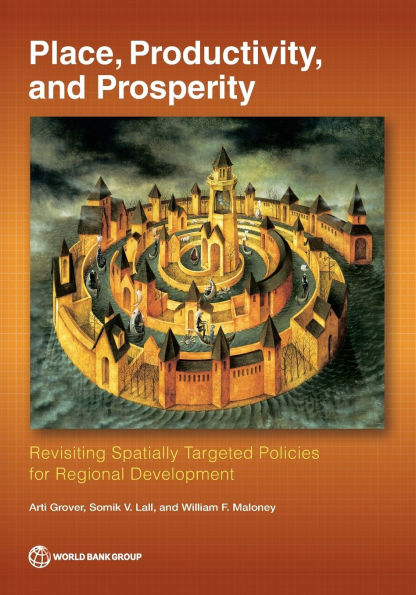
Place, Productivity, and Prosperity: Revisiting Spatially Targeted Policies for Regional Development in Franklin, TN
Current price: $48.50
Barnes and Noble
Place, Productivity, and Prosperity: Revisiting Spatially Targeted Policies for Regional Development in Franklin, TN
Current price: $48.50
Loading Inventory...
Size: Paperback
Place matters for productivity and prosperity. Myriad factors support a successful place, including not only the hard infrastructure such as roads, but also the softer elements such as worker skills, entrepreneurial ability, and well-functioning institutions. History suggests that prosperous places tend to persist, while “left-behind” regions—or those hurt by climatic, technological, or commercial shocks—struggle to catch up. This division gives rise to demands to “do something” about the subsequent spatial inequality. Such pressures often result in costly spatially targeted policies with disappointing outcomes because of a lack of analysis of the underlying barriers to growth and structural transformation and a fair appraisal of the possibility of overcoming them. The latest volume of the World Bank Productivity Project series, Place, Productivity, and Prosperity: Revisiting Spatially Targeted Policies for Regional Development makes three broad contributions. First, it provides new analytical and empirical insights into the three drivers of economic geography—agglomeration economies, migration, and distance—and the way in which these drivers interact. Second, it argues that these forces are playing out differently in developing countries than they have in advanced economies: urbanization is not accompanied by structural transformation, leaving cities crowded and accruing all the negative aspects of urbanization without being concentrated productively. Long-term amelioration of poverty in lagging regions requires advancing the overall national agenda of structural change and productivity growth. Third, it provides a heuristic framework with which to inform policy makers’ assessments of place-based policy proposals, helping them identify the regions where policy is likely to have an impact and those that would remain nonviable. The framework enables governments to clarify the implications of various policy options; to think critically about design priorities, including necessary complementary policies; and to navigate the implementation challenges. “This is an extremely welcome book. Three experts lay out the principles behind spatially targeted policy and the experience of countries using such policies. A must-read for anyone interested in spatial inequality and policy to address it.” Anthony J. Venables Professor of Economics, University of Manchester, and Research Director, The Productivity Institute “Delivering better livelihoods for all requires tapping into the economic potential of every place, including those losing out or lagging behind. This, however, cannot be done effectively without a sound theoretical and empirical framework. Place, Productivity, and Prosperity is the right book to look for such a framework.” Andrés Rodríguez-Pose Princesa de Asturias Chair and Professor of Economic Geography, London School of Economics
Place matters for productivity and prosperity. Myriad factors support a successful place, including not only the hard infrastructure such as roads, but also the softer elements such as worker skills, entrepreneurial ability, and well-functioning institutions. History suggests that prosperous places tend to persist, while “left-behind” regions—or those hurt by climatic, technological, or commercial shocks—struggle to catch up. This division gives rise to demands to “do something” about the subsequent spatial inequality. Such pressures often result in costly spatially targeted policies with disappointing outcomes because of a lack of analysis of the underlying barriers to growth and structural transformation and a fair appraisal of the possibility of overcoming them. The latest volume of the World Bank Productivity Project series, Place, Productivity, and Prosperity: Revisiting Spatially Targeted Policies for Regional Development makes three broad contributions. First, it provides new analytical and empirical insights into the three drivers of economic geography—agglomeration economies, migration, and distance—and the way in which these drivers interact. Second, it argues that these forces are playing out differently in developing countries than they have in advanced economies: urbanization is not accompanied by structural transformation, leaving cities crowded and accruing all the negative aspects of urbanization without being concentrated productively. Long-term amelioration of poverty in lagging regions requires advancing the overall national agenda of structural change and productivity growth. Third, it provides a heuristic framework with which to inform policy makers’ assessments of place-based policy proposals, helping them identify the regions where policy is likely to have an impact and those that would remain nonviable. The framework enables governments to clarify the implications of various policy options; to think critically about design priorities, including necessary complementary policies; and to navigate the implementation challenges. “This is an extremely welcome book. Three experts lay out the principles behind spatially targeted policy and the experience of countries using such policies. A must-read for anyone interested in spatial inequality and policy to address it.” Anthony J. Venables Professor of Economics, University of Manchester, and Research Director, The Productivity Institute “Delivering better livelihoods for all requires tapping into the economic potential of every place, including those losing out or lagging behind. This, however, cannot be done effectively without a sound theoretical and empirical framework. Place, Productivity, and Prosperity is the right book to look for such a framework.” Andrés Rodríguez-Pose Princesa de Asturias Chair and Professor of Economic Geography, London School of Economics
You May Also Like










More About Barnes and Noble at CoolSprings Galleria
Barnes & Noble is the world’s largest retail bookseller and a leading retailer of content, digital media and educational products. Our Nook Digital business offers a lineup of NOOK® tablets and e-Readers and an expansive collection of digital reading content through the NOOK Store®. Barnes & Noble’s mission is to operate the best omni-channel specialty retail business in America, helping both our customers and booksellers reach their aspirations, while being a credit to the communities we serve.
1800 Galleria Blvd #1310, Franklin, TN 37067, United States
Find Barnes and Noble at CoolSprings Galleria in Franklin, TN
Visit Barnes and Noble at CoolSprings Galleria in Franklin, TN
