
Home
Political Thought in Japanese Historical Writing: From Kojiki (712) to Tokushi Yoron (1712)
Barnes and Noble
Loading Inventory...
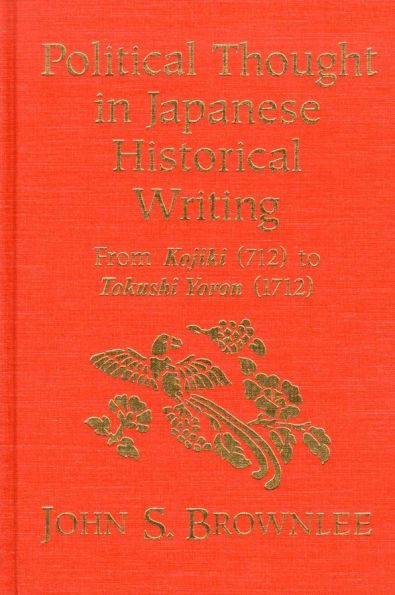
Political Thought in Japanese Historical Writing: From Kojiki (712) to Tokushi Yoron (1712) in Franklin, TN
Current price: $48.99
Barnes and Noble
Political Thought in Japanese Historical Writing: From Kojiki (712) to Tokushi Yoron (1712) in Franklin, TN
Current price: $48.99
Loading Inventory...
Size: OS
It was only at the onset of the Tokugawa period (1602-1868) that formal political thought emerged in Japan. Prior to that time Japanese scholars had concentrated, rather, on questions of legitimacy and authority in historical writing., producing a stream of works. Brownlee’s illuminating study describes twenty of these important historical works commencing with
Kojiki
(712) and
Nihon Shoki
(720) and ending with
Tokushi Yoron
(1712) by Arai Hakuseki. Historical writing would cease to be the sole vehicle for political discussion in Japan in the eighteenth century as Chinese Confucian thought became dominant.
The author illustrates how the first works conceptualized history as imperial history and that subsequent scholars were unable to devise alternative schemes or patterns for history until Arai Hakuseki. Following the first histories, the central concern became the question of the relation of the Emperors to the new powers that arose. Brownlee examines the genre of Historical Tales and how it treated the Fujiwara Regents, the War Tales dealing with warriors at large, and specific works of historical argument depicting the Bakufu in relation to the Emperors. By interposing the works of
Gukanshø
(1219) by Jien,
Jinnø Shøtøki
(1339) by Kitabatake Chikafusa and
by Arai Hakuseki a clear pattern, demonstrating the sequential development of complexity and sophistication in handling the question, is revealed. Japanese political thought thus developed independently towards rationalism and secularism in early modern times.
Kojiki
(712) and
Nihon Shoki
(720) and ending with
Tokushi Yoron
(1712) by Arai Hakuseki. Historical writing would cease to be the sole vehicle for political discussion in Japan in the eighteenth century as Chinese Confucian thought became dominant.
The author illustrates how the first works conceptualized history as imperial history and that subsequent scholars were unable to devise alternative schemes or patterns for history until Arai Hakuseki. Following the first histories, the central concern became the question of the relation of the Emperors to the new powers that arose. Brownlee examines the genre of Historical Tales and how it treated the Fujiwara Regents, the War Tales dealing with warriors at large, and specific works of historical argument depicting the Bakufu in relation to the Emperors. By interposing the works of
Gukanshø
(1219) by Jien,
Jinnø Shøtøki
(1339) by Kitabatake Chikafusa and
by Arai Hakuseki a clear pattern, demonstrating the sequential development of complexity and sophistication in handling the question, is revealed. Japanese political thought thus developed independently towards rationalism and secularism in early modern times.
It was only at the onset of the Tokugawa period (1602-1868) that formal political thought emerged in Japan. Prior to that time Japanese scholars had concentrated, rather, on questions of legitimacy and authority in historical writing., producing a stream of works. Brownlee’s illuminating study describes twenty of these important historical works commencing with
Kojiki
(712) and
Nihon Shoki
(720) and ending with
Tokushi Yoron
(1712) by Arai Hakuseki. Historical writing would cease to be the sole vehicle for political discussion in Japan in the eighteenth century as Chinese Confucian thought became dominant.
The author illustrates how the first works conceptualized history as imperial history and that subsequent scholars were unable to devise alternative schemes or patterns for history until Arai Hakuseki. Following the first histories, the central concern became the question of the relation of the Emperors to the new powers that arose. Brownlee examines the genre of Historical Tales and how it treated the Fujiwara Regents, the War Tales dealing with warriors at large, and specific works of historical argument depicting the Bakufu in relation to the Emperors. By interposing the works of
Gukanshø
(1219) by Jien,
Jinnø Shøtøki
(1339) by Kitabatake Chikafusa and
by Arai Hakuseki a clear pattern, demonstrating the sequential development of complexity and sophistication in handling the question, is revealed. Japanese political thought thus developed independently towards rationalism and secularism in early modern times.
Kojiki
(712) and
Nihon Shoki
(720) and ending with
Tokushi Yoron
(1712) by Arai Hakuseki. Historical writing would cease to be the sole vehicle for political discussion in Japan in the eighteenth century as Chinese Confucian thought became dominant.
The author illustrates how the first works conceptualized history as imperial history and that subsequent scholars were unable to devise alternative schemes or patterns for history until Arai Hakuseki. Following the first histories, the central concern became the question of the relation of the Emperors to the new powers that arose. Brownlee examines the genre of Historical Tales and how it treated the Fujiwara Regents, the War Tales dealing with warriors at large, and specific works of historical argument depicting the Bakufu in relation to the Emperors. By interposing the works of
Gukanshø
(1219) by Jien,
Jinnø Shøtøki
(1339) by Kitabatake Chikafusa and
by Arai Hakuseki a clear pattern, demonstrating the sequential development of complexity and sophistication in handling the question, is revealed. Japanese political thought thus developed independently towards rationalism and secularism in early modern times.
You May Also Like











More About Barnes and Noble at CoolSprings Galleria
Barnes & Noble is the world’s largest retail bookseller and a leading retailer of content, digital media and educational products. Our Nook Digital business offers a lineup of NOOK® tablets and e-Readers and an expansive collection of digital reading content through the NOOK Store®. Barnes & Noble’s mission is to operate the best omni-channel specialty retail business in America, helping both our customers and booksellers reach their aspirations, while being a credit to the communities we serve.
1800 Galleria Blvd #1310, Franklin, TN 37067, United States
Find Barnes and Noble at CoolSprings Galleria in Franklin, TN
Visit Barnes and Noble at CoolSprings Galleria in Franklin, TN
