
Home
Pope, Homer, and Manliness: Some Aspects of Eighteenth Century Classical Learning
Barnes and Noble
Loading Inventory...
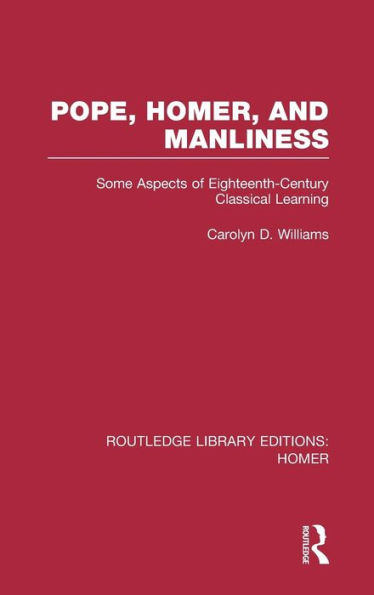
Pope, Homer, and Manliness: Some Aspects of Eighteenth Century Classical Learning in Franklin, TN
Current price: $190.00
Barnes and Noble
Pope, Homer, and Manliness: Some Aspects of Eighteenth Century Classical Learning in Franklin, TN
Current price: $190.00
Loading Inventory...
Size: OS
The author here reassesses the concept of ‘masculinity’, and argues that it cannot be seen as an absolute standard, but only as the product of perpetual conflict between competing and unstable models.
The argument is sustained by a close reading of the problematic conflict between gendered values in eighteenth-century classical learning. Pope’s
Homer
ensured the continuation of the tradition of using the
Iliad
and
Odyssey
to teach privileged boys how to become more ‘manly’. This book examines this pedagogy in its socio-literary context, and concludes that Pope’s
emerges as a relic of the struggle to preserve masculine dignity from the encroachments of feminine values in the text. This knowledge of classical and early modern literature has rarely been brought to bear on gender studies. First published in 1993, it remains a valuable contribution to debates concerning the reception of the Classical tradition.
The argument is sustained by a close reading of the problematic conflict between gendered values in eighteenth-century classical learning. Pope’s
Homer
ensured the continuation of the tradition of using the
Iliad
and
Odyssey
to teach privileged boys how to become more ‘manly’. This book examines this pedagogy in its socio-literary context, and concludes that Pope’s
emerges as a relic of the struggle to preserve masculine dignity from the encroachments of feminine values in the text. This knowledge of classical and early modern literature has rarely been brought to bear on gender studies. First published in 1993, it remains a valuable contribution to debates concerning the reception of the Classical tradition.
The author here reassesses the concept of ‘masculinity’, and argues that it cannot be seen as an absolute standard, but only as the product of perpetual conflict between competing and unstable models.
The argument is sustained by a close reading of the problematic conflict between gendered values in eighteenth-century classical learning. Pope’s
Homer
ensured the continuation of the tradition of using the
Iliad
and
Odyssey
to teach privileged boys how to become more ‘manly’. This book examines this pedagogy in its socio-literary context, and concludes that Pope’s
emerges as a relic of the struggle to preserve masculine dignity from the encroachments of feminine values in the text. This knowledge of classical and early modern literature has rarely been brought to bear on gender studies. First published in 1993, it remains a valuable contribution to debates concerning the reception of the Classical tradition.
The argument is sustained by a close reading of the problematic conflict between gendered values in eighteenth-century classical learning. Pope’s
Homer
ensured the continuation of the tradition of using the
Iliad
and
Odyssey
to teach privileged boys how to become more ‘manly’. This book examines this pedagogy in its socio-literary context, and concludes that Pope’s
emerges as a relic of the struggle to preserve masculine dignity from the encroachments of feminine values in the text. This knowledge of classical and early modern literature has rarely been brought to bear on gender studies. First published in 1993, it remains a valuable contribution to debates concerning the reception of the Classical tradition.
You May Also Like











More About Barnes and Noble at CoolSprings Galleria
Barnes & Noble is the world’s largest retail bookseller and a leading retailer of content, digital media and educational products. Our Nook Digital business offers a lineup of NOOK® tablets and e-Readers and an expansive collection of digital reading content through the NOOK Store®. Barnes & Noble’s mission is to operate the best omni-channel specialty retail business in America, helping both our customers and booksellers reach their aspirations, while being a credit to the communities we serve.
1800 Galleria Blvd #1310, Franklin, TN 37067, United States
Find Barnes and Noble at CoolSprings Galleria in Franklin, TN
Visit Barnes and Noble at CoolSprings Galleria in Franklin, TN
