
Home
Principles and Practices of OMICS Genome Editing for Crop Improvement
Barnes and Noble
Loading Inventory...
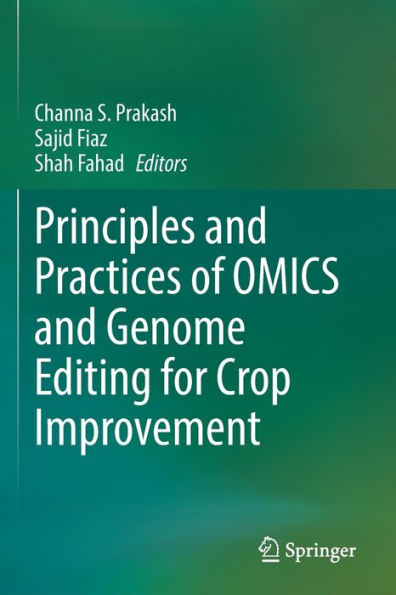
Principles and Practices of OMICS Genome Editing for Crop Improvement in Franklin, TN
Current price: $199.99
Barnes and Noble
Principles and Practices of OMICS Genome Editing for Crop Improvement in Franklin, TN
Current price: $199.99
Loading Inventory...
Size: Hardcover
Global food security is increasingly challenging in light of population increase, the impact of climate change on crop production, and limited land available for agricultural expansion. Plant breeding and other agricultural technologies have contributed considerably for food and nutritional security over the last few decades. Genetic engineering approaches are powerful tools that we have at our disposal to overcome substantial obstacles in the way of efficiency and productivity of current agricultural practices. Genome engineering via CRISPR/Cas9, Cpf1, base editing and prime editing, and OMICs through genomics, transcriptomics, proteomics, phenomics, an metabolomics have helped to discover underlying mechanisms controlling traits of economic importance.
Principle and Practices of OMICs and Genome Editing for Crop Improvement
provides recent research from eminent scholars from around the world, from various geographical regions, with established expertise on genome editing and OMICs technologies. This book offers a wide range of information on OMICs techniques and their applications to develop biotic, abiotic and climate resilient crops, metabolomics and next generation sequencing for sustainable crop production, integration bioinformatics, and multi-omics for precision plant breeding. Other topics include application of genome editing technologies for food and nutritional security, speed breeding, hybrid seed production, resource use efficiency, epigenetic modifications, transgene free breeding, database and bioinformatics for genome editing, and regulations adopted by various countries around globe for genome edited crops. Both OMICs and genome editing are vigorously utilized by researchers for crop improvement programs; however, there is limited literature available in a single source. This book provides a valuable resource not only for students at undergraduate and postgraduate level but also for researchers, stakeholders, policy makers, and practitioners interested in the potential of genome editing and OMICs for crop improvement programs.
Principle and Practices of OMICs and Genome Editing for Crop Improvement
provides recent research from eminent scholars from around the world, from various geographical regions, with established expertise on genome editing and OMICs technologies. This book offers a wide range of information on OMICs techniques and their applications to develop biotic, abiotic and climate resilient crops, metabolomics and next generation sequencing for sustainable crop production, integration bioinformatics, and multi-omics for precision plant breeding. Other topics include application of genome editing technologies for food and nutritional security, speed breeding, hybrid seed production, resource use efficiency, epigenetic modifications, transgene free breeding, database and bioinformatics for genome editing, and regulations adopted by various countries around globe for genome edited crops. Both OMICs and genome editing are vigorously utilized by researchers for crop improvement programs; however, there is limited literature available in a single source. This book provides a valuable resource not only for students at undergraduate and postgraduate level but also for researchers, stakeholders, policy makers, and practitioners interested in the potential of genome editing and OMICs for crop improvement programs.
Global food security is increasingly challenging in light of population increase, the impact of climate change on crop production, and limited land available for agricultural expansion. Plant breeding and other agricultural technologies have contributed considerably for food and nutritional security over the last few decades. Genetic engineering approaches are powerful tools that we have at our disposal to overcome substantial obstacles in the way of efficiency and productivity of current agricultural practices. Genome engineering via CRISPR/Cas9, Cpf1, base editing and prime editing, and OMICs through genomics, transcriptomics, proteomics, phenomics, an metabolomics have helped to discover underlying mechanisms controlling traits of economic importance.
Principle and Practices of OMICs and Genome Editing for Crop Improvement
provides recent research from eminent scholars from around the world, from various geographical regions, with established expertise on genome editing and OMICs technologies. This book offers a wide range of information on OMICs techniques and their applications to develop biotic, abiotic and climate resilient crops, metabolomics and next generation sequencing for sustainable crop production, integration bioinformatics, and multi-omics for precision plant breeding. Other topics include application of genome editing technologies for food and nutritional security, speed breeding, hybrid seed production, resource use efficiency, epigenetic modifications, transgene free breeding, database and bioinformatics for genome editing, and regulations adopted by various countries around globe for genome edited crops. Both OMICs and genome editing are vigorously utilized by researchers for crop improvement programs; however, there is limited literature available in a single source. This book provides a valuable resource not only for students at undergraduate and postgraduate level but also for researchers, stakeholders, policy makers, and practitioners interested in the potential of genome editing and OMICs for crop improvement programs.
Principle and Practices of OMICs and Genome Editing for Crop Improvement
provides recent research from eminent scholars from around the world, from various geographical regions, with established expertise on genome editing and OMICs technologies. This book offers a wide range of information on OMICs techniques and their applications to develop biotic, abiotic and climate resilient crops, metabolomics and next generation sequencing for sustainable crop production, integration bioinformatics, and multi-omics for precision plant breeding. Other topics include application of genome editing technologies for food and nutritional security, speed breeding, hybrid seed production, resource use efficiency, epigenetic modifications, transgene free breeding, database and bioinformatics for genome editing, and regulations adopted by various countries around globe for genome edited crops. Both OMICs and genome editing are vigorously utilized by researchers for crop improvement programs; however, there is limited literature available in a single source. This book provides a valuable resource not only for students at undergraduate and postgraduate level but also for researchers, stakeholders, policy makers, and practitioners interested in the potential of genome editing and OMICs for crop improvement programs.
You May Also Like









More About Barnes and Noble at CoolSprings Galleria
Barnes & Noble is the world’s largest retail bookseller and a leading retailer of content, digital media and educational products. Our Nook Digital business offers a lineup of NOOK® tablets and e-Readers and an expansive collection of digital reading content through the NOOK Store®. Barnes & Noble’s mission is to operate the best omni-channel specialty retail business in America, helping both our customers and booksellers reach their aspirations, while being a credit to the communities we serve.
1800 Galleria Blvd #1310, Franklin, TN 37067, United States
Find Barnes and Noble at CoolSprings Galleria in Franklin, TN
Visit Barnes and Noble at CoolSprings Galleria in Franklin, TN
