
Home
Problems from the Discrete to Continuous: Probability, Number Theory, Graph and Combinatorics
Barnes and Noble
Loading Inventory...
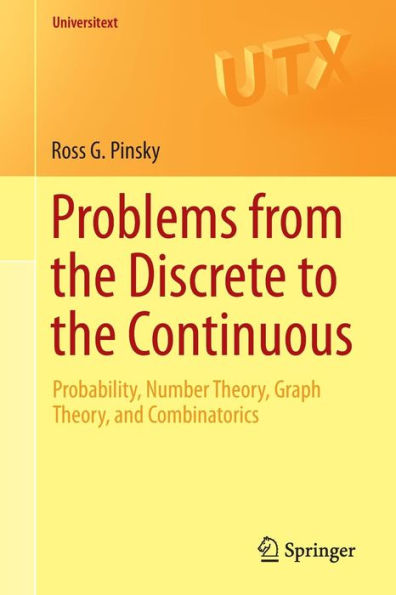
Problems from the Discrete to Continuous: Probability, Number Theory, Graph and Combinatorics in Franklin, TN
Current price: $59.99
Barnes and Noble
Problems from the Discrete to Continuous: Probability, Number Theory, Graph and Combinatorics in Franklin, TN
Current price: $59.99
Loading Inventory...
Size: Paperback
The primary intent of the book is to introduce an array of beautiful problems in a variety of subjects quickly, pithily and completely rigorously to graduate students and advanced undergraduates. The book takes a number of specific problems and solves them, the needed tools developed along the way in the context of the particular problems. It treats a melange of topics from combinatorial probability theory, number theory, random graph theory and combinatorics. The problems in this book involve the asymptotic analysis of a discrete construct, as some natural parameter of the system tends to infinity. Besides bridging discrete mathematics and mathematical analysis, the book makes a modest attempt at bridging disciplines. The problems were selected with an eye toward accessibility to a wide audience, including advanced undergraduate students. The book could be used for a seminar course in which students present the lectures.
The primary intent of the book is to introduce an array of beautiful problems in a variety of subjects quickly, pithily and completely rigorously to graduate students and advanced undergraduates. The book takes a number of specific problems and solves them, the needed tools developed along the way in the context of the particular problems. It treats a melange of topics from combinatorial probability theory, number theory, random graph theory and combinatorics. The problems in this book involve the asymptotic analysis of a discrete construct, as some natural parameter of the system tends to infinity. Besides bridging discrete mathematics and mathematical analysis, the book makes a modest attempt at bridging disciplines. The problems were selected with an eye toward accessibility to a wide audience, including advanced undergraduate students. The book could be used for a seminar course in which students present the lectures.
You May Also Like







More About Barnes and Noble at CoolSprings Galleria
Barnes & Noble is the world’s largest retail bookseller and a leading retailer of content, digital media and educational products. Our Nook Digital business offers a lineup of NOOK® tablets and e-Readers and an expansive collection of digital reading content through the NOOK Store®. Barnes & Noble’s mission is to operate the best omni-channel specialty retail business in America, helping both our customers and booksellers reach their aspirations, while being a credit to the communities we serve.
1800 Galleria Blvd #1310, Franklin, TN 37067, United States
Find Barnes and Noble at CoolSprings Galleria in Franklin, TN
Visit Barnes and Noble at CoolSprings Galleria in Franklin, TN
