
Home
Province and Politics Late Imperial China: Viceregal Government Szechwan 1898-1911
Barnes and Noble
Loading Inventory...
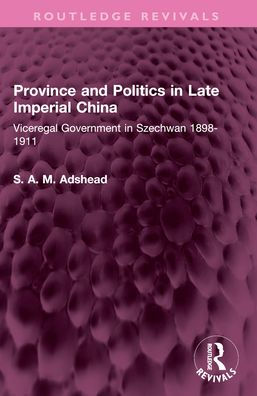
Province and Politics Late Imperial China: Viceregal Government Szechwan 1898-1911 in Franklin, TN
Current price: $125.00
Barnes and Noble
Province and Politics Late Imperial China: Viceregal Government Szechwan 1898-1911 in Franklin, TN
Current price: $125.00
Loading Inventory...
Size: Hardcover
First Published in 1984
Province and Politics in Late Imperial China
presents analysis of one of the regional governments of China, the administration of the Szechwan governor-general from its apogee at the end of the nineteenth century to its nadir in the revolution of 1911. The Szechwan governor – general not only ruled the one province of Szechwan, but also exercised significant powers in Kweichow, the Tibetan borderlands, and parts of Yunnan and Hupei, as well as playing a major role in imperial politics. He was therefore a regional and not simply a provincial figure, while Szechwan was characteristic of the system of Chinese regions. This book seeks to show that the main threat to the dominance of the Szechwan governors – general came from their own modernizing activities; viceregal government broke down in the attempt to use traditional means to modern ends. In microcosm, therefore, Szechwan displays the pattern in both politics and ecology that was one of disruptive modernization in China. This book is an interesting read for scholars of Chinese history.
Province and Politics in Late Imperial China
presents analysis of one of the regional governments of China, the administration of the Szechwan governor-general from its apogee at the end of the nineteenth century to its nadir in the revolution of 1911. The Szechwan governor – general not only ruled the one province of Szechwan, but also exercised significant powers in Kweichow, the Tibetan borderlands, and parts of Yunnan and Hupei, as well as playing a major role in imperial politics. He was therefore a regional and not simply a provincial figure, while Szechwan was characteristic of the system of Chinese regions. This book seeks to show that the main threat to the dominance of the Szechwan governors – general came from their own modernizing activities; viceregal government broke down in the attempt to use traditional means to modern ends. In microcosm, therefore, Szechwan displays the pattern in both politics and ecology that was one of disruptive modernization in China. This book is an interesting read for scholars of Chinese history.
First Published in 1984
Province and Politics in Late Imperial China
presents analysis of one of the regional governments of China, the administration of the Szechwan governor-general from its apogee at the end of the nineteenth century to its nadir in the revolution of 1911. The Szechwan governor – general not only ruled the one province of Szechwan, but also exercised significant powers in Kweichow, the Tibetan borderlands, and parts of Yunnan and Hupei, as well as playing a major role in imperial politics. He was therefore a regional and not simply a provincial figure, while Szechwan was characteristic of the system of Chinese regions. This book seeks to show that the main threat to the dominance of the Szechwan governors – general came from their own modernizing activities; viceregal government broke down in the attempt to use traditional means to modern ends. In microcosm, therefore, Szechwan displays the pattern in both politics and ecology that was one of disruptive modernization in China. This book is an interesting read for scholars of Chinese history.
Province and Politics in Late Imperial China
presents analysis of one of the regional governments of China, the administration of the Szechwan governor-general from its apogee at the end of the nineteenth century to its nadir in the revolution of 1911. The Szechwan governor – general not only ruled the one province of Szechwan, but also exercised significant powers in Kweichow, the Tibetan borderlands, and parts of Yunnan and Hupei, as well as playing a major role in imperial politics. He was therefore a regional and not simply a provincial figure, while Szechwan was characteristic of the system of Chinese regions. This book seeks to show that the main threat to the dominance of the Szechwan governors – general came from their own modernizing activities; viceregal government broke down in the attempt to use traditional means to modern ends. In microcosm, therefore, Szechwan displays the pattern in both politics and ecology that was one of disruptive modernization in China. This book is an interesting read for scholars of Chinese history.
You May Also Like










More About Barnes and Noble at CoolSprings Galleria
Barnes & Noble is the world’s largest retail bookseller and a leading retailer of content, digital media and educational products. Our Nook Digital business offers a lineup of NOOK® tablets and e-Readers and an expansive collection of digital reading content through the NOOK Store®. Barnes & Noble’s mission is to operate the best omni-channel specialty retail business in America, helping both our customers and booksellers reach their aspirations, while being a credit to the communities we serve.
1800 Galleria Blvd #1310, Franklin, TN 37067, United States
Find Barnes and Noble at CoolSprings Galleria in Franklin, TN
Visit Barnes and Noble at CoolSprings Galleria in Franklin, TN
