
Home
Revolution: A Story of the Near Future of England
Barnes and Noble
Loading Inventory...
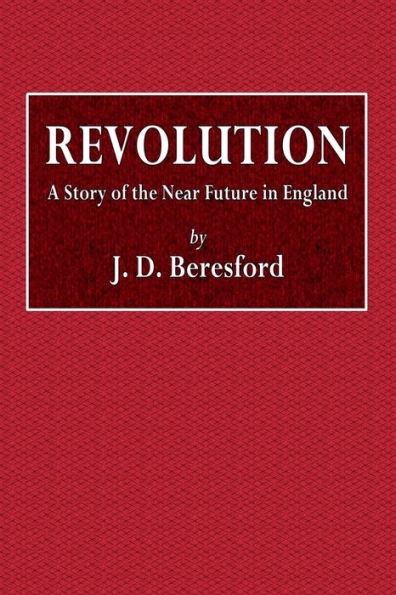
Revolution: A Story of the Near Future of England in Franklin, TN
Current price: $11.32
Barnes and Noble
Revolution: A Story of the Near Future of England in Franklin, TN
Current price: $11.32
Loading Inventory...
Size: OS
"IT is a novel," quoth the publisher or the publisher's man, "that must be read not only for its intensely moving story, but for its sweeping power, its uplifting inspiration, its overmastering sense of inevitability." It may be so, for those who have eyes to see. Pity the poor blind. Far be it from me to deny that it is a novel; for what isn't? But an intensely moving story I have not found it. Rather it strikes me as one of those ingenious fantasies or stunts of the fancy which every current novelist permits himself at some time or other. Pleasant to abandon interpretation or ingenuity for dealing in the business of minor prophecy. Day after to-morrow is fair game for us all. But minor prophecy isn't story-telling. The author of Jacob Stahl, like H. G. Wells and Jack London and the vast company of their successors at this kind of thing, really creates nothing. All he does is to put an interesting speculation in narrative form. After the subtitle of the book, one may be puzzled by the author's "Foreword to American Edition." He is a little hurt that English reviewers have taken his forecast seriously. "I do not," he says, "anticipate a bloody revolution in England either on the lines indicated or on any other; but I do, nevertheless, hold myself committed definitely to a prophecy." This prophecy is nothing less than that "European civilization has passed its highest point of development and will gradually decline; that the conflict between Capital and Labor in Europe may be ultimately settled on some more or less reasonable basis, but that in the process our civilization, as such, will cease to be a world-influence; and that, finally, we must look to the United States of America for the development of a new world-order, which I sincerely hope and pray may be greater and better than the one it will supersede."
"IT is a novel," quoth the publisher or the publisher's man, "that must be read not only for its intensely moving story, but for its sweeping power, its uplifting inspiration, its overmastering sense of inevitability." It may be so, for those who have eyes to see. Pity the poor blind. Far be it from me to deny that it is a novel; for what isn't? But an intensely moving story I have not found it. Rather it strikes me as one of those ingenious fantasies or stunts of the fancy which every current novelist permits himself at some time or other. Pleasant to abandon interpretation or ingenuity for dealing in the business of minor prophecy. Day after to-morrow is fair game for us all. But minor prophecy isn't story-telling. The author of Jacob Stahl, like H. G. Wells and Jack London and the vast company of their successors at this kind of thing, really creates nothing. All he does is to put an interesting speculation in narrative form. After the subtitle of the book, one may be puzzled by the author's "Foreword to American Edition." He is a little hurt that English reviewers have taken his forecast seriously. "I do not," he says, "anticipate a bloody revolution in England either on the lines indicated or on any other; but I do, nevertheless, hold myself committed definitely to a prophecy." This prophecy is nothing less than that "European civilization has passed its highest point of development and will gradually decline; that the conflict between Capital and Labor in Europe may be ultimately settled on some more or less reasonable basis, but that in the process our civilization, as such, will cease to be a world-influence; and that, finally, we must look to the United States of America for the development of a new world-order, which I sincerely hope and pray may be greater and better than the one it will supersede."
You May Also Like














More About Barnes and Noble at CoolSprings Galleria
Barnes & Noble is the world’s largest retail bookseller and a leading retailer of content, digital media and educational products. Our Nook Digital business offers a lineup of NOOK® tablets and e-Readers and an expansive collection of digital reading content through the NOOK Store®. Barnes & Noble’s mission is to operate the best omni-channel specialty retail business in America, helping both our customers and booksellers reach their aspirations, while being a credit to the communities we serve.
1800 Galleria Blvd #1310, Franklin, TN 37067, United States
Find Barnes and Noble at CoolSprings Galleria in Franklin, TN
Visit Barnes and Noble at CoolSprings Galleria in Franklin, TN
