
Home
Social Welfare Functions and Development: Measurement Policy Applications
Barnes and Noble
Loading Inventory...
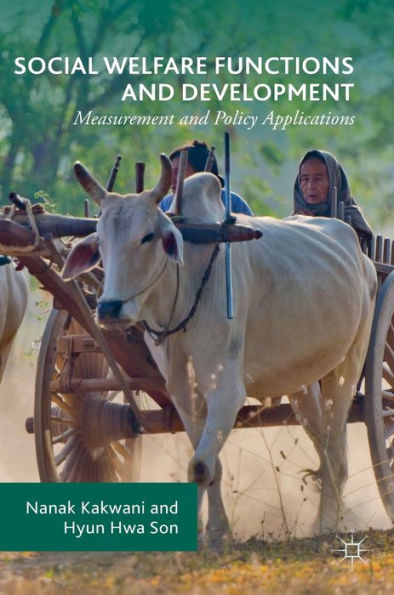
Social Welfare Functions and Development: Measurement Policy Applications in Franklin, TN
Current price: $109.99
Barnes and Noble
Social Welfare Functions and Development: Measurement Policy Applications in Franklin, TN
Current price: $109.99
Loading Inventory...
Size: Hardcover
Nanak Kakwani and Hyun Hwa Son make use of social welfare functions to derive indicators of development relevant to specific social objectives, such as poverty- and inequality-reduction. Arguing that the measurement of development cannot be value-free, the authors assert that if indicators of development are to have policy relevance, they must be assessed on the basis of the social objectives in question.
This study develops indicators that are sensitive to both the level and the distribution of individuals’ capabilities. The idea of the social welfare function, defined in income space, is extended to the concept of the social well-being function, defined in capability space.
Through empirical analysis from selected developing countries, with a particular focus on Brazil, the authors shape techniques appropriate to the analysis of development in different dimensions. The focus of this evidence-based policy analysis is to evaluate alternative policies affecting the capacities of people to enjoy a better life.
This study develops indicators that are sensitive to both the level and the distribution of individuals’ capabilities. The idea of the social welfare function, defined in income space, is extended to the concept of the social well-being function, defined in capability space.
Through empirical analysis from selected developing countries, with a particular focus on Brazil, the authors shape techniques appropriate to the analysis of development in different dimensions. The focus of this evidence-based policy analysis is to evaluate alternative policies affecting the capacities of people to enjoy a better life.
Nanak Kakwani and Hyun Hwa Son make use of social welfare functions to derive indicators of development relevant to specific social objectives, such as poverty- and inequality-reduction. Arguing that the measurement of development cannot be value-free, the authors assert that if indicators of development are to have policy relevance, they must be assessed on the basis of the social objectives in question.
This study develops indicators that are sensitive to both the level and the distribution of individuals’ capabilities. The idea of the social welfare function, defined in income space, is extended to the concept of the social well-being function, defined in capability space.
Through empirical analysis from selected developing countries, with a particular focus on Brazil, the authors shape techniques appropriate to the analysis of development in different dimensions. The focus of this evidence-based policy analysis is to evaluate alternative policies affecting the capacities of people to enjoy a better life.
This study develops indicators that are sensitive to both the level and the distribution of individuals’ capabilities. The idea of the social welfare function, defined in income space, is extended to the concept of the social well-being function, defined in capability space.
Through empirical analysis from selected developing countries, with a particular focus on Brazil, the authors shape techniques appropriate to the analysis of development in different dimensions. The focus of this evidence-based policy analysis is to evaluate alternative policies affecting the capacities of people to enjoy a better life.
You May Also Like









More About Barnes and Noble at CoolSprings Galleria
Barnes & Noble is the world’s largest retail bookseller and a leading retailer of content, digital media and educational products. Our Nook Digital business offers a lineup of NOOK® tablets and e-Readers and an expansive collection of digital reading content through the NOOK Store®. Barnes & Noble’s mission is to operate the best omni-channel specialty retail business in America, helping both our customers and booksellers reach their aspirations, while being a credit to the communities we serve.
1800 Galleria Blvd #1310, Franklin, TN 37067, United States
Find Barnes and Noble at CoolSprings Galleria in Franklin, TN
Visit Barnes and Noble at CoolSprings Galleria in Franklin, TN
