
Home
Starfish: A warning from the past regarding polarization in Science and Society
Barnes and Noble
Loading Inventory...
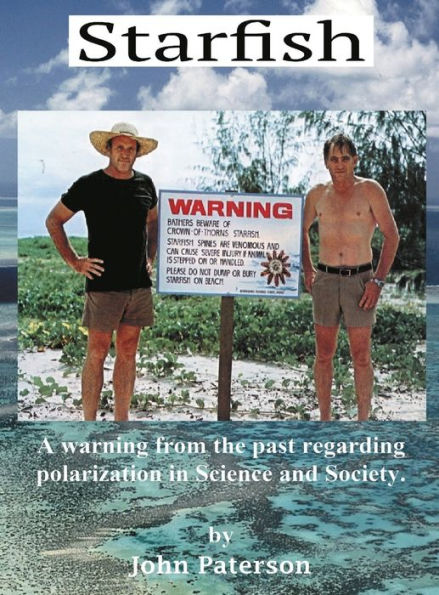
Starfish: A warning from the past regarding polarization in Science and Society in Franklin, TN
Current price: $43.84
Barnes and Noble
Starfish: A warning from the past regarding polarization in Science and Society in Franklin, TN
Current price: $43.84
Loading Inventory...
Size: OS
Sea-urchins and starfish both belong to Phylum Echinodermata and while early research on the fertilization reaction was conducted by Rothschild and Swann (1949) on sea-urchins, the conclusions regarding egg fertilization and proximity of spawning individuals were just as applicable to starfish.
Human collection of the Giant Triton and other predators was suggested by Endean (1969) as a causative factor in starfish outbreaks, but this Predator Control Hypothesis was generally disregarded due to the enormous potential numbers of starfish. Recent research demonstrating the strong avoidance reaction of the starfish to the triton together with an understanding of the importance of starfish aggregation to reproductive success may be slowly changing this opinion.
The existence of crown-of-thorns starfish outbreaks influenced many important world economic decisions of the 1960s, including the rejection on ecological grounds of a new sea-level Panama Canal. Starfish radial nerve extract (1-methyladenine) has been used to experimentally induce starfish spawning since Noumura and Kanatani (1962), but any possible causal connection with the starfish outbreaks has never been investigated.
Human collection of the Giant Triton and other predators was suggested by Endean (1969) as a causative factor in starfish outbreaks, but this Predator Control Hypothesis was generally disregarded due to the enormous potential numbers of starfish. Recent research demonstrating the strong avoidance reaction of the starfish to the triton together with an understanding of the importance of starfish aggregation to reproductive success may be slowly changing this opinion.
The existence of crown-of-thorns starfish outbreaks influenced many important world economic decisions of the 1960s, including the rejection on ecological grounds of a new sea-level Panama Canal. Starfish radial nerve extract (1-methyladenine) has been used to experimentally induce starfish spawning since Noumura and Kanatani (1962), but any possible causal connection with the starfish outbreaks has never been investigated.
Sea-urchins and starfish both belong to Phylum Echinodermata and while early research on the fertilization reaction was conducted by Rothschild and Swann (1949) on sea-urchins, the conclusions regarding egg fertilization and proximity of spawning individuals were just as applicable to starfish.
Human collection of the Giant Triton and other predators was suggested by Endean (1969) as a causative factor in starfish outbreaks, but this Predator Control Hypothesis was generally disregarded due to the enormous potential numbers of starfish. Recent research demonstrating the strong avoidance reaction of the starfish to the triton together with an understanding of the importance of starfish aggregation to reproductive success may be slowly changing this opinion.
The existence of crown-of-thorns starfish outbreaks influenced many important world economic decisions of the 1960s, including the rejection on ecological grounds of a new sea-level Panama Canal. Starfish radial nerve extract (1-methyladenine) has been used to experimentally induce starfish spawning since Noumura and Kanatani (1962), but any possible causal connection with the starfish outbreaks has never been investigated.
Human collection of the Giant Triton and other predators was suggested by Endean (1969) as a causative factor in starfish outbreaks, but this Predator Control Hypothesis was generally disregarded due to the enormous potential numbers of starfish. Recent research demonstrating the strong avoidance reaction of the starfish to the triton together with an understanding of the importance of starfish aggregation to reproductive success may be slowly changing this opinion.
The existence of crown-of-thorns starfish outbreaks influenced many important world economic decisions of the 1960s, including the rejection on ecological grounds of a new sea-level Panama Canal. Starfish radial nerve extract (1-methyladenine) has been used to experimentally induce starfish spawning since Noumura and Kanatani (1962), but any possible causal connection with the starfish outbreaks has never been investigated.
You May Also Like


















More About Barnes and Noble at CoolSprings Galleria
Barnes & Noble is the world’s largest retail bookseller and a leading retailer of content, digital media and educational products. Our Nook Digital business offers a lineup of NOOK® tablets and e-Readers and an expansive collection of digital reading content through the NOOK Store®. Barnes & Noble’s mission is to operate the best omni-channel specialty retail business in America, helping both our customers and booksellers reach their aspirations, while being a credit to the communities we serve.
1800 Galleria Blvd #1310, Franklin, TN 37067, United States
Find Barnes and Noble at CoolSprings Galleria in Franklin, TN
Visit Barnes and Noble at CoolSprings Galleria in Franklin, TN
