
Home
Strangers at the Bedside: A History of How Law and Bioethics Transformed Medical Decision Making
Barnes and Noble
Loading Inventory...
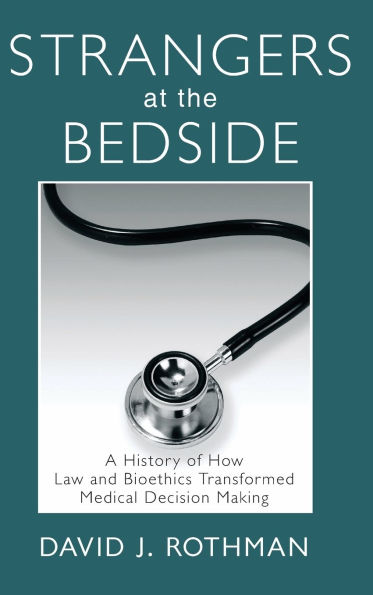
Strangers at the Bedside: A History of How Law and Bioethics Transformed Medical Decision Making in Franklin, TN
Current price: $210.00
Barnes and Noble
Strangers at the Bedside: A History of How Law and Bioethics Transformed Medical Decision Making in Franklin, TN
Current price: $210.00
Loading Inventory...
Size: Hardcover
David Rothman gives us a brilliant, finely etched study of medical practice today. Beginning in the mid-1960s, the practice of medicine in the United States underwent a most remarkable--and thoroughly controversial--transformation. The discretion that the profession once enjoyed has been increasingly circumscribed, and now an almost bewildering number of parties and procedures participate in medical decision making.
Well into the post-World War II period, decisions at the bedside were the almost exclusive concern of the individual physician, even when they raised fundamental ethical and social issues. It was mainly doctors who wrote and read about the morality of withholding a course of antibiotics and letting pneumonia serve as the old man's best friend, of considering a newborn with grave birth defects a "stillbirth" thus sparing the parents the agony of choice and the burden of care, of experimenting on the institutionalized the retarded to learn more about hepatitis, or of giving one patient and not another access to the iron lung when the machine was in short supply. Moreover, it was usually the individual physician who decided these matters without formal discussions with patients, their families, or even with colleagues, and certainly without drawing the attention of journalists, judges, or professional philosophers.
The impact of the invasion of outsiders into medical decision-making, most generally framed, was to make the invisible visible. Outsiders to medicine--that is, lawyers, judges, legislators, and academics--have penetrated its every nook and cranny, in the process giving medicine exceptional prominence on the public agenda and making it the subject of popular discourse. The glare of the spotlight transformed medical decision making, shaping not merely the external conditions under which medicine would be practiced (something that the state, through the regulation of licensure, had always done), but the very substance of medical practice--the decisions that physicians made at the bedside.
Well into the post-World War II period, decisions at the bedside were the almost exclusive concern of the individual physician, even when they raised fundamental ethical and social issues. It was mainly doctors who wrote and read about the morality of withholding a course of antibiotics and letting pneumonia serve as the old man's best friend, of considering a newborn with grave birth defects a "stillbirth" thus sparing the parents the agony of choice and the burden of care, of experimenting on the institutionalized the retarded to learn more about hepatitis, or of giving one patient and not another access to the iron lung when the machine was in short supply. Moreover, it was usually the individual physician who decided these matters without formal discussions with patients, their families, or even with colleagues, and certainly without drawing the attention of journalists, judges, or professional philosophers.
The impact of the invasion of outsiders into medical decision-making, most generally framed, was to make the invisible visible. Outsiders to medicine--that is, lawyers, judges, legislators, and academics--have penetrated its every nook and cranny, in the process giving medicine exceptional prominence on the public agenda and making it the subject of popular discourse. The glare of the spotlight transformed medical decision making, shaping not merely the external conditions under which medicine would be practiced (something that the state, through the regulation of licensure, had always done), but the very substance of medical practice--the decisions that physicians made at the bedside.
David Rothman gives us a brilliant, finely etched study of medical practice today. Beginning in the mid-1960s, the practice of medicine in the United States underwent a most remarkable--and thoroughly controversial--transformation. The discretion that the profession once enjoyed has been increasingly circumscribed, and now an almost bewildering number of parties and procedures participate in medical decision making.
Well into the post-World War II period, decisions at the bedside were the almost exclusive concern of the individual physician, even when they raised fundamental ethical and social issues. It was mainly doctors who wrote and read about the morality of withholding a course of antibiotics and letting pneumonia serve as the old man's best friend, of considering a newborn with grave birth defects a "stillbirth" thus sparing the parents the agony of choice and the burden of care, of experimenting on the institutionalized the retarded to learn more about hepatitis, or of giving one patient and not another access to the iron lung when the machine was in short supply. Moreover, it was usually the individual physician who decided these matters without formal discussions with patients, their families, or even with colleagues, and certainly without drawing the attention of journalists, judges, or professional philosophers.
The impact of the invasion of outsiders into medical decision-making, most generally framed, was to make the invisible visible. Outsiders to medicine--that is, lawyers, judges, legislators, and academics--have penetrated its every nook and cranny, in the process giving medicine exceptional prominence on the public agenda and making it the subject of popular discourse. The glare of the spotlight transformed medical decision making, shaping not merely the external conditions under which medicine would be practiced (something that the state, through the regulation of licensure, had always done), but the very substance of medical practice--the decisions that physicians made at the bedside.
Well into the post-World War II period, decisions at the bedside were the almost exclusive concern of the individual physician, even when they raised fundamental ethical and social issues. It was mainly doctors who wrote and read about the morality of withholding a course of antibiotics and letting pneumonia serve as the old man's best friend, of considering a newborn with grave birth defects a "stillbirth" thus sparing the parents the agony of choice and the burden of care, of experimenting on the institutionalized the retarded to learn more about hepatitis, or of giving one patient and not another access to the iron lung when the machine was in short supply. Moreover, it was usually the individual physician who decided these matters without formal discussions with patients, their families, or even with colleagues, and certainly without drawing the attention of journalists, judges, or professional philosophers.
The impact of the invasion of outsiders into medical decision-making, most generally framed, was to make the invisible visible. Outsiders to medicine--that is, lawyers, judges, legislators, and academics--have penetrated its every nook and cranny, in the process giving medicine exceptional prominence on the public agenda and making it the subject of popular discourse. The glare of the spotlight transformed medical decision making, shaping not merely the external conditions under which medicine would be practiced (something that the state, through the regulation of licensure, had always done), but the very substance of medical practice--the decisions that physicians made at the bedside.
You May Also Like












More About Barnes and Noble at CoolSprings Galleria
Barnes & Noble is the world’s largest retail bookseller and a leading retailer of content, digital media and educational products. Our Nook Digital business offers a lineup of NOOK® tablets and e-Readers and an expansive collection of digital reading content through the NOOK Store®. Barnes & Noble’s mission is to operate the best omni-channel specialty retail business in America, helping both our customers and booksellers reach their aspirations, while being a credit to the communities we serve.
1800 Galleria Blvd #1310, Franklin, TN 37067, United States
Find Barnes and Noble at CoolSprings Galleria in Franklin, TN
Visit Barnes and Noble at CoolSprings Galleria in Franklin, TN
