
Home
Supplement to the Index of Middle English Verse: Carleton Brown and Rossell Hope Robbins
Barnes and Noble
Loading Inventory...
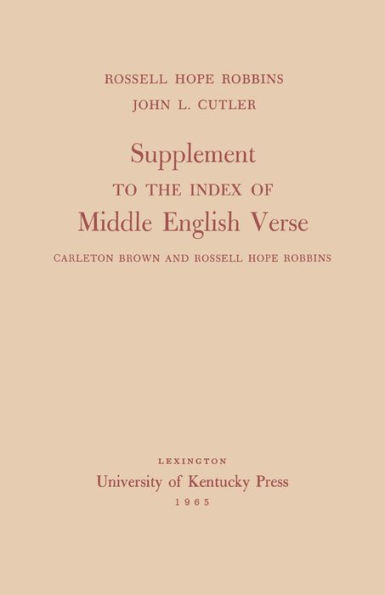
Supplement to the Index of Middle English Verse: Carleton Brown and Rossell Hope Robbins in Franklin, TN
Current price: $60.00
Barnes and Noble
Supplement to the Index of Middle English Verse: Carleton Brown and Rossell Hope Robbins in Franklin, TN
Current price: $60.00
Loading Inventory...
Size: OS
Rossell Hope Robbins collaborated with Carleton Brown in the publishing of the
Index of Middle English Verse
in 1943. With John L. Cutler, associate professor of English in the University of Kentucky, he has now compiled a supplement to the
Index
incorporating those texts published since 1943. At the same time, the two have completely revised the Index by including in the Supplement texts previously neglected. The number of entries has been increased to 6,000, and more than half of the 4,500 original entries have been revised.
In addition to this basic revision, the appendices of the
have been corrected and enlarged, especially the listing and locating of privately held manuscripts. Cross references have been inserted abundantly to facilitate easy use of the combined works. Additionally, reference has been made to related specialized studies.
The large number of new entries is attributable not only to prolonged manuscript research but also to a broadening of the original criteria for the inclusion of poems. Rather than cutting off entries at 1500, which the authors felt impaired the usefulness of the original
, Robbins and Cutler included genres that had not concluded but continued into the sixteenth century, as well as poems with uncertain dates they felt would be important for scholars. The
Supplement
overcomes these barriers by including the socalled Scottish Chaucerians, the late fifteenth and early sixteenth century manuscripts such as the "Tudor songbooks," verse items of only two lines, and tombstone and church bras epitaphs.
Index of Middle English Verse
in 1943. With John L. Cutler, associate professor of English in the University of Kentucky, he has now compiled a supplement to the
Index
incorporating those texts published since 1943. At the same time, the two have completely revised the Index by including in the Supplement texts previously neglected. The number of entries has been increased to 6,000, and more than half of the 4,500 original entries have been revised.
In addition to this basic revision, the appendices of the
have been corrected and enlarged, especially the listing and locating of privately held manuscripts. Cross references have been inserted abundantly to facilitate easy use of the combined works. Additionally, reference has been made to related specialized studies.
The large number of new entries is attributable not only to prolonged manuscript research but also to a broadening of the original criteria for the inclusion of poems. Rather than cutting off entries at 1500, which the authors felt impaired the usefulness of the original
, Robbins and Cutler included genres that had not concluded but continued into the sixteenth century, as well as poems with uncertain dates they felt would be important for scholars. The
Supplement
overcomes these barriers by including the socalled Scottish Chaucerians, the late fifteenth and early sixteenth century manuscripts such as the "Tudor songbooks," verse items of only two lines, and tombstone and church bras epitaphs.
Rossell Hope Robbins collaborated with Carleton Brown in the publishing of the
Index of Middle English Verse
in 1943. With John L. Cutler, associate professor of English in the University of Kentucky, he has now compiled a supplement to the
Index
incorporating those texts published since 1943. At the same time, the two have completely revised the Index by including in the Supplement texts previously neglected. The number of entries has been increased to 6,000, and more than half of the 4,500 original entries have been revised.
In addition to this basic revision, the appendices of the
have been corrected and enlarged, especially the listing and locating of privately held manuscripts. Cross references have been inserted abundantly to facilitate easy use of the combined works. Additionally, reference has been made to related specialized studies.
The large number of new entries is attributable not only to prolonged manuscript research but also to a broadening of the original criteria for the inclusion of poems. Rather than cutting off entries at 1500, which the authors felt impaired the usefulness of the original
, Robbins and Cutler included genres that had not concluded but continued into the sixteenth century, as well as poems with uncertain dates they felt would be important for scholars. The
Supplement
overcomes these barriers by including the socalled Scottish Chaucerians, the late fifteenth and early sixteenth century manuscripts such as the "Tudor songbooks," verse items of only two lines, and tombstone and church bras epitaphs.
Index of Middle English Verse
in 1943. With John L. Cutler, associate professor of English in the University of Kentucky, he has now compiled a supplement to the
Index
incorporating those texts published since 1943. At the same time, the two have completely revised the Index by including in the Supplement texts previously neglected. The number of entries has been increased to 6,000, and more than half of the 4,500 original entries have been revised.
In addition to this basic revision, the appendices of the
have been corrected and enlarged, especially the listing and locating of privately held manuscripts. Cross references have been inserted abundantly to facilitate easy use of the combined works. Additionally, reference has been made to related specialized studies.
The large number of new entries is attributable not only to prolonged manuscript research but also to a broadening of the original criteria for the inclusion of poems. Rather than cutting off entries at 1500, which the authors felt impaired the usefulness of the original
, Robbins and Cutler included genres that had not concluded but continued into the sixteenth century, as well as poems with uncertain dates they felt would be important for scholars. The
Supplement
overcomes these barriers by including the socalled Scottish Chaucerians, the late fifteenth and early sixteenth century manuscripts such as the "Tudor songbooks," verse items of only two lines, and tombstone and church bras epitaphs.
You May Also Like







More About Barnes and Noble at CoolSprings Galleria
Barnes & Noble is the world’s largest retail bookseller and a leading retailer of content, digital media and educational products. Our Nook Digital business offers a lineup of NOOK® tablets and e-Readers and an expansive collection of digital reading content through the NOOK Store®. Barnes & Noble’s mission is to operate the best omni-channel specialty retail business in America, helping both our customers and booksellers reach their aspirations, while being a credit to the communities we serve.
1800 Galleria Blvd #1310, Franklin, TN 37067, United States
Find Barnes and Noble at CoolSprings Galleria in Franklin, TN
Visit Barnes and Noble at CoolSprings Galleria in Franklin, TN
