
Home
Technics and Time, 3: Cinematic Time the Question of Malaise
Barnes and Noble
Loading Inventory...
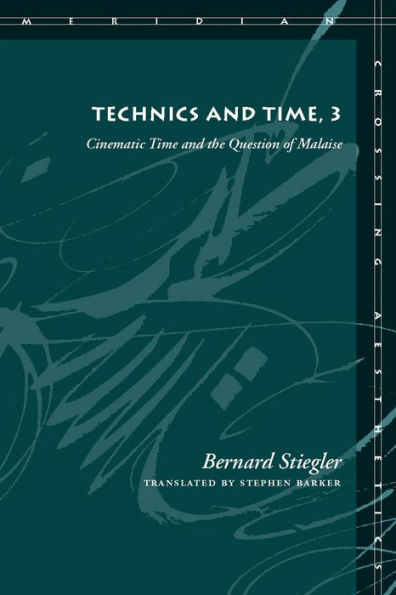
Technics and Time, 3: Cinematic Time the Question of Malaise in Franklin, TN
Current price: $32.00
Barnes and Noble
Technics and Time, 3: Cinematic Time the Question of Malaise in Franklin, TN
Current price: $32.00
Loading Inventory...
Size: Paperback
In the first two volumes of
Technics and Time
, Bernard Stiegler worked carefully through Heidegger's and Husserl's relationship to technics and technology. Here, in volume three, he turns his attention to the prolematic relationship to technics he finds in Kant's
Critique of Pure Reason
, particularly in the two versions of the Transcendental Deduction. Stiegler relates this problematic to the "cinematic nature" of time, which precedes cinema itself but reaches an apotheosis in it as the
exteriorization process
of schema, through tertiary retentions and their mechanisms. The book focuses on the relationship between these themes and the "culture industry"— as defined by Adorno and Horkheimer—that has supplanted the educational institutions on which genuine cultural participation depends. This displacement, Stiegler says, has produced a malaise from which current global culture suffers. The result is potentially catastrophic.
Technics and Time
, Bernard Stiegler worked carefully through Heidegger's and Husserl's relationship to technics and technology. Here, in volume three, he turns his attention to the prolematic relationship to technics he finds in Kant's
Critique of Pure Reason
, particularly in the two versions of the Transcendental Deduction. Stiegler relates this problematic to the "cinematic nature" of time, which precedes cinema itself but reaches an apotheosis in it as the
exteriorization process
of schema, through tertiary retentions and their mechanisms. The book focuses on the relationship between these themes and the "culture industry"— as defined by Adorno and Horkheimer—that has supplanted the educational institutions on which genuine cultural participation depends. This displacement, Stiegler says, has produced a malaise from which current global culture suffers. The result is potentially catastrophic.
In the first two volumes of
Technics and Time
, Bernard Stiegler worked carefully through Heidegger's and Husserl's relationship to technics and technology. Here, in volume three, he turns his attention to the prolematic relationship to technics he finds in Kant's
Critique of Pure Reason
, particularly in the two versions of the Transcendental Deduction. Stiegler relates this problematic to the "cinematic nature" of time, which precedes cinema itself but reaches an apotheosis in it as the
exteriorization process
of schema, through tertiary retentions and their mechanisms. The book focuses on the relationship between these themes and the "culture industry"— as defined by Adorno and Horkheimer—that has supplanted the educational institutions on which genuine cultural participation depends. This displacement, Stiegler says, has produced a malaise from which current global culture suffers. The result is potentially catastrophic.
Technics and Time
, Bernard Stiegler worked carefully through Heidegger's and Husserl's relationship to technics and technology. Here, in volume three, he turns his attention to the prolematic relationship to technics he finds in Kant's
Critique of Pure Reason
, particularly in the two versions of the Transcendental Deduction. Stiegler relates this problematic to the "cinematic nature" of time, which precedes cinema itself but reaches an apotheosis in it as the
exteriorization process
of schema, through tertiary retentions and their mechanisms. The book focuses on the relationship between these themes and the "culture industry"— as defined by Adorno and Horkheimer—that has supplanted the educational institutions on which genuine cultural participation depends. This displacement, Stiegler says, has produced a malaise from which current global culture suffers. The result is potentially catastrophic.
You May Also Like















More About Barnes and Noble at CoolSprings Galleria
Barnes & Noble is the world’s largest retail bookseller and a leading retailer of content, digital media and educational products. Our Nook Digital business offers a lineup of NOOK® tablets and e-Readers and an expansive collection of digital reading content through the NOOK Store®. Barnes & Noble’s mission is to operate the best omni-channel specialty retail business in America, helping both our customers and booksellers reach their aspirations, while being a credit to the communities we serve.
1800 Galleria Blvd #1310, Franklin, TN 37067, United States
Find Barnes and Noble at CoolSprings Galleria in Franklin, TN
Visit Barnes and Noble at CoolSprings Galleria in Franklin, TN