
Home
The False Discovery Rate: Its Meaning, Interpretation and Application Data Science
Barnes and Noble
Loading Inventory...
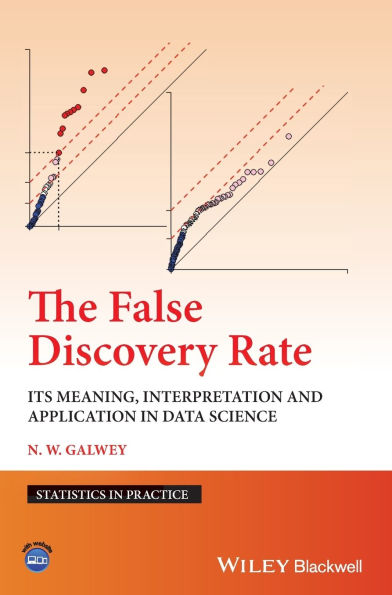
The False Discovery Rate: Its Meaning, Interpretation and Application Data Science in Franklin, TN
Current price: $95.00
Barnes and Noble
The False Discovery Rate: Its Meaning, Interpretation and Application Data Science in Franklin, TN
Current price: $95.00
Loading Inventory...
Size: Hardcover
The False Discovery Rate
An essential tool for statisticians and data scientists seeking to interpret the vast troves of data that increasingly power our world
First developed in the 1990s, the False Discovery Rate (FDR) is a way of describing the rate at which null hypothesis testing produces errors. It has since become an essential tool for interpreting large datasets. In recent years, as datasets have become ever larger, and as the importance of ‘big data’ to scientific research has grown, the significance of the FDR has grown correspondingly.
provides an analysis of the FDR’s value as a tool, including why it should generally be preferred to the Bonferroni correction and other methods by which multiplicity can be accounted for. It offers a systematic overview of the FDR, its core claims, and its applications.
Readers of
will also find:
Case studies throughout, rooted in real and simulated data sets
Detailed discussion of topics including representation of the FDR on a Q–Q plot, consequences of non-monotonicity, and many more
Wide-ranging analysis suited for a broad readership
is ideal for Statistics and Data Science courses, and short courses associated with conferences. It is also useful as supplementary reading in courses in other disciplines that require the statistical interpretation of ‘big data’. The book will also be of great value to statisticians and researchers looking to learn more about the FDR.
STATISTICS IN PRACTICE
A series of practical books outlining the use of statistical techniques in a wide range of applications areas:
HUMAN AND BIOLOGICAL SCIENCES
EARTH AND ENVIRONMENTAL SCIENCES
INDUSTRY, COMMERCE AND FINANCE
An essential tool for statisticians and data scientists seeking to interpret the vast troves of data that increasingly power our world
First developed in the 1990s, the False Discovery Rate (FDR) is a way of describing the rate at which null hypothesis testing produces errors. It has since become an essential tool for interpreting large datasets. In recent years, as datasets have become ever larger, and as the importance of ‘big data’ to scientific research has grown, the significance of the FDR has grown correspondingly.
provides an analysis of the FDR’s value as a tool, including why it should generally be preferred to the Bonferroni correction and other methods by which multiplicity can be accounted for. It offers a systematic overview of the FDR, its core claims, and its applications.
Readers of
will also find:
Case studies throughout, rooted in real and simulated data sets
Detailed discussion of topics including representation of the FDR on a Q–Q plot, consequences of non-monotonicity, and many more
Wide-ranging analysis suited for a broad readership
is ideal for Statistics and Data Science courses, and short courses associated with conferences. It is also useful as supplementary reading in courses in other disciplines that require the statistical interpretation of ‘big data’. The book will also be of great value to statisticians and researchers looking to learn more about the FDR.
STATISTICS IN PRACTICE
A series of practical books outlining the use of statistical techniques in a wide range of applications areas:
HUMAN AND BIOLOGICAL SCIENCES
EARTH AND ENVIRONMENTAL SCIENCES
INDUSTRY, COMMERCE AND FINANCE
The False Discovery Rate
An essential tool for statisticians and data scientists seeking to interpret the vast troves of data that increasingly power our world
First developed in the 1990s, the False Discovery Rate (FDR) is a way of describing the rate at which null hypothesis testing produces errors. It has since become an essential tool for interpreting large datasets. In recent years, as datasets have become ever larger, and as the importance of ‘big data’ to scientific research has grown, the significance of the FDR has grown correspondingly.
provides an analysis of the FDR’s value as a tool, including why it should generally be preferred to the Bonferroni correction and other methods by which multiplicity can be accounted for. It offers a systematic overview of the FDR, its core claims, and its applications.
Readers of
will also find:
Case studies throughout, rooted in real and simulated data sets
Detailed discussion of topics including representation of the FDR on a Q–Q plot, consequences of non-monotonicity, and many more
Wide-ranging analysis suited for a broad readership
is ideal for Statistics and Data Science courses, and short courses associated with conferences. It is also useful as supplementary reading in courses in other disciplines that require the statistical interpretation of ‘big data’. The book will also be of great value to statisticians and researchers looking to learn more about the FDR.
STATISTICS IN PRACTICE
A series of practical books outlining the use of statistical techniques in a wide range of applications areas:
HUMAN AND BIOLOGICAL SCIENCES
EARTH AND ENVIRONMENTAL SCIENCES
INDUSTRY, COMMERCE AND FINANCE
An essential tool for statisticians and data scientists seeking to interpret the vast troves of data that increasingly power our world
First developed in the 1990s, the False Discovery Rate (FDR) is a way of describing the rate at which null hypothesis testing produces errors. It has since become an essential tool for interpreting large datasets. In recent years, as datasets have become ever larger, and as the importance of ‘big data’ to scientific research has grown, the significance of the FDR has grown correspondingly.
provides an analysis of the FDR’s value as a tool, including why it should generally be preferred to the Bonferroni correction and other methods by which multiplicity can be accounted for. It offers a systematic overview of the FDR, its core claims, and its applications.
Readers of
will also find:
Case studies throughout, rooted in real and simulated data sets
Detailed discussion of topics including representation of the FDR on a Q–Q plot, consequences of non-monotonicity, and many more
Wide-ranging analysis suited for a broad readership
is ideal for Statistics and Data Science courses, and short courses associated with conferences. It is also useful as supplementary reading in courses in other disciplines that require the statistical interpretation of ‘big data’. The book will also be of great value to statisticians and researchers looking to learn more about the FDR.
STATISTICS IN PRACTICE
A series of practical books outlining the use of statistical techniques in a wide range of applications areas:
HUMAN AND BIOLOGICAL SCIENCES
EARTH AND ENVIRONMENTAL SCIENCES
INDUSTRY, COMMERCE AND FINANCE
You May Also Like














More About Barnes and Noble at CoolSprings Galleria
Barnes & Noble is the world’s largest retail bookseller and a leading retailer of content, digital media and educational products. Our Nook Digital business offers a lineup of NOOK® tablets and e-Readers and an expansive collection of digital reading content through the NOOK Store®. Barnes & Noble’s mission is to operate the best omni-channel specialty retail business in America, helping both our customers and booksellers reach their aspirations, while being a credit to the communities we serve.
1800 Galleria Blvd #1310, Franklin, TN 37067, United States
Find Barnes and Noble at CoolSprings Galleria in Franklin, TN
Visit Barnes and Noble at CoolSprings Galleria in Franklin, TN
