
Home
The Lean Education Manifesto: A Synthesis of 900+ Systematic Reviews for Visible Learning Developing Countries
Barnes and Noble
Loading Inventory...
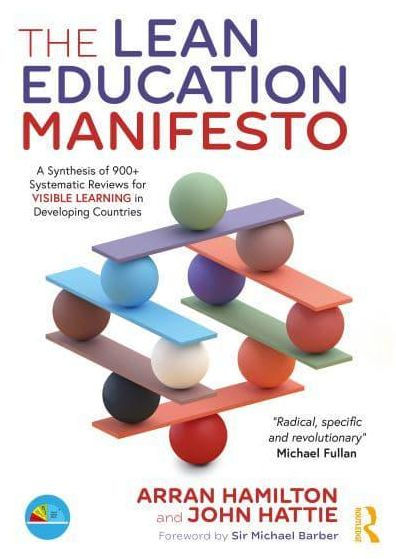
The Lean Education Manifesto: A Synthesis of 900+ Systematic Reviews for Visible Learning Developing Countries in Franklin, TN
Current price: $190.00
Barnes and Noble
The Lean Education Manifesto: A Synthesis of 900+ Systematic Reviews for Visible Learning Developing Countries in Franklin, TN
Current price: $190.00
Loading Inventory...
Size: Hardcover
The global expansion of education is one of the greatest successes of the modern era. More children have access to schooling and leave with higher levels of learning than at any time in history. However, 250 million+ children in developing countries are still not in school, and 600 million+ attend but get little out of it – a situation further exacerbated by the dislocations from COVID-19.
In a context where education funding is stagnating and even declining, Arran Hamilton and John Hattie suggest that we need to start thinking Lean and explicitly look for ways of unlocking more from less. Drawing on data from 900+ systematic reviews of 53,000+ research studies – from the perspective of efficiency of impact – they controversially suggest that for low- and middle-income countries:
Maybe
pre-service initial teacher training programs could be significantly shortened and perhaps even stopped
teachers need not have degree-level qualifications in the subjects they teach, and they
might
not really need degrees at all!
the hours per week and years of schooling that each child receives could be significantly reduced, or at least not increased
learners can be taught more effectively and less resource intensively in mixed-age classrooms, with peers tutoring one another
different approaches to curriculum, instruction, and the length of the school day might be more cost-effective ways of driving up student achievement than hiring extra teachers, reducing class sizes, or building more classrooms
school-based management, public–private partnerships, and performance-related pay are blind and expensive alleys that have limited influence or impact on what teachers actually do in classrooms.
This groundbreaking and thought-provoking work also identifies a range of initiatives that are worth starting. It introduces the
Leaning to G.O.L.D.
methodology to support school and system leaders in selecting, implementing, and scaling those high-probability initiatives; and to rigorously de-implement those to be stopped. It is essential reading for anyone with an interest in education.
In a context where education funding is stagnating and even declining, Arran Hamilton and John Hattie suggest that we need to start thinking Lean and explicitly look for ways of unlocking more from less. Drawing on data from 900+ systematic reviews of 53,000+ research studies – from the perspective of efficiency of impact – they controversially suggest that for low- and middle-income countries:
Maybe
pre-service initial teacher training programs could be significantly shortened and perhaps even stopped
teachers need not have degree-level qualifications in the subjects they teach, and they
might
not really need degrees at all!
the hours per week and years of schooling that each child receives could be significantly reduced, or at least not increased
learners can be taught more effectively and less resource intensively in mixed-age classrooms, with peers tutoring one another
different approaches to curriculum, instruction, and the length of the school day might be more cost-effective ways of driving up student achievement than hiring extra teachers, reducing class sizes, or building more classrooms
school-based management, public–private partnerships, and performance-related pay are blind and expensive alleys that have limited influence or impact on what teachers actually do in classrooms.
This groundbreaking and thought-provoking work also identifies a range of initiatives that are worth starting. It introduces the
Leaning to G.O.L.D.
methodology to support school and system leaders in selecting, implementing, and scaling those high-probability initiatives; and to rigorously de-implement those to be stopped. It is essential reading for anyone with an interest in education.
The global expansion of education is one of the greatest successes of the modern era. More children have access to schooling and leave with higher levels of learning than at any time in history. However, 250 million+ children in developing countries are still not in school, and 600 million+ attend but get little out of it – a situation further exacerbated by the dislocations from COVID-19.
In a context where education funding is stagnating and even declining, Arran Hamilton and John Hattie suggest that we need to start thinking Lean and explicitly look for ways of unlocking more from less. Drawing on data from 900+ systematic reviews of 53,000+ research studies – from the perspective of efficiency of impact – they controversially suggest that for low- and middle-income countries:
Maybe
pre-service initial teacher training programs could be significantly shortened and perhaps even stopped
teachers need not have degree-level qualifications in the subjects they teach, and they
might
not really need degrees at all!
the hours per week and years of schooling that each child receives could be significantly reduced, or at least not increased
learners can be taught more effectively and less resource intensively in mixed-age classrooms, with peers tutoring one another
different approaches to curriculum, instruction, and the length of the school day might be more cost-effective ways of driving up student achievement than hiring extra teachers, reducing class sizes, or building more classrooms
school-based management, public–private partnerships, and performance-related pay are blind and expensive alleys that have limited influence or impact on what teachers actually do in classrooms.
This groundbreaking and thought-provoking work also identifies a range of initiatives that are worth starting. It introduces the
Leaning to G.O.L.D.
methodology to support school and system leaders in selecting, implementing, and scaling those high-probability initiatives; and to rigorously de-implement those to be stopped. It is essential reading for anyone with an interest in education.
In a context where education funding is stagnating and even declining, Arran Hamilton and John Hattie suggest that we need to start thinking Lean and explicitly look for ways of unlocking more from less. Drawing on data from 900+ systematic reviews of 53,000+ research studies – from the perspective of efficiency of impact – they controversially suggest that for low- and middle-income countries:
Maybe
pre-service initial teacher training programs could be significantly shortened and perhaps even stopped
teachers need not have degree-level qualifications in the subjects they teach, and they
might
not really need degrees at all!
the hours per week and years of schooling that each child receives could be significantly reduced, or at least not increased
learners can be taught more effectively and less resource intensively in mixed-age classrooms, with peers tutoring one another
different approaches to curriculum, instruction, and the length of the school day might be more cost-effective ways of driving up student achievement than hiring extra teachers, reducing class sizes, or building more classrooms
school-based management, public–private partnerships, and performance-related pay are blind and expensive alleys that have limited influence or impact on what teachers actually do in classrooms.
This groundbreaking and thought-provoking work also identifies a range of initiatives that are worth starting. It introduces the
Leaning to G.O.L.D.
methodology to support school and system leaders in selecting, implementing, and scaling those high-probability initiatives; and to rigorously de-implement those to be stopped. It is essential reading for anyone with an interest in education.
You May Also Like








More About Barnes and Noble at CoolSprings Galleria
Barnes & Noble is the world’s largest retail bookseller and a leading retailer of content, digital media and educational products. Our Nook Digital business offers a lineup of NOOK® tablets and e-Readers and an expansive collection of digital reading content through the NOOK Store®. Barnes & Noble’s mission is to operate the best omni-channel specialty retail business in America, helping both our customers and booksellers reach their aspirations, while being a credit to the communities we serve.
1800 Galleria Blvd #1310, Franklin, TN 37067, United States
Find Barnes and Noble at CoolSprings Galleria in Franklin, TN
Visit Barnes and Noble at CoolSprings Galleria in Franklin, TN
