
Home
the Ley Line Legacy: Watkins' Early British Trackways and Old Straight Track
Barnes and Noble
Loading Inventory...
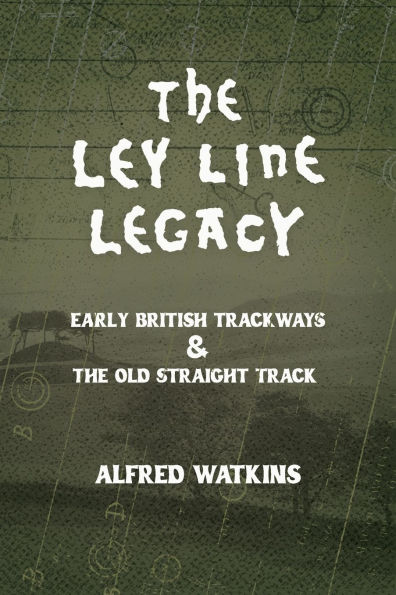
the Ley Line Legacy: Watkins' Early British Trackways and Old Straight Track in Franklin, TN
Current price: $35.99
Barnes and Noble
the Ley Line Legacy: Watkins' Early British Trackways and Old Straight Track in Franklin, TN
Current price: $35.99
Loading Inventory...
Size: Hardcover
The Ley Line Legacy
brings together Alfred Watkins' two groundbreaking works,
Early British Trackways
and
The Old Straight Track
, in a single volume charting the origins of one of Britain's most enduring landscape theories.
First published in 1922,
introduced Watkins' revolutionary concept of 'leys', straight alignments linking prehistoric monuments, burial sites, and ancient landmarks across the British countryside. Drawing from detailed fieldwork in Herefordshire, Wiltshire, Berkshire, and beyond, Watkins argued that these linear pathways once served as a form of practical navigation and sacred geography.
In
(1925), Watkins further developed his theory with expanded research and wider-ranging examples, offering a deeper examination of Britain's ancient landscape through both archaeological observation and folkloric tradition. His work traced the alignment of stone circles, mounds, and waypoints, proposing an interconnected web of pre-Roman routes shaped by early civilisations.
Although Watkins' ideas were met with scepticism by archaeologists and geographers, they've since become foundational in the study of sacred geography, with ley lines reinterpreted in spiritual and esoteric traditions.
presents these influential texts in one edition, offering a detailed exploration into the mystical energies and folklore of Britain's ancient paths.
brings together Alfred Watkins' two groundbreaking works,
Early British Trackways
and
The Old Straight Track
, in a single volume charting the origins of one of Britain's most enduring landscape theories.
First published in 1922,
introduced Watkins' revolutionary concept of 'leys', straight alignments linking prehistoric monuments, burial sites, and ancient landmarks across the British countryside. Drawing from detailed fieldwork in Herefordshire, Wiltshire, Berkshire, and beyond, Watkins argued that these linear pathways once served as a form of practical navigation and sacred geography.
In
(1925), Watkins further developed his theory with expanded research and wider-ranging examples, offering a deeper examination of Britain's ancient landscape through both archaeological observation and folkloric tradition. His work traced the alignment of stone circles, mounds, and waypoints, proposing an interconnected web of pre-Roman routes shaped by early civilisations.
Although Watkins' ideas were met with scepticism by archaeologists and geographers, they've since become foundational in the study of sacred geography, with ley lines reinterpreted in spiritual and esoteric traditions.
presents these influential texts in one edition, offering a detailed exploration into the mystical energies and folklore of Britain's ancient paths.
The Ley Line Legacy
brings together Alfred Watkins' two groundbreaking works,
Early British Trackways
and
The Old Straight Track
, in a single volume charting the origins of one of Britain's most enduring landscape theories.
First published in 1922,
introduced Watkins' revolutionary concept of 'leys', straight alignments linking prehistoric monuments, burial sites, and ancient landmarks across the British countryside. Drawing from detailed fieldwork in Herefordshire, Wiltshire, Berkshire, and beyond, Watkins argued that these linear pathways once served as a form of practical navigation and sacred geography.
In
(1925), Watkins further developed his theory with expanded research and wider-ranging examples, offering a deeper examination of Britain's ancient landscape through both archaeological observation and folkloric tradition. His work traced the alignment of stone circles, mounds, and waypoints, proposing an interconnected web of pre-Roman routes shaped by early civilisations.
Although Watkins' ideas were met with scepticism by archaeologists and geographers, they've since become foundational in the study of sacred geography, with ley lines reinterpreted in spiritual and esoteric traditions.
presents these influential texts in one edition, offering a detailed exploration into the mystical energies and folklore of Britain's ancient paths.
brings together Alfred Watkins' two groundbreaking works,
Early British Trackways
and
The Old Straight Track
, in a single volume charting the origins of one of Britain's most enduring landscape theories.
First published in 1922,
introduced Watkins' revolutionary concept of 'leys', straight alignments linking prehistoric monuments, burial sites, and ancient landmarks across the British countryside. Drawing from detailed fieldwork in Herefordshire, Wiltshire, Berkshire, and beyond, Watkins argued that these linear pathways once served as a form of practical navigation and sacred geography.
In
(1925), Watkins further developed his theory with expanded research and wider-ranging examples, offering a deeper examination of Britain's ancient landscape through both archaeological observation and folkloric tradition. His work traced the alignment of stone circles, mounds, and waypoints, proposing an interconnected web of pre-Roman routes shaped by early civilisations.
Although Watkins' ideas were met with scepticism by archaeologists and geographers, they've since become foundational in the study of sacred geography, with ley lines reinterpreted in spiritual and esoteric traditions.
presents these influential texts in one edition, offering a detailed exploration into the mystical energies and folklore of Britain's ancient paths.
You May Also Like

















More About Barnes and Noble at CoolSprings Galleria
Barnes & Noble is the world’s largest retail bookseller and a leading retailer of content, digital media and educational products. Our Nook Digital business offers a lineup of NOOK® tablets and e-Readers and an expansive collection of digital reading content through the NOOK Store®. Barnes & Noble’s mission is to operate the best omni-channel specialty retail business in America, helping both our customers and booksellers reach their aspirations, while being a credit to the communities we serve.
1800 Galleria Blvd #1310, Franklin, TN 37067, United States
Find Barnes and Noble at CoolSprings Galleria in Franklin, TN
Visit Barnes and Noble at CoolSprings Galleria in Franklin, TN
