
Home
the Philosophy of Future
Barnes and Noble
Loading Inventory...
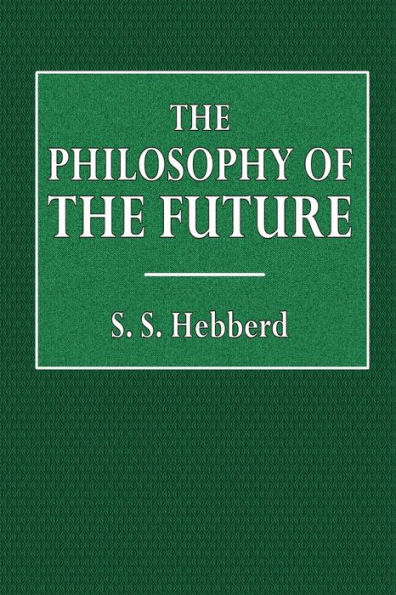
the Philosophy of Future in Franklin, TN
Current price: $28.52
Barnes and Noble
the Philosophy of Future in Franklin, TN
Current price: $28.52
Loading Inventory...
Size: Hardcover
"The Philosophy of the Future" which has cost the author 'more than half a century of toil', is a stout defense of the principle of Causation both against the philosophical scientists who, following Hume, would reduce cause to customary sequence among our sense-impressions, and against the subordination by many writers on logic of the notion of cause to that of reason or ground. To cancel causality is to efface all distinction between truth and falsehood. "Scientia est cognoscere causas." "The sole essential function of all thinking is to discriminate between cause and effect." "There is no known form of thought which is not ultimately reducible into an assertion of cause and effect." From the vantage ground of this theorem, with its corollary that "a cause cannot be known except through its effects, or an effect apart from its cause", Mr. Hebberd trains his guns upon the systems of Hume, Kant, Hegel, Mill, and other logical writers. He reviews successively Space, Time, the Concept, Judgment, and finally Induction, defined as "the discovery of causal processes by means of physical and mental experiment", in the attempt to show that all categories are but species and derivative forms under the supreme and all-embracing category of causality.
"The Philosophy of the Future" which has cost the author 'more than half a century of toil', is a stout defense of the principle of Causation both against the philosophical scientists who, following Hume, would reduce cause to customary sequence among our sense-impressions, and against the subordination by many writers on logic of the notion of cause to that of reason or ground. To cancel causality is to efface all distinction between truth and falsehood. "Scientia est cognoscere causas." "The sole essential function of all thinking is to discriminate between cause and effect." "There is no known form of thought which is not ultimately reducible into an assertion of cause and effect." From the vantage ground of this theorem, with its corollary that "a cause cannot be known except through its effects, or an effect apart from its cause", Mr. Hebberd trains his guns upon the systems of Hume, Kant, Hegel, Mill, and other logical writers. He reviews successively Space, Time, the Concept, Judgment, and finally Induction, defined as "the discovery of causal processes by means of physical and mental experiment", in the attempt to show that all categories are but species and derivative forms under the supreme and all-embracing category of causality.
You May Also Like












More About Barnes and Noble at CoolSprings Galleria
Barnes & Noble is the world’s largest retail bookseller and a leading retailer of content, digital media and educational products. Our Nook Digital business offers a lineup of NOOK® tablets and e-Readers and an expansive collection of digital reading content through the NOOK Store®. Barnes & Noble’s mission is to operate the best omni-channel specialty retail business in America, helping both our customers and booksellers reach their aspirations, while being a credit to the communities we serve.
1800 Galleria Blvd #1310, Franklin, TN 37067, United States
Find Barnes and Noble at CoolSprings Galleria in Franklin, TN
Visit Barnes and Noble at CoolSprings Galleria in Franklin, TN
