
Home
the Populist Temptation: Economic Grievance and Political Reaction Modern Era
Barnes and Noble
Loading Inventory...
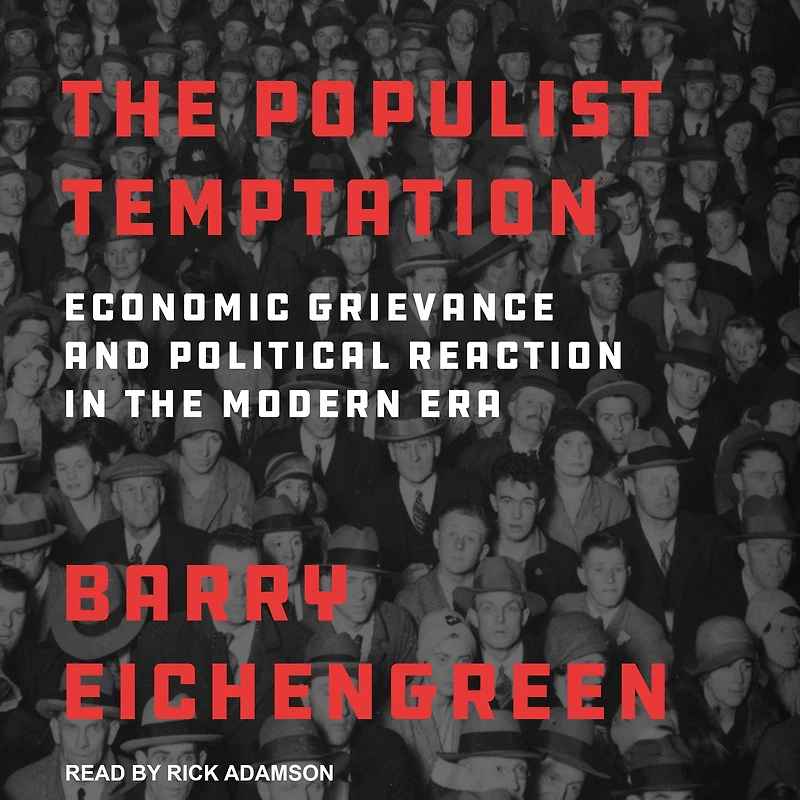


the Populist Temptation: Economic Grievance and Political Reaction Modern Era in Franklin, TN
By Barnes & Noble
Current price: $19.99
Barnes and Noble
the Populist Temptation: Economic Grievance and Political Reaction Modern Era in Franklin, TN
By Barnes & Noble
Current price: $19.99
Loading Inventory...
Size: Audiobook
Populism of the right and left has spread like wildfire throughout the world. The impulse reached its apogee in the United States with the election of Trump, but it was a force in Europe ever since the Great Recession sent the European economy into a prolonged tailspin. In the simplest terms, populism is a political ideology that vilifies economic and political elites and instead lionizes 'the people.' The people, populists of all stripes contend, need to retake power from the unaccountable elites who have left them powerless. And typically, populists' distrust of elites shades into a catchall distrust of trained experts because of their perceived distance from and contempt for 'the people.' Another signature element of populist movements is faith in a savior who can not only speak directly to the people, but also serve as a vessel for the plain people's hopes and dreams. Going back to the 1890s, a series of such saviors have come and gone in the US alone, from William Jennings Bryan to Huey Long tofinallyDonald Trump.In The Populist Temptation, the eminent economic historian Barry Eichengreen focuses on the global resurgence of populism today and places it in a deep context. Alternating between the present and earlier populist waves from modern history, he argues that populists tend to thrive most in the wake of economic downturns, when it is easy to convince the masses of elite malfeasance. Yet while there is more than a grain of truth that bankers, financiers, and 'bought' politicians are responsible for the mess, populists' own solutions tend to be simplistic and economically counterproductive. Moreover, by arguing that the ordinary people are at the mercy of extra-national forces beyond their controlinternational capital, immigrants, cosmopolitan globalistspopulists often degenerate into demagoguery and xenophobia. There is no one solution to addressing the concerns that populists raise, but Eichengreen argues that there is an obvious place to start: shoring up and improving the welfare state so that it is better able to act as a buffer for those who suffer most during economic slumps. For example, America's patchwork welfare state was not well equipped to deal with the economic fallout that attended globalization and the decline of manufacturing in America, and that played no small part in Trump's victory. Lucidly explaining both the appeals and dangers of populism across history, this book is essential reading for anyone seeking to understand not just the populist phenomenon, but more generally the lasting political fallout that follows in the wake of major economic crises.
Populism of the right and left has spread like wildfire throughout the world. The impulse reached its apogee in the United States with the election of Trump, but it was a force in Europe ever since the Great Recession sent the European economy into a prolonged tailspin. In the simplest terms, populism is a political ideology that vilifies economic and political elites and instead lionizes 'the people.' The people, populists of all stripes contend, need to retake power from the unaccountable elites who have left them powerless. And typically, populists' distrust of elites shades into a catchall distrust of trained experts because of their perceived distance from and contempt for 'the people.' Another signature element of populist movements is faith in a savior who can not only speak directly to the people, but also serve as a vessel for the plain people's hopes and dreams. Going back to the 1890s, a series of such saviors have come and gone in the US alone, from William Jennings Bryan to Huey Long tofinallyDonald Trump.In The Populist Temptation, the eminent economic historian Barry Eichengreen focuses on the global resurgence of populism today and places it in a deep context. Alternating between the present and earlier populist waves from modern history, he argues that populists tend to thrive most in the wake of economic downturns, when it is easy to convince the masses of elite malfeasance. Yet while there is more than a grain of truth that bankers, financiers, and 'bought' politicians are responsible for the mess, populists' own solutions tend to be simplistic and economically counterproductive. Moreover, by arguing that the ordinary people are at the mercy of extra-national forces beyond their controlinternational capital, immigrants, cosmopolitan globalistspopulists often degenerate into demagoguery and xenophobia. There is no one solution to addressing the concerns that populists raise, but Eichengreen argues that there is an obvious place to start: shoring up and improving the welfare state so that it is better able to act as a buffer for those who suffer most during economic slumps. For example, America's patchwork welfare state was not well equipped to deal with the economic fallout that attended globalization and the decline of manufacturing in America, and that played no small part in Trump's victory. Lucidly explaining both the appeals and dangers of populism across history, this book is essential reading for anyone seeking to understand not just the populist phenomenon, but more generally the lasting political fallout that follows in the wake of major economic crises.
You May Also Like

















More About Barnes and Noble at CoolSprings Galleria
Barnes & Noble is the world’s largest retail bookseller and a leading retailer of content, digital media and educational products. Our Nook Digital business offers a lineup of NOOK® tablets and e-Readers and an expansive collection of digital reading content through the NOOK Store®. Barnes & Noble’s mission is to operate the best omni-channel specialty retail business in America, helping both our customers and booksellers reach their aspirations, while being a credit to the communities we serve.
1800 Galleria Blvd #1310, Franklin, TN 37067, United States
Find Barnes and Noble at CoolSprings Galleria in Franklin, TN
Visit Barnes and Noble at CoolSprings Galleria in Franklin, TN
