
Home
Trust: Forms, Foundations, Functions, Failures and Figures
Barnes and Noble
Loading Inventory...
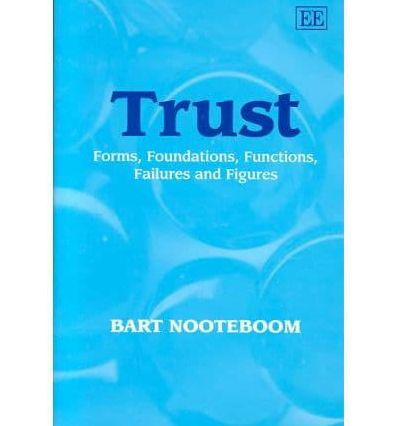
Trust: Forms, Foundations, Functions, Failures and Figures in Franklin, TN
Current price: $151.00
Barnes and Noble
Trust: Forms, Foundations, Functions, Failures and Figures in Franklin, TN
Current price: $151.00
Loading Inventory...
Size: OS
Trust is an elusive concept, meaning different things to different people, and so needs to be clearly defined. By focusing on relations within and between firms, Bart Nooteboom undertakes to produce a clearer definition of trust and its role in the economy.
Trust
deals with a range of questions such as: what are the roles of trust? What can we trust in? Can trust serve as an instrument for the governance of relations? Is trust a substitute, a precondition or an outcome of contracts? The author then goes on to analyse what trust is based on, what its limits are, how it grows and how it can also break down. The role of intermediaries is also discussed.
Bart Nooteboom argues that trust goes beyond calculative self-interest and that blind, unconditional trust is unwise. He then examines the paradox of how trust can be non-calculative and yet, not blind. The book also reveals ways to measure and model trust, its antecedents and its consequences.
Trust
deals with a range of questions such as: what are the roles of trust? What can we trust in? Can trust serve as an instrument for the governance of relations? Is trust a substitute, a precondition or an outcome of contracts? The author then goes on to analyse what trust is based on, what its limits are, how it grows and how it can also break down. The role of intermediaries is also discussed.
Bart Nooteboom argues that trust goes beyond calculative self-interest and that blind, unconditional trust is unwise. He then examines the paradox of how trust can be non-calculative and yet, not blind. The book also reveals ways to measure and model trust, its antecedents and its consequences.
Trust is an elusive concept, meaning different things to different people, and so needs to be clearly defined. By focusing on relations within and between firms, Bart Nooteboom undertakes to produce a clearer definition of trust and its role in the economy.
Trust
deals with a range of questions such as: what are the roles of trust? What can we trust in? Can trust serve as an instrument for the governance of relations? Is trust a substitute, a precondition or an outcome of contracts? The author then goes on to analyse what trust is based on, what its limits are, how it grows and how it can also break down. The role of intermediaries is also discussed.
Bart Nooteboom argues that trust goes beyond calculative self-interest and that blind, unconditional trust is unwise. He then examines the paradox of how trust can be non-calculative and yet, not blind. The book also reveals ways to measure and model trust, its antecedents and its consequences.
Trust
deals with a range of questions such as: what are the roles of trust? What can we trust in? Can trust serve as an instrument for the governance of relations? Is trust a substitute, a precondition or an outcome of contracts? The author then goes on to analyse what trust is based on, what its limits are, how it grows and how it can also break down. The role of intermediaries is also discussed.
Bart Nooteboom argues that trust goes beyond calculative self-interest and that blind, unconditional trust is unwise. He then examines the paradox of how trust can be non-calculative and yet, not blind. The book also reveals ways to measure and model trust, its antecedents and its consequences.
You May Also Like















More About Barnes and Noble at CoolSprings Galleria
Barnes & Noble is the world’s largest retail bookseller and a leading retailer of content, digital media and educational products. Our Nook Digital business offers a lineup of NOOK® tablets and e-Readers and an expansive collection of digital reading content through the NOOK Store®. Barnes & Noble’s mission is to operate the best omni-channel specialty retail business in America, helping both our customers and booksellers reach their aspirations, while being a credit to the communities we serve.
1800 Galleria Blvd #1310, Franklin, TN 37067, United States
Find Barnes and Noble at CoolSprings Galleria in Franklin, TN
Visit Barnes and Noble at CoolSprings Galleria in Franklin, TN
