
Home
Viator, Medieval and Renaissance Studies, Volume 7 (1976)
Barnes and Noble
Loading Inventory...
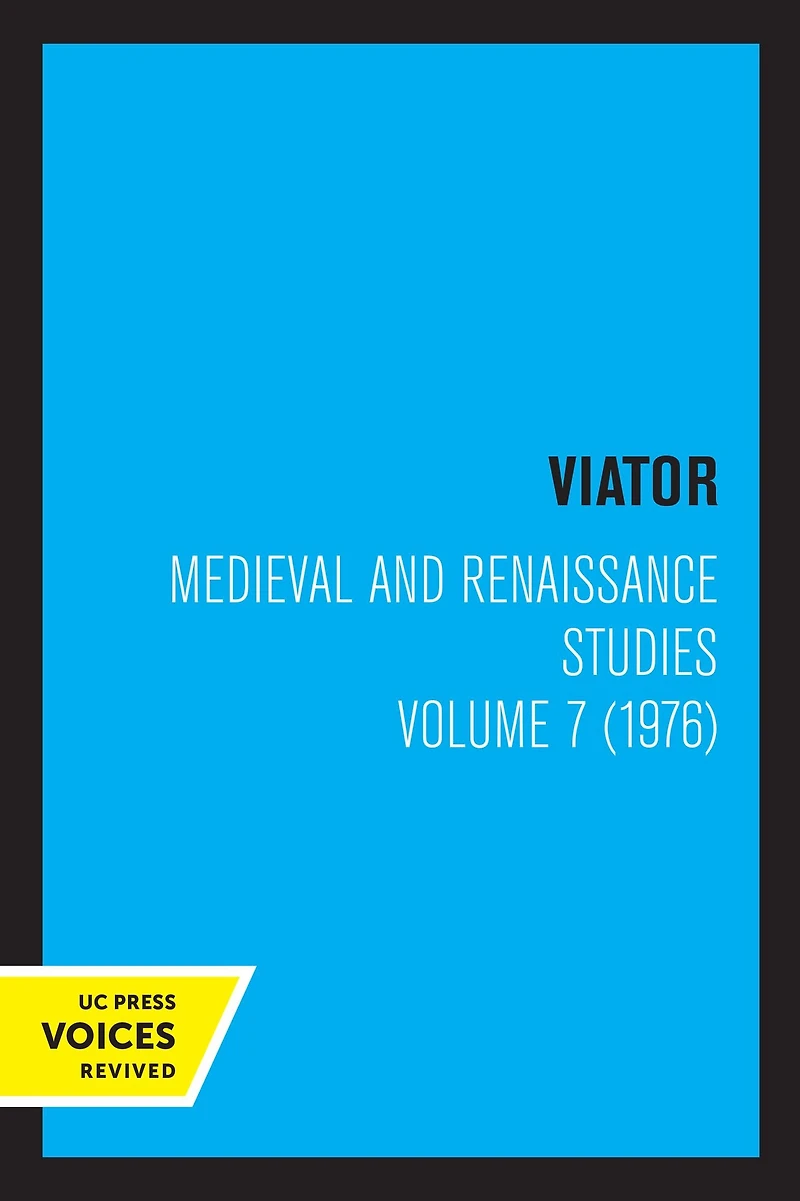

Viator, Medieval and Renaissance Studies, Volume 7 (1976) in Franklin, TN
By Barnes & Noble
Current price: $29.95
Barnes and Noble
Viator, Medieval and Renaissance Studies, Volume 7 (1976) in Franklin, TN
By Barnes & Noble
Current price: $29.95
Loading Inventory...
Size: EBook
Viator: Medieval and Renaissance Studies, Volume 7 gathers an impressive range of scholarship that spans late antiquity through the Renaissance, reflecting the journal’s distinctive breadth across periods, disciplines, and geographies. The volume opens with Gerhart B. Ladner on Roman attitudes toward barbarians in late antiquity and Franz Staab’s study of Ostrogothic geographers at Theodoric’s court, before turning to Josiah Cox Russell’s work on medieval plague in the British Isles and Barbara Kreutz on transformations in early medieval Mediterranean shipping. Political and cultural studies follow, including Bernard Bachrach on feudal politics between Fulk Nerra and William the Great, John D. Niles on Charlemagne’s image in La Chanson de Roland, and David Pingree on Indian and pseudo-Indian passages in Greco-Latin astrological texts. Later contributions explore the reintroduction of Aristotle via Alfred of Sareshel (James K. Otte), the emergence of European nobility and the ministeriales (John B. Freed), Flemish administrative structures under Philip of Alsace (Louis M. de Gryse), and Marjorie McIntosh on villeins in the English ancient demesne. Essays by Duane Osheim on rural Tuscany, Scott Hendrix on late medieval ecclesiology, Patrick Ford on the death of Merlin, and James Overfield on scholastic opposition to humanism highlight the volume’s thematic range. The issue closes with William Bouwsma’s essay on changing cultural assumptions in the Renaissance and John Patrick Donnelly on Calvinist Thomism. Collectively, these studies exemplify Viator’s commitment to crossing traditional boundaries of periodization and discipline, making this volume a rich resource for historians, literary scholars, and students of intellectual and cultural history alike. This title is part of UC Press's Voices Revived program, which commemorates University of California Press’s mission to seek out and cultivate the brightest minds and give them voice, reach, and impact. Drawing on a backlist dating to 1893, Voices Revived makes high-quality, peer-reviewed scholarship accessible once again using print-on-demand technology. This title was originally published in 1976.
Viator: Medieval and Renaissance Studies, Volume 7 gathers an impressive range of scholarship that spans late antiquity through the Renaissance, reflecting the journal’s distinctive breadth across periods, disciplines, and geographies. The volume opens with Gerhart B. Ladner on Roman attitudes toward barbarians in late antiquity and Franz Staab’s study of Ostrogothic geographers at Theodoric’s court, before turning to Josiah Cox Russell’s work on medieval plague in the British Isles and Barbara Kreutz on transformations in early medieval Mediterranean shipping. Political and cultural studies follow, including Bernard Bachrach on feudal politics between Fulk Nerra and William the Great, John D. Niles on Charlemagne’s image in La Chanson de Roland, and David Pingree on Indian and pseudo-Indian passages in Greco-Latin astrological texts. Later contributions explore the reintroduction of Aristotle via Alfred of Sareshel (James K. Otte), the emergence of European nobility and the ministeriales (John B. Freed), Flemish administrative structures under Philip of Alsace (Louis M. de Gryse), and Marjorie McIntosh on villeins in the English ancient demesne. Essays by Duane Osheim on rural Tuscany, Scott Hendrix on late medieval ecclesiology, Patrick Ford on the death of Merlin, and James Overfield on scholastic opposition to humanism highlight the volume’s thematic range. The issue closes with William Bouwsma’s essay on changing cultural assumptions in the Renaissance and John Patrick Donnelly on Calvinist Thomism. Collectively, these studies exemplify Viator’s commitment to crossing traditional boundaries of periodization and discipline, making this volume a rich resource for historians, literary scholars, and students of intellectual and cultural history alike. This title is part of UC Press's Voices Revived program, which commemorates University of California Press’s mission to seek out and cultivate the brightest minds and give them voice, reach, and impact. Drawing on a backlist dating to 1893, Voices Revived makes high-quality, peer-reviewed scholarship accessible once again using print-on-demand technology. This title was originally published in 1976.
You May Also Like
















More About Barnes and Noble at CoolSprings Galleria
Barnes & Noble is the world’s largest retail bookseller and a leading retailer of content, digital media and educational products. Our Nook Digital business offers a lineup of NOOK® tablets and e-Readers and an expansive collection of digital reading content through the NOOK Store®. Barnes & Noble’s mission is to operate the best omni-channel specialty retail business in America, helping both our customers and booksellers reach their aspirations, while being a credit to the communities we serve.
1800 Galleria Blvd #1310, Franklin, TN 37067, United States
Find Barnes and Noble at CoolSprings Galleria in Franklin, TN
Visit Barnes and Noble at CoolSprings Galleria in Franklin, TN
