
Home
Who Owns Appalachia?: Landownership and Its Impact
Barnes and Noble
Loading Inventory...
Who Owns Appalachia?: Landownership and Its Impact in Franklin, TN
Current price: $35.00
Barnes and Noble
Who Owns Appalachia?: Landownership and Its Impact in Franklin, TN
Current price: $35.00
Loading Inventory...
Size: Paperback
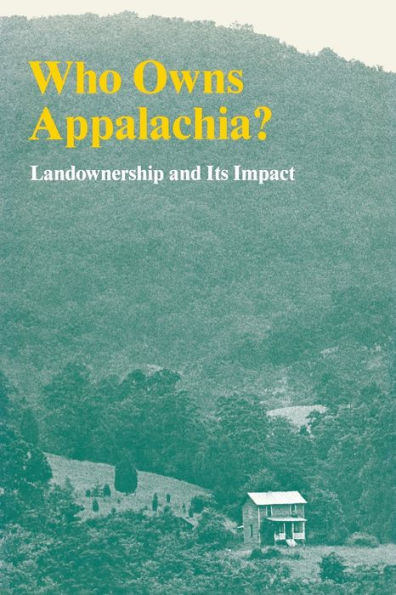
Long viewed as a problem in other countries, the ownership of land and resources is becoming an issue of mounting concern in the United States. Nowhere has it surfaced more dramatically than in the southern Appalachians where the exploitation of timber and mineral resources has been recently aggravated by the ravages of stripmining and flash floods. This landmark study of the mountain region documents for the first time the full scale and extent of the ownership and control of the region's land and resources and shows in a compelling, yet nonpolemical fashion the relationship between this control and conditions affecting the lives of the region's people.
Begun in 1978 and extending through 1980, this survey of land ownership is notable for the magnitude of its coverage. It embraces six states of the southern Appalachian region—Virginia, West Virginia, Kentucky, Tennessee, North Carolina, and Alabama. From these states the research team selected 80 counties, and within those counties field workers documented the ownership of over 55,000 parcels of property, totaling over 20 million acres of land and mineral rights.
The survey is equally significant for its systematic investigation of the relations between ownership and conditions within Appalachian communities. Researchers compiled data on 100 socioeconomic indicators and correlated these with the ownership of land and mineral rights. The findings of the survey form a generally dark picture of the region—local governments struggling to provide needed services on tax revenues that are at once inadequate and inequitable; economic development and diversification stifled; increasing loss of farmland, a traditional source of subsistence in the region. Most evident perhaps is the adverse effect upon housing resulting from corporate ownership and land speculation. Nor is the trend toward greater conglomerate ownership of energy resources, the expansion of absentee ownership into new areas, and the search for new mineral and energy sources encouraging.
Who Owns Appalachia?
will be an enduring resource for all those interested in this region and its problems. It is, moreover, both a model and a document for social and economic concerns likely to be of critical importance for the entire nation.
Begun in 1978 and extending through 1980, this survey of land ownership is notable for the magnitude of its coverage. It embraces six states of the southern Appalachian region—Virginia, West Virginia, Kentucky, Tennessee, North Carolina, and Alabama. From these states the research team selected 80 counties, and within those counties field workers documented the ownership of over 55,000 parcels of property, totaling over 20 million acres of land and mineral rights.
The survey is equally significant for its systematic investigation of the relations between ownership and conditions within Appalachian communities. Researchers compiled data on 100 socioeconomic indicators and correlated these with the ownership of land and mineral rights. The findings of the survey form a generally dark picture of the region—local governments struggling to provide needed services on tax revenues that are at once inadequate and inequitable; economic development and diversification stifled; increasing loss of farmland, a traditional source of subsistence in the region. Most evident perhaps is the adverse effect upon housing resulting from corporate ownership and land speculation. Nor is the trend toward greater conglomerate ownership of energy resources, the expansion of absentee ownership into new areas, and the search for new mineral and energy sources encouraging.
Who Owns Appalachia?
will be an enduring resource for all those interested in this region and its problems. It is, moreover, both a model and a document for social and economic concerns likely to be of critical importance for the entire nation.
Long viewed as a problem in other countries, the ownership of land and resources is becoming an issue of mounting concern in the United States. Nowhere has it surfaced more dramatically than in the southern Appalachians where the exploitation of timber and mineral resources has been recently aggravated by the ravages of stripmining and flash floods. This landmark study of the mountain region documents for the first time the full scale and extent of the ownership and control of the region's land and resources and shows in a compelling, yet nonpolemical fashion the relationship between this control and conditions affecting the lives of the region's people.
Begun in 1978 and extending through 1980, this survey of land ownership is notable for the magnitude of its coverage. It embraces six states of the southern Appalachian region—Virginia, West Virginia, Kentucky, Tennessee, North Carolina, and Alabama. From these states the research team selected 80 counties, and within those counties field workers documented the ownership of over 55,000 parcels of property, totaling over 20 million acres of land and mineral rights.
The survey is equally significant for its systematic investigation of the relations between ownership and conditions within Appalachian communities. Researchers compiled data on 100 socioeconomic indicators and correlated these with the ownership of land and mineral rights. The findings of the survey form a generally dark picture of the region—local governments struggling to provide needed services on tax revenues that are at once inadequate and inequitable; economic development and diversification stifled; increasing loss of farmland, a traditional source of subsistence in the region. Most evident perhaps is the adverse effect upon housing resulting from corporate ownership and land speculation. Nor is the trend toward greater conglomerate ownership of energy resources, the expansion of absentee ownership into new areas, and the search for new mineral and energy sources encouraging.
Who Owns Appalachia?
will be an enduring resource for all those interested in this region and its problems. It is, moreover, both a model and a document for social and economic concerns likely to be of critical importance for the entire nation.
Begun in 1978 and extending through 1980, this survey of land ownership is notable for the magnitude of its coverage. It embraces six states of the southern Appalachian region—Virginia, West Virginia, Kentucky, Tennessee, North Carolina, and Alabama. From these states the research team selected 80 counties, and within those counties field workers documented the ownership of over 55,000 parcels of property, totaling over 20 million acres of land and mineral rights.
The survey is equally significant for its systematic investigation of the relations between ownership and conditions within Appalachian communities. Researchers compiled data on 100 socioeconomic indicators and correlated these with the ownership of land and mineral rights. The findings of the survey form a generally dark picture of the region—local governments struggling to provide needed services on tax revenues that are at once inadequate and inequitable; economic development and diversification stifled; increasing loss of farmland, a traditional source of subsistence in the region. Most evident perhaps is the adverse effect upon housing resulting from corporate ownership and land speculation. Nor is the trend toward greater conglomerate ownership of energy resources, the expansion of absentee ownership into new areas, and the search for new mineral and energy sources encouraging.
Who Owns Appalachia?
will be an enduring resource for all those interested in this region and its problems. It is, moreover, both a model and a document for social and economic concerns likely to be of critical importance for the entire nation.
You May Also Like


















More About Barnes and Noble at CoolSprings Galleria
Barnes & Noble is the world’s largest retail bookseller and a leading retailer of content, digital media and educational products. Our Nook Digital business offers a lineup of NOOK® tablets and e-Readers and an expansive collection of digital reading content through the NOOK Store®. Barnes & Noble’s mission is to operate the best omni-channel specialty retail business in America, helping both our customers and booksellers reach their aspirations, while being a credit to the communities we serve.
1800 Galleria Blvd #1310, Franklin, TN 37067, United States
Find Barnes and Noble at CoolSprings Galleria in Franklin, TN
Visit Barnes and Noble at CoolSprings Galleria in Franklin, TN
