
Home
Why Do We Need Both Liquidity Regulations and a Lender of Last Resort? A Perspective from Federal Reserve Lending during the 2007-09 U.S. Financial Crisis
Barnes and Noble
Loading Inventory...
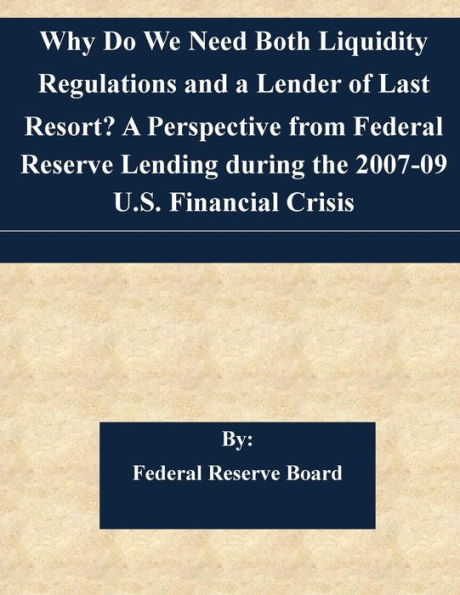
Why Do We Need Both Liquidity Regulations and a Lender of Last Resort? A Perspective from Federal Reserve Lending during the 2007-09 U.S. Financial Crisis in Franklin, TN
Current price: $12.95
Barnes and Noble
Why Do We Need Both Liquidity Regulations and a Lender of Last Resort? A Perspective from Federal Reserve Lending during the 2007-09 U.S. Financial Crisis in Franklin, TN
Current price: $12.95
Loading Inventory...
Size: OS
During the 2007-09 financial crisis, there were severe reductions in the liquidity of financial markets, runs on the shadow banking system, and destabilizing defaults and near-defaults of major financial institutions. In response, the Federal Reserve, in its role as lender of last resort (LOLR), injected extraordinary amounts of liquidity. In the aftermath, lawmakers and regulators have taken steps to reduce the likelihood that such lending would be required in the future, including the introduction of liquidity regulations. These changes were motivated in part by the argument that central bank lending entails extremely high costs and should be made unnecessary by liquidity regulations. By contrast, some have argued that the loss of liquidity was the result of market failures, and that central banks can solve such failures by lending, making liquidity regulations unnecessary. In this paper, we argue that LOLR lending and liquidity regulations are complementary tools. Liquidity shortfalls can arise for two very different reasons: First, sound institutions can face runs or a deterioration in the liquidity of markets they depend on for funding. Second, solvency concerns can cause creditors to pull away from troubled institutions. Using examples from the recent crisis, we argue that central bank lending is the best response in the former situation, while orderly resolution (by the institution as it gets through the problem on its own or via a controlled failure) is the best response in the second situation. We also contend that liquidity regulations are a necessary tool in both situations: They help ensure that the authorities will have time to assess the nature of the shortfall and arrange the appropriate response, and they provide an incentive for banks to internalize the externalities associated with any liquidity risks.
During the 2007-09 financial crisis, there were severe reductions in the liquidity of financial markets, runs on the shadow banking system, and destabilizing defaults and near-defaults of major financial institutions. In response, the Federal Reserve, in its role as lender of last resort (LOLR), injected extraordinary amounts of liquidity. In the aftermath, lawmakers and regulators have taken steps to reduce the likelihood that such lending would be required in the future, including the introduction of liquidity regulations. These changes were motivated in part by the argument that central bank lending entails extremely high costs and should be made unnecessary by liquidity regulations. By contrast, some have argued that the loss of liquidity was the result of market failures, and that central banks can solve such failures by lending, making liquidity regulations unnecessary. In this paper, we argue that LOLR lending and liquidity regulations are complementary tools. Liquidity shortfalls can arise for two very different reasons: First, sound institutions can face runs or a deterioration in the liquidity of markets they depend on for funding. Second, solvency concerns can cause creditors to pull away from troubled institutions. Using examples from the recent crisis, we argue that central bank lending is the best response in the former situation, while orderly resolution (by the institution as it gets through the problem on its own or via a controlled failure) is the best response in the second situation. We also contend that liquidity regulations are a necessary tool in both situations: They help ensure that the authorities will have time to assess the nature of the shortfall and arrange the appropriate response, and they provide an incentive for banks to internalize the externalities associated with any liquidity risks.
You May Also Like
















More About Barnes and Noble at CoolSprings Galleria
Barnes & Noble is the world’s largest retail bookseller and a leading retailer of content, digital media and educational products. Our Nook Digital business offers a lineup of NOOK® tablets and e-Readers and an expansive collection of digital reading content through the NOOK Store®. Barnes & Noble’s mission is to operate the best omni-channel specialty retail business in America, helping both our customers and booksellers reach their aspirations, while being a credit to the communities we serve.
1800 Galleria Blvd #1310, Franklin, TN 37067, United States
Find Barnes and Noble at CoolSprings Galleria in Franklin, TN
Visit Barnes and Noble at CoolSprings Galleria in Franklin, TN
